
If a truck caused your injury in Irvine, compensation is often available, but the amount depends on three things: your provable damages, the strength of the liability evidence, and how much insurance coverage actually exists to pay a claim. Get medical care first. Then call a California personal injury lawyer before you talk to any insurance adjuster, since Serendib Law Firm offers a free consultation and works on contingency for qualifying cases, meaning you owe nothing upfront.
TL;DR:
- The total payout depends on your provable damages, the strength of liability evidence, and the insurance coverage available to pay your claim.
- California law limits damages to actual medical payments made, and future care must be backed by medical testimony to maximize claims.
- Several parties, including carriers, brokers, shippers, and parts manufacturers, can be liable, often sharing responsibility beyond just the driver.
- Preservation of key evidence like ELD data and dashcam footage within days of the crash is critical to prevent data loss and strengthen your case.
- Deadlines vary: two years for personal injury claims and only six months if a public entity may be involved, making timely legal action essential.
Table of Contents
- Types of Compensation Available After a Truck Crash in Irvine, CA
- Who Can Be Sued and How Insurance Shapes Your Recovery
- How Case Value Is Calculated: The Three Drivers and What Moves the Number
- Deadlines and Procedural Traps You Can’t Afford to Miss
- What to Do First: A Practical 72-Hour Checklist After a Truck Crash in Irvine
- Steps to Take When Dealing With Insurance Adjusters After a Truck Accident
- Typical Challenges and Defenses Trucking Companies Use in Injury Claims
- How to Document and Prove Pain and Suffering in Truck Accident Cases
- Why Expert Witnesses Matter in Truck Accident Compensation Cases
- How Serendib Law Firm Approaches Irvine Truck Accident Cases
- Contact Serendib Law Firm for a Free Consultation
- Where These Legal Standards Come From
- Why the “Average Settlement” Question Misses the Point
- Sources
- FAQ
Types of Compensation Available After a Truck Crash in Irvine, CA
California law splits truck accident recovery into three categories, and understanding each one changes how you build your claim from day one.
Economic damages cover the bills you can point to: past medical treatment, future care needs, lost wages, reduced earning capacity, and vehicle repair or replacement. Here’s something insurers rarely explain upfront: under Howell v. Hamilton Meats, you can generally recover only what was actually paid and accepted for your medical care, not the inflated amount originally billed. That single rule can shrink a claim significantly if your attorney doesn’t push for a full accounting of future treatment needs backed by medical testimony.
Non-economic damages compensate for pain and suffering, emotional distress, and loss of enjoyment of life. These are real, recoverable losses, though certain circumstances (like driving uninsured) can limit what you’re entitled to collect.
Punitive damages are rare but not off the table. Under Civil Code §3294, they apply when a company’s conduct rises to willful, malicious, or fraudulent behavior. Falsified logbooks or a known defective brake system ignored for months are the kind of facts that can support a punitive claim.
Families who lose a loved one may pursue wrongful death claims under CCP §§377.60 through 377.61, covering funeral costs, lost financial support, and loss of companionship.
- Economic damages: medical bills (paid amount), future care, lost income, property damage
- Non-economic damages: pain and suffering, emotional distress, diminished quality of life
- Punitive damages: reserved for willful or fraudulent corporate conduct
- Wrongful death: financial support and companionship losses for surviving family
Reality check: there’s no verified “average” truck accident settlement in California. Case value depends entirely on three variables: what you can prove, how strong your liability case is, and how much insurance is actually collectible.
Who Can Be Sued and How Insurance Shapes Your Recovery
The driver is rarely the only party who owes you money. Because trucking is a heavily regulated industry, several parties often share responsibility for a single crash.
Under respondeat superior, the motor carrier is typically liable for its employee driver’s negligence. Beyond that, brokers who negligently hired an unsafe carrier, shippers who improperly loaded cargo, maintenance contractors who skipped inspections, and parts manufacturers under strict product liability can all be named defendants. That last theory matters: California allows strict liability claims to run alongside standard negligence claims in the same lawsuit, which widens your path to recovery when a defective part contributed to the crash.
Insurance coverage is the ceiling on what you can actually collect, regardless of how strong your case is. Federal rules require interstate carriers to carry minimum liability coverage, often $750,000 or more depending on cargo type, and many carriers stack excess policies on top of that minimum.
- Driver: direct negligence (speeding, fatigue, distraction)
- Motor carrier: vicarious liability for its employees
- Broker or shipper: negligent hiring or improper loading
- Maintenance company or parts manufacturer: mechanical failure claims
Naming every liable party expands the insurance pool available to pay your claim. If your own losses exceed what any defendant’s policy covers, your own underinsured motorist (UIM) coverage can fill the gap, which is one more reason to review your own policy early rather than assume the trucking company’s insurer will cover everything.
How Case Value Is Calculated: The Three Drivers and What Moves the Number
Every truck injury claim in Irvine gets evaluated against the same framework: provable damages, liability strength, and collectible coverage. These three factors interact constantly. A catastrophic injury with weak liability evidence settles for less than a moderate injury backed by an airtight paper trail.
Evidence that raises value tends to come from the regulatory side of trucking, since commercial carriers generate documentation passenger vehicles simply don’t. Preserving that evidence early can turn a disputed file into a documented one:
- Electronic logging device (ELD) data showing hours-of-service violations
- Dashcam footage from the truck or nearby vehicles
- Maintenance and inspection records
- Driver qualification files showing hiring red flags
On the flip side, gaps in medical treatment, a suspiciously fast recovery, undocumented pre-existing conditions, and comparative fault findings all push value down. California’s pure comparative negligence rule, established in Li v. Yellow Cab Co., means your award gets reduced by your percentage of fault, but it doesn’t bar recovery even if you’re found mostly responsible.
Pro Tip: Ask any attorney you’re considering for a sample net sheet at your first meeting. It shows how attorney fees, advanced costs, and health plan or Medi-Cal liens affect your actual take-home, not just the headline settlement number. Skilled lien negotiation at the end of a case can meaningfully increase what lands in your pocket.
Deadlines and Procedural Traps You Can’t Afford to Miss
California gives you two years from the date of injury to file a personal injury lawsuit under CCP §335.1. That sounds like plenty of time, until you factor in the exceptions that catch Irvine claimants off guard every year.
If a public entity, Caltrans, the city, a school district, or a county maintenance crew, may share fault, you generally have only six months to file a formal government claim under Government Code §911.2. Miss that window and your two-year runway disappears entirely.
- Two years from injury date for standard personal injury claims (CCP §335.1)
- Six months to file a government claim when a public entity may be liable
- Separate deadlines can apply to UM/UIM claims versus property damage claims
- Ongoing settlement talks with an insurer do not pause any of these clocks
That last point trips up more people than it should. Insurance negotiations don’t extend your filing deadline; only filing suit, or completing the specific steps your UM policy requires, actually protects your right to recover.
What to Do First: A Practical 72-Hour Checklist After a Truck Crash in Irvine
The first three days after a crash shape everything that follows, both medically and legally. Here’s the order that protects both your health and your claim.
- Get medical care immediately, even if you feel fine. Adrenaline masks injuries, and a documented gap in treatment gives insurers ammunition to argue your injuries weren’t serious.
- Preserve physical evidence before it disappears: photograph the scene, vehicle damage, skid marks, and road conditions, and collect witness names and phone numbers on the spot.
- Secure the police report and get the responding officer’s name and badge number for follow-up.
- Request ELD and dashcam data through a preservation letter sent to the carrier as soon as possible. Trucking companies routinely overwrite this data on short cycles, sometimes within days.
- Decline recorded statements to any insurance adjuster and never sign a release until an attorney has reviewed it.
- Track every lost dollar, from missed shifts to prescription co-pays, and bring that documentation to your consultation.
Pro Tip: Send the preservation letter within 24 to 48 hours if you can. ELD and camera systems on commercial trucks often follow automatic overwrite cycles, and evidence that could prove hours-of-service violations can vanish before a claim is even filed.
Steps to Take When Dealing With Insurance Adjusters After a Truck Accident
An adjuster’s job is to close your file for as little as possible, and they’re often calling within 24 hours of the crash for exactly that reason. Politeness costs nothing, but oversharing costs you real money.
Give only basic facts: your name, the date, and the location of the crash. Decline to provide a recorded statement, decline to speculate about fault, and decline to discuss your injuries in detail until you’ve been evaluated by a doctor. Adjusters are trained to ask open-ended questions that invite you to minimize your pain or admit partial fault, and California’s comparative negligence rule means any admission can directly reduce your payout.
Never accept the first settlement offer without understanding your full medical picture. Trucking company insurers often move fast precisely because early offers arrive before the full extent of an injury, especially soft tissue or spinal trauma, becomes clear. Once you sign a release, you generally can’t go back for more money later even if your condition worsens.
If an adjuster asks you to sign medical authorization forms, be cautious. Broad authorizations can let insurers dig through your entire medical history looking for unrelated pre-existing conditions to blame for your pain. Route all substantive communication through your attorney once you’ve retained one. That single change stops the pressure tactics almost immediately and lets someone with no financial stake in lowballing you handle every conversation from that point forward.
Typical Challenges and Defenses Trucking Companies Use in Injury Claims
Trucking companies and their insurers have significant resources, and they use a predictable playbook to reduce or deny claims.
Comparative fault arguments are the most common defense. Because California follows pure comparative negligence, the carrier’s lawyers will look for any way to shift blame onto you, arguing you changed lanes unsafely, followed too closely, or were distracted. Even a 20% fault finding cuts your recovery by a fifth.
Independent contractor defenses come up when a carrier tries to distance itself from a driver’s negligence by claiming the driver was a contractor, not an employee, hoping to avoid vicarious liability. This defense often fails once discovery reveals the carrier controlled the driver’s schedule, route, and equipment, but it can delay a case for months.
Disputing the severity of injuries is standard practice. Insurers hire their own medical experts to argue your injuries are less severe than your treating physician says, or that they stem from a prior condition rather than the crash.
Challenging causation on jackknife or multi-vehicle crashes is common when several vehicles were involved, since the carrier’s lawyers may argue another driver’s actions, not the truck, caused your specific injuries.
Spoliation disputes arise when preservation letters weren’t sent quickly enough and key evidence, like ELD data, has already been overwritten. Carriers will simply say the data no longer exists, which is exactly why fast evidence preservation matters so much in the first days after a crash.
How to Document and Prove Pain and Suffering in Truck Accident Cases
Pain and suffering has no invoice attached to it, which makes it the damages category insurers fight hardest to minimize. The strongest claims build a paper trail from day one rather than trying to reconstruct one months later.
Start with a pain journal. Daily or near-daily entries describing pain levels, sleep disruption, mood changes, and activities you can no longer do create a contemporaneous record that’s far more credible than a vague recollection given a year later.

Consistent medical treatment matters as much for pain and suffering as it does for economic damages. Gaps in care don’t just weaken your bills claim, they let defense attorneys argue your pain wasn’t severe enough to warrant ongoing treatment.
Mental health documentation counts too. If the crash triggered anxiety, depression, or symptoms of post-traumatic stress, therapy records and a formal diagnosis carry real weight in settlement negotiations.
Testimony from people who know you rounds out the picture. Statements from a spouse, coworker, or close friend describing how your daily life changed after the crash, missed family events, an inability to lift your kids, giving up a hobby, humanize losses that medical records alone can’t fully capture.
Why Expert Witnesses Matter in Truck Accident Compensation Cases
Truck cases are technical in ways car accident cases usually aren’t, and jurors and insurance adjusters alike lean on expert testimony to understand what actually happened.
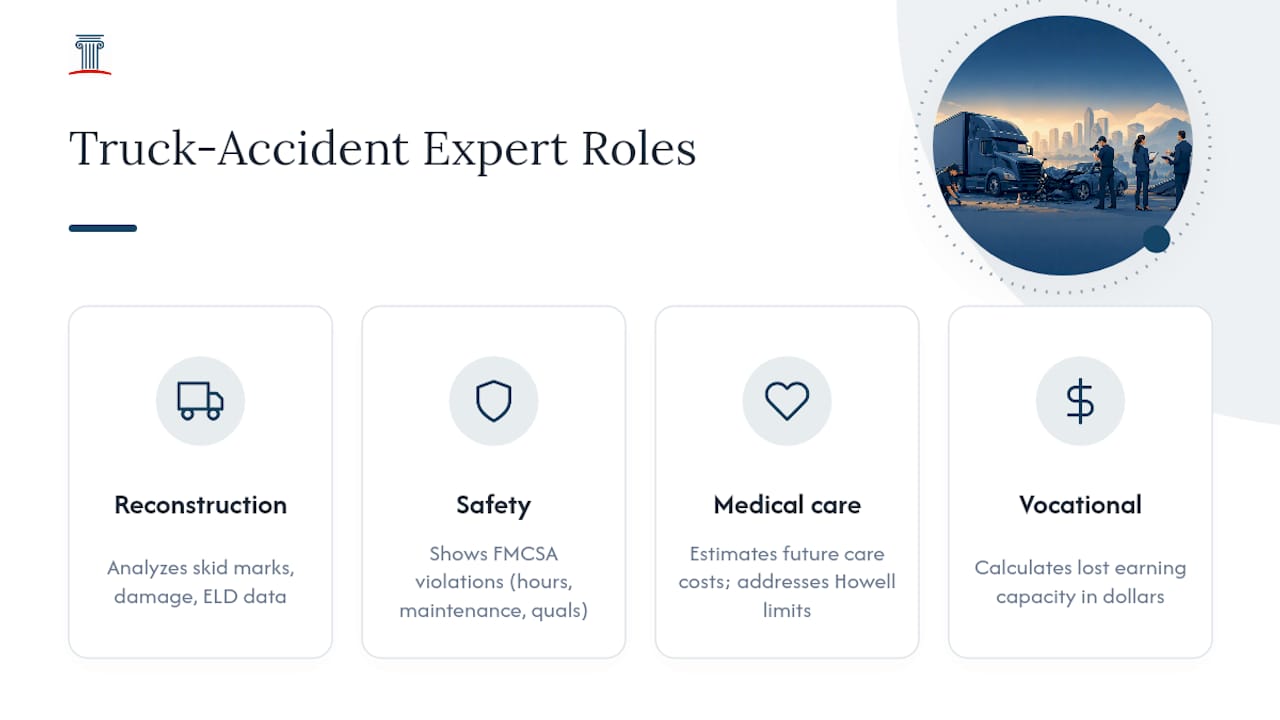
Accident reconstruction experts analyze skid marks, vehicle damage patterns, and ELD data to establish speed, braking distance, and driver behavior in the seconds before impact. Their analysis can directly counter a trucking company’s claim that you caused the crash.
Trucking industry and safety experts evaluate whether the carrier violated Federal Motor Carrier Safety Administration regulations around hours-of-service, maintenance schedules, or driver qualification standards. These experts often turn a routine negligence claim into a stronger case by showing a pattern of corporate corner-cutting.
Medical and life care planning experts project the cost of future treatment for serious injuries, filling the gap left by the Howell rule’s limits on past medical damages. Without this testimony, future care needs are easy for insurers to dismiss as speculative.
Vocational and economic experts calculate lost earning capacity when an injury prevents you from returning to your previous job or industry. Their reports translate a career disruption into a dollar figure a judge or insurer can actually evaluate.
How Serendib Law Firm Approaches Irvine Truck Accident Cases
A local firm providing legal services in personal injury, employment law, business litigation, immigration, and disability and workers’ compensation claims, including accident and injury cases, alongside workplace disputes and discrimination matters. That range matters when a truck crash also raises related issues, like a wrongful termination tied to your recovery time.
The firm offers free consultations and handles qualifying personal injury cases on a contingency basis, with a bilingual team to assist a diverse community, and provides information about attorney experience and client testimonials on its website.
At initial meetings, clients are provided with information on how fees and liens may impact recovery, timelines, and potential next investigative steps, including preservation letters and identifying expert needs.
Contact Serendib Law Firm for a Free Consultation
This firm offers an alternative to handling insurance calls alone after a truck crash in Irvine by taking qualifying personal injury cases on a contingency basis, aligning their interests with clients since payment depends on successful recovery.
Bring what you have to your free consultation: the police report, photos from the scene, medical records and bills, and contact information for any witnesses. If you don’t have all of it yet, don’t wait to call. We can start the preservation process, including requesting ELD and dashcam data before it’s overwritten, while you focus on recovering.
Reach out through our contact page to schedule your free consultation, or learn more about how we handle personal injury claims and our experience representing injured clients in Irvine. If your situation also touches on workplace issues, immigration status, a business dispute, or a workers’ compensation question, our employment law, business litigation, immigration law, and disability and workers’ compensation teams can help too.
Where These Legal Standards Come From
The deadlines discussed here come from California’s statute of limitations guide covering CCP §335.1 and government claim rules under Government Code §911.2. The valuation framework draws on analysis of what actually drives truck settlement value and on how strict liability and comparative negligence interact in California truck cases. Claimants who understand these rules going in avoid the two most common mistakes: missing a deadline and underestimating what their case is actually worth.
Why the “Average Settlement” Question Misses the Point
Every Irvine client who walks into our office wants to know one thing first: what’s my case worth? It’s a fair question, and it deserves an honest answer rather than a comforting number pulled from a marketing page.
The uncomfortable truth is that anyone who quotes you an average truck accident settlement before reviewing your medical records, the liability evidence, and the available insurance coverage is guessing. There is no reliable average, and treating one as gospel does claimants a disservice, because it sets an anchor that has nothing to do with their actual facts.
What I think gets underestimated most often isn’t the medical side of these cases. It’s the insurance-coverage side. Two clients with identical injuries can walk away with wildly different outcomes if one crash involved a well-insured national carrier and the other involved a small operator running close to the federal minimum. That’s not a failure of legal strategy; it’s math. The smartest move any injured person can make isn’t demanding a number on day one. It’s making sure every liable party and every layer of coverage gets identified before anyone starts talking settlement.
— Maya Serkova
This article is general information, not a substitute for advice from a qualified lawyer. Consult a qualified legal professional about your own circumstances before acting on anything here.
Sources
- California’s Strict Liability vs. Comparative Negligence in Truck Crashes: How Both Theories Reshape Your Recovery
- Deadlines to sue someone | California Courts | Self Help Guide
FAQ
How Long Do I Have to File a Truck Accident Claim in Irvine?
You generally have two years from the date of injury under CCP §335.1. If a government entity like Caltrans or the city may share fault, that deadline can shrink to six months for filing a government claim.
What’s the Average Settlement for a Truck Accident in California?
There’s no reliable average figure, since settlement value depends on your provable damages, the strength of your liability evidence, and how much insurance coverage is actually collectible. A firm review of your specific facts is the only way to get a realistic range.
Can I Still Recover Compensation if I Was Partly at Fault?
Yes. California follows pure comparative negligence, meaning your award gets reduced by your percentage of fault but isn’t eliminated even if you’re found mostly responsible.
Who Can Be Held Liable Besides the Truck Driver?
Motor carriers, brokers, shippers, maintenance contractors, and parts manufacturers can all share liability depending on what caused the crash. Naming every responsible party often expands the insurance available to pay your claim.
Does Serendib Law Firm Charge Upfront Fees for Truck Accident Cases?
No. Serendib Law Firm offers a free consultation and handles qualifying personal injury cases, including truck accident claims, on contingency, so you pay no attorney fees unless we recover compensation for you. Current fee details for other practice areas are available on our personal injury page.