
Unpaid wages and overtime claims are legal actions employees file when employers fail to pay the full compensation required under California law, specifically under California Labor Code § 510. If you work in Costa Mesa and suspect your paycheck is short, you are not alone and you are not without options. California has some of the strongest wage protection laws in the country, and those protections apply directly to workers in retail, hospitality, healthcare, and every other industry operating in Costa Mesa. This article explains your rights, how to spot violations, and exactly what steps to take to recover what you are owed.
What are the California overtime pay laws that protect Costa Mesa employees?
California Labor Code § 510 requires non-exempt employees to receive 1.5 times their regular pay for hours worked beyond 8 in a single day or 40 in a workweek, and double time for any hours beyond 12 in a single day. This daily overtime rule is unique to California. Most other states only trigger overtime after 40 weekly hours, so many workers who move here from other states do not realize they have been underpaid from day one.
The law also covers the seventh consecutive day of work in a workweek. On that day, the first 8 hours are paid at 1.5x, and any hours beyond 8 are paid at 2x. These rules apply regardless of whether you are paid hourly or on salary, as long as you are classified as non-exempt.
One detail that surprises many Costa Mesa workers: the regular rate of pay must include non-discretionary bonuses and commissions, not just your base hourly wage. If your employer pays you a monthly performance bonus and then calculates overtime only on your hourly rate, that is a violation. The bonus must be factored into the rate before overtime is computed.
Here is a summary of California’s overtime pay structure:
- Hours 1 to 8 per day: Regular rate of pay
- Hours 9 to 12 per day: 1.5x regular rate
- Hours beyond 12 per day: 2x regular rate
- First 8 hours on the 7th consecutive workday: 1.5x regular rate
- Beyond 8 hours on the 7th consecutive workday: 2x regular rate
- Hours beyond 40 per week (non-daily overtime): 1.5x regular rate
Pro Tip: Keep a personal log of your daily start and end times, separate from your employer’s records. If a dispute arises, your own contemporaneous notes carry significant weight.
How to identify unpaid wage and overtime violations in your Costa Mesa job
Wage violations rarely look like obvious theft. They show up as small discrepancies on a pay stub, a missed meal break premium, or an overtime calculation that uses the wrong base rate. Costa Mesa workers in retail, food service, and warehouse distribution are especially vulnerable because shift scheduling in those industries often pushes employees past the 8-hour daily threshold without managers flagging it.
The most common violations Costa Mesa employees encounter include:
- Unpaid overtime: Hours over 8 per day or 40 per week paid at straight time instead of 1.5x or 2x
- Missed meal and rest break premiums: California requires a 30-minute unpaid meal break for shifts over 5 hours. Skipping it entitles you to one hour of pay as a premium.
- Incorrect regular rate: Overtime calculated on base hourly pay while excluding commissions, shift differentials, or non-discretionary bonuses
- Off-the-clock work: Time spent setting up equipment, attending pre-shift meetings, or closing out registers without compensation
- Misclassification: Being labeled a salaried “manager” or an independent contractor to avoid overtime rules when your actual duties do not qualify for those exemptions
Review your pay stubs against your time records every pay period. If your employer uses a time-tracking system like ADP, Kronos, or Homebase, request a copy of your raw time data. Compare those hours to what appears on your check. Discrepancies between recorded time and paid time are the clearest evidence of a violation.
Non-discretionary bonuses and commissions complicate the calculation further. If your employer promises a bonus tied to performance targets, that bonus is non-discretionary and must be included when computing your overtime base rate. Many employers in Costa Mesa’s hospitality sector, including hotel and restaurant groups, routinely omit service charges and tip pools from this calculation.
What are the options for filing unpaid wages and overtime claims in Costa Mesa?
Costa Mesa employees have three primary paths to recover unpaid wages: filing a wage claim with the California Labor Commissioner’s Office, pursuing a Private Attorneys General Act (PAGA) representative action, or filing a civil lawsuit in Orange County Superior Court.
Filing with the California Labor Commissioner
Employees can file wage claims with the California Labor Commissioner’s Office online, by mail, or in person at a local office. The process begins with submitting a claim form that details the violations, the time period involved, and the amount owed. The Labor Commissioner then schedules a settlement conference, and if no resolution is reached, a formal hearing follows.
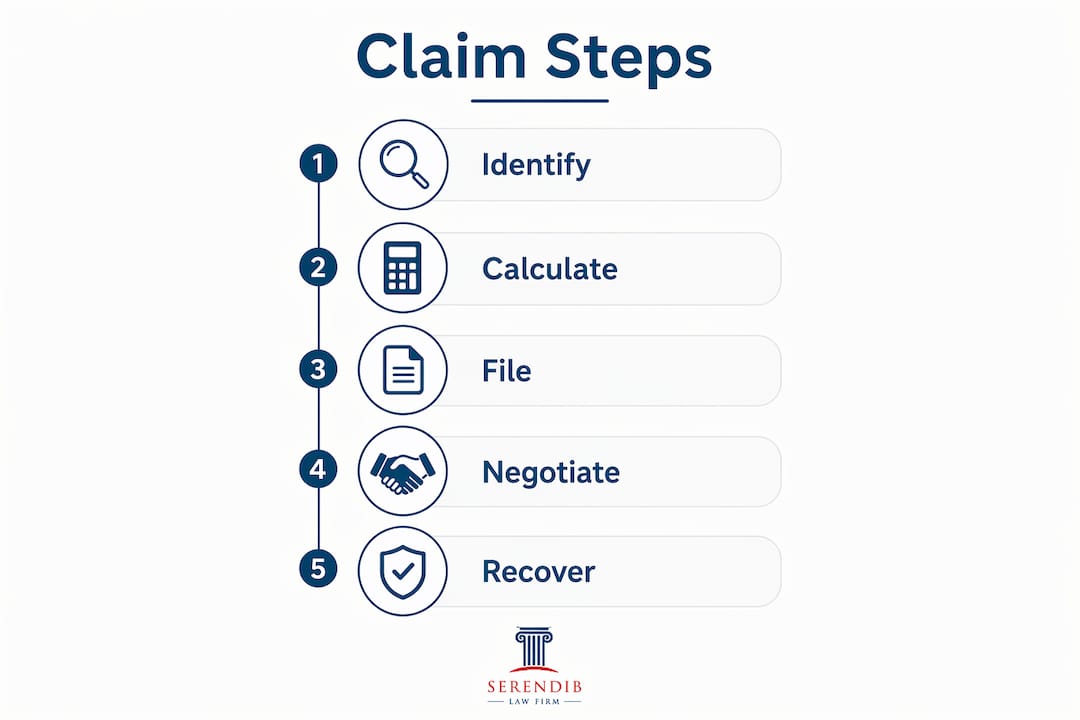
The steps in order:
- Gather all supporting documents: pay stubs, time records, schedules, and any written communications about your pay
- Complete the wage claim form (DLSE Form 1) available on the California Department of Industrial Relations website
- Submit the form online, by mail, or in person to the nearest Labor Commissioner office
- Attend the mandatory settlement conference, where a deputy labor commissioner mediates between you and your employer
- If no settlement is reached, proceed to a formal hearing where both sides present evidence
- Receive the Order, Decision, or Award from the Labor Commissioner, which is enforceable in court
PAGA claims: a powerful but procedural option
PAGA deputizes employees as private attorneys general, allowing them to sue on behalf of themselves and other affected workers to enforce labor laws the state cannot fully police on its own. Before filing a PAGA lawsuit, you must submit a written notice to the Labor and Workforce Development Agency (LWDA) describing the specific violations. The LWDA then has 65 days to decide whether to investigate. If it declines or does not respond, you may proceed with the lawsuit independently.
PAGA claims carry a 1-year statute of limitations starting from the date the written notice is submitted to the LWDA. For standard wage claims, the applicable limitations period is different and should be evaluated with an attorney based on your specific facts.
Pro Tip: PAGA actions can recover civil penalties on top of unpaid wages, which significantly increases the total recovery. They are most effective when multiple employees at the same company share the same violation.
Costa Mesa workers who face travel challenges or work irregular hours can take advantage of remote case management through video conferencing, which California Rule of Court 3.672 permits. This means you do not need to take time off work to attend every proceeding in person.
| Claim path | Best for | Key advantage |
|---|---|---|
| Labor Commissioner wage claim | Individual employees with clear, documented violations | Free to file, no attorney required |
| PAGA representative action | Groups of employees with shared violations | Recovers civil penalties beyond back pay |
| Civil lawsuit in Superior Court | High-value claims or complex misclassification cases | Full discovery and jury trial rights |
How to calculate your unpaid wages and build a strong claim
Calculating what you are owed starts with identifying your correct regular rate of pay. Take your total compensation for the workweek, including base wages, non-discretionary bonuses, and commissions, and divide by total hours worked. That figure is your regular rate. Multiply it by 1.5 for daily overtime hours and by 2 for double-time hours.
Here is a simplified example. Suppose you earn $20 per hour and worked 10 hours on a Tuesday in Costa Mesa. Your employer paid you $20 for all 10 hours. Under California law, hours 9 and 10 should have been paid at $30 each. You are owed an additional $20 for that single day. Multiply that across weeks or months and the total grows quickly.
The documents that build the strongest claims include:
- Pay stubs from the entire period in question, showing gross pay, hours listed, and deductions
- Time records from your employer’s system, requested formally in writing to create a paper trail
- Work schedules showing assigned shifts versus actual hours worked
- Emails or text messages where supervisors directed you to stay late, skip breaks, or work off the clock
- Witness statements from coworkers who observed the same patterns
Unpaid overtime settlements in California typically range from $15,000 to $50,000, depending on the duration of the violation, the number of affected employees, and whether penalties are included. That range reflects why thorough documentation matters. A claim supported by two years of time records and a clear rate calculation will settle for far more than one based on memory alone.
Pro Tip: Request your complete personnel file and payroll records in writing as soon as you suspect a violation. California Labor Code § 226 gives you the right to inspect these records within 21 days.
Key takeaways
Wage theft in California is recoverable through multiple legal channels, and Costa Mesa employees who document violations early and file promptly recover the most.
| Point | Details |
|---|---|
| California overtime rules are strict | Labor Code § 510 triggers overtime daily after 8 hours, not just weekly after 40. |
| Regular rate includes bonuses | Non-discretionary bonuses and commissions must be factored into overtime calculations. |
| Three filing paths exist | Labor Commissioner, PAGA action, and civil lawsuit each serve different situations. |
| Documentation drives recovery | Pay stubs, time records, and written communications are the foundation of every strong claim. |
| Settlements can be substantial | California unpaid overtime cases typically settle between $15,000 and $50,000. |
What I’ve learned from watching Costa Mesa workers navigate these claims
After years of working alongside employees in Orange County wage disputes, the pattern I see most often is not malice. It is systematic underpayment that employers treat as a cost of doing business until someone pushes back. Costa Mesa’s retail corridors along Harbor Boulevard and the restaurant clusters near South Coast Plaza generate a steady stream of overtime violations, most of them involving the daily overtime rule that out-of-state employers simply ignore.
The workers who recover the most are not necessarily the ones with the largest violations. They are the ones who started documenting early, asked for their records in writing, and got legal counsel before the statute of limitations became a problem. I have seen employees lose valid claims entirely because they waited too long or accepted a small settlement without understanding what they were actually owed.
One thing most articles will not tell you: the regular rate calculation involving bonuses is where employers most often win disputes, because employees cannot reconstruct the correct rate without the underlying payroll data. If you receive any form of performance pay, get those records before you leave the job or before the employer has any reason to anticipate a claim.
The employment rights framework in Costa Mesa is genuinely protective. The law is on your side. The gap between what the law promises and what workers actually recover comes down almost entirely to preparation and timing.
How Serendib law helps Costa Mesa employees recover unpaid wages
Serendib law’s employment attorneys represent Costa Mesa workers in unpaid wage and overtime disputes, from initial claim filing through settlement or trial. The firm offers free consultations and handles select cases on contingency, meaning you pay nothing unless you recover. Whether your violation involves miscalculated overtime, missed break premiums, or a misclassification scheme, Serendib law’s team knows the local courts, the Labor Commissioner process, and the PAGA framework. Remote consultations are available for workers who cannot take time away from their jobs. If you believe your employer owes you wages, speak with the Costa Mesa employment attorneys at Serendib law before the applicable deadlines pass.
FAQ
What qualifies as unpaid wages in California?
Unpaid wages include any compensation an employer is legally required to pay but does not, including overtime, missed meal break premiums, minimum wage shortfalls, and off-the-clock work. California Labor Code § 510 sets the specific overtime thresholds that trigger additional pay obligations.
How much can I recover in an unpaid overtime claim in Costa Mesa?
California overtime settlements typically range from $15,000 to $50,000, though amounts vary based on the duration of violations, the number of affected employees, and whether civil penalties under PAGA are included.
Do I need an attorney to file a wage claim?
You can file directly with the California Labor Commissioner’s Office without an attorney, but legal representation significantly improves outcomes in complex cases involving bonus calculations, misclassification, or PAGA actions. Serendib law offers free consultations to help you assess your options.
What is a PAGA claim and how does it differ from a regular wage claim?
A PAGA claim allows one employee to sue on behalf of all affected coworkers and recover civil penalties in addition to back pay. It requires a written notice to the LWDA before filing, followed by a 65-day waiting period, and carries its own statute of limitations that should be reviewed with an attorney.
Can I file a wage claim if I am still employed at the company?
Yes. California law prohibits employers from retaliating against employees who file wage claims or report labor violations. Filing while still employed is legal and sometimes strategically advantageous because you still have access to current pay records and coworker witnesses.
Recommended
- Unpaid Overtime Claims in Anaheim Hospitality – Employee Rights and Employer Duties | Serendib Law Firm
- Employment Law Rights for Employees in Costa Mesa, CA | Serendib Law Firm
- Garden Grove Overtime Violations: 25% Surge in Claims | Serendib Law Firm
- Off-The-Clock Work Claims: Protect Your Garden Grove Rights | Serendib Law Firm