

Nearly one in five American finance professionals faces workplace disputes that risk career and reputation. For high earners in Newport Beach financial firms, being terminated is rarely just about the loss of income—it can threaten decades of growth and professional standing. Understanding the true meaning of wrongful termination, and knowing your rights to compensation, is essential for anyone navigating the pressure and complexity of American finance roles.
Table of Contents
- Defining Wrongful Termination in Finance Roles
- Common Grounds for Firing High-Earners
- California Laws Protecting Financial Professionals
- Severance, Compensation, and Damages Claims
- Legal Strategies for Challenging Termination
- Employer Tactics and What to Avoid
Key Takeaways
| Point | Details |
|---|---|
| Understanding Wrongful Termination | Wrongful termination involves illegal dismissals violating contracts, public policy, or discrimination laws, especially in finance roles. |
| Documentation is Crucial | Keep thorough records of performance and communications; this evidence is vital for potential wrongful termination claims. |
| California Protections | California laws extend protections for financial professionals against wrongful termination, emphasizing whistleblower rights and contractual exceptions. |
| Beware of Employer Tactics | Employers may use manipulative severance agreements and vague documentation; scrutinizing these can help preserve your rights. |
Defining Wrongful Termination in Finance Roles
Wrongful termination in finance roles involves complex legal standards that go far beyond simple job loss. Fundamentally, it represents an illegal dismissal that violates employment contracts, public policy, or statutory protections specific to financial sector professionals. When a high-earning finance employee is fired for reasons that contravene legal standards, they may have grounds for a substantial legal claim.
Under standard employment principles, most finance roles operate under at-will employment doctrine, which technically permits employers to terminate workers for almost any reason. However, this broad latitude has critical exceptions. Wrongful termination occurs when an employee is fired in violation of laws or contracts, particularly if the dismissal stems from discriminatory motives, retaliatory actions, or violations of explicit employment agreements.
Specifically in finance roles, wrongful termination can manifest through several distinct scenarios. These include terminations related to whistleblowing about financial misconduct, refusing to participate in potentially illegal transactions, reporting workplace discrimination, exercising statutory rights like workers’ compensation claims, or being dismissed based on protected characteristics such as age, gender, race, or disability. Each of these scenarios represents a potential breach of employment law that could support a legal challenge.
Pro tip: Document every interaction, performance review, and communication with your employer if you suspect your termination might be unlawful, as contemporaneous evidence can be crucial in establishing a wrongful termination claim.
Common Grounds for Firing High-Earners
In the competitive landscape of finance, high-earning professionals face unique vulnerabilities when it comes to job security. Dismissal for high-earners often involves complex evaluations of performance, ethical conduct, and organizational alignment, extending far beyond simple job performance metrics.
Financial institutions typically identify several primary grounds for terminating high-earning employees. Performance-related issues remain the most common justification, which can include failure to meet revenue targets, consistent underperformance, or inability to manage critical client relationships. Ethical breaches represent another significant ground for termination, particularly when they involve potential financial misconduct, conflicts of interest, or violations of compliance standards that could expose the organization to legal or reputational risks.

Organizational restructuring and strategic realignment also contribute to termination scenarios for high-earners. This might involve eliminating redundant leadership positions, consolidating departments, or shifting strategic priorities that no longer align with an employee’s specific skill set. Additionally, behavioral issues such as creating toxic work environments, displaying consistent poor interpersonal skills, or demonstrating leadership approaches misaligned with company culture can trigger termination proceedings, even for top-performing financial professionals.
Pro tip: Maintain comprehensive documentation of your professional achievements, performance metrics, and positive contributions to create a robust professional portfolio that can serve as evidence of your value if your job becomes unexpectedly vulnerable.
California Laws Protecting Financial Professionals
California offers robust legal protections for financial professionals that significantly transcend standard at-will employment principles. Specific statutes provide comprehensive safeguards against wrongful termination, ensuring that financial sector employees have substantial legal recourse when facing unjust dismissal.
The California Fair Employment and Housing Act (FEHA) serves as a cornerstone of employee protection, establishing clear legal standards that shield financial professionals from discriminatory or retaliatory termination. Whistleblower protections are particularly strong, allowing employees to report financial misconduct, ethical violations, or potential legal infractions without fear of professional retaliation. These protections extend beyond direct reporting to cover situations where an employee refuses to participate in potentially illegal activities or exposes organizational wrongdoing.
Importantly, California recognizes multiple exceptions to traditional at-will employment doctrine. Implied contracts created through employee handbooks, verbal assurances, or established workplace practices can provide additional layers of job protection. Financial professionals may have grounds for legal action if their termination violates public policy, breaches an explicit or implied contract, or stems from discriminatory motivations related to protected characteristics such as age, gender, race, disability, or sexual orientation.
Pro tip: Preserve all employment documentation, including performance reviews, communication records, and employee handbooks, as these can become critical evidence in establishing potential wrongful termination claims.
Severance, Compensation, and Damages Claims
Wrongful termination cases for high-earning financial professionals involve complex compensation strategies designed to address comprehensive financial losses. Damages in these cases can encompass multiple financial components beyond simple wage replacement, providing a sophisticated framework for potential recovery.
Typically, damages claims for high-earning employees include several critical categories. Back pay represents direct compensation for lost wages from the date of termination, while front pay projects potential future income losses if reinstatement is not feasible. Emotional distress damages recognize the psychological impact of unjust job loss, which can be particularly significant for professionals whose reputation and career trajectory are closely tied to their employment history.
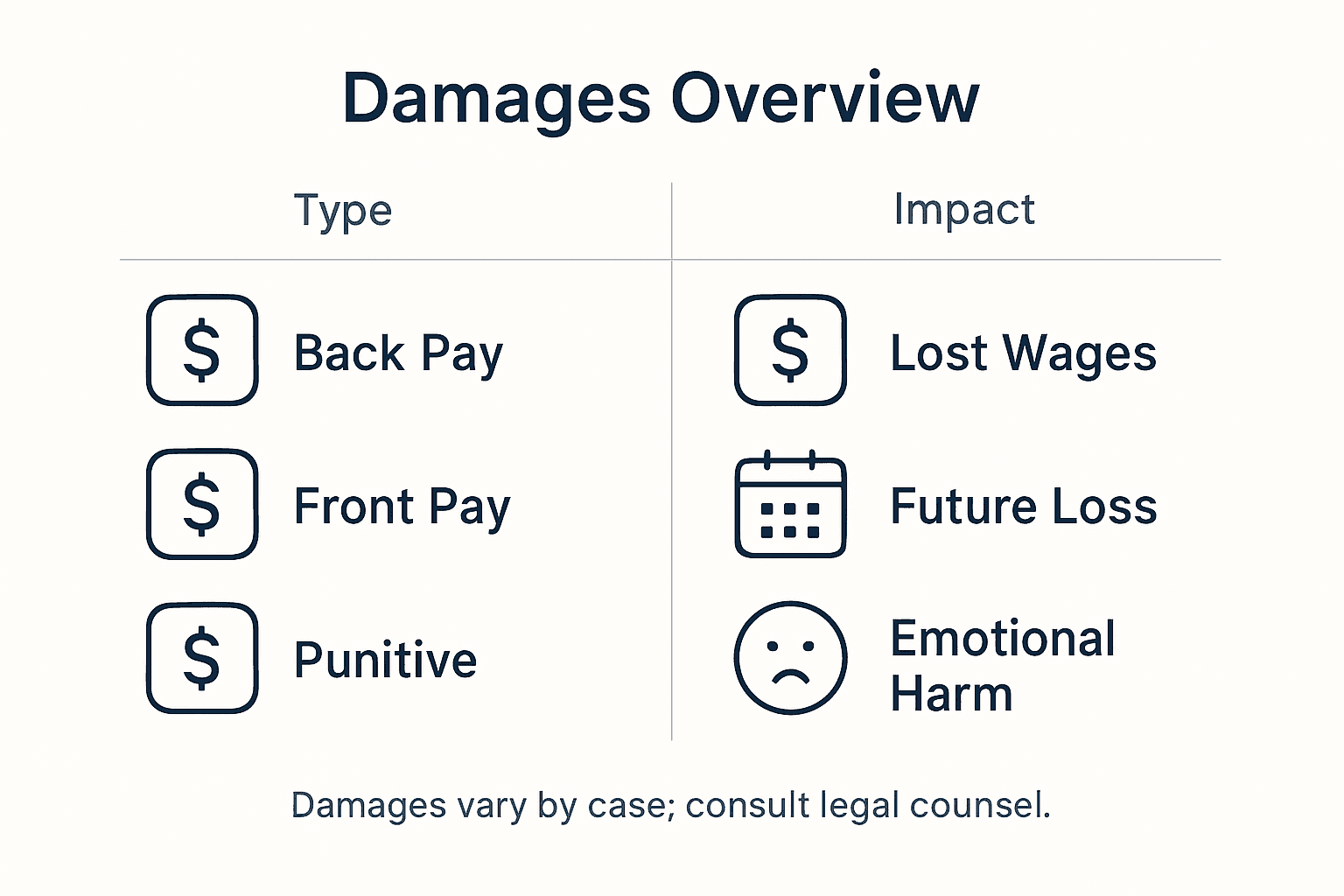
Punitive damages represent a unique compensation mechanism reserved for cases of egregious employer misconduct. These damages aim to penalize employers for particularly unethical termination practices and serve as a deterrent against future workplace violations. For high-earning financial professionals, such claims might arise from situations involving deliberate discrimination, retaliation, or systematic violations of employment contracts and professional standards.
Here’s a quick reference on typical damages and their impact in wrongful termination cases for finance professionals:
| Type of Damages | Purpose | Typical Impact on Employee |
|---|---|---|
| Back Pay | Compensate lost prior wages | Provides replacement income |
| Front Pay | Address future lost earnings | Mitigates disruption in career plans |
| Emotional Distress | Recognize psychological harm | Accounts for reputation and stress |
| Punitive Damages | Penalize employer misconduct | Deters future employer violations |
Pro tip: Collect and preserve all documentation related to your employment, including performance reviews, communication records, and evidence of professional achievements, as these can significantly strengthen your potential damages claim.
Legal Strategies for Challenging Termination
Successful wrongful termination challenges require a strategic and methodical approach that goes beyond emotional reactions. Legal strategies for challenging termination involve carefully documenting evidence and understanding the precise grounds for potential legal action, with high-earning financial professionals having unique considerations in their approach.
Evidence collection forms the cornerstone of any robust legal challenge. This involves systematically gathering performance reviews, email communications, employment contracts, and any documentation that demonstrates your professional contributions and the potentially discriminatory or retaliatory nature of your termination. Procedural documentation is equally critical, including tracking all interactions with human resources, supervisors, and any communications surrounding your dismissal.
Navigating the legal landscape requires understanding the specific mechanisms for challenging termination. This typically involves filing administrative complaints with agencies like the Equal Employment Opportunity Commission (EEOC), obtaining right-to-sue letters, and potentially initiating litigation. For high-earning financial professionals, the stakes are particularly high, with potential claims encompassing not just lost wages but also damage to professional reputation, future earning potential, and potential career trajectory interruption.
Pro tip: Consult with an employment attorney specializing in financial sector litigation before taking any formal actions, as they can provide nuanced guidance specific to your unique professional circumstances.
Employer Tactics and What to Avoid
Employers frequently deploy sophisticated strategies to limit their legal exposure and complicate potential wrongful termination claims. Tactics designed to obscure potential discriminatory or retaliatory motives can create significant challenges for high-earning financial professionals, requiring vigilant and strategic responses.
Severance agreement manipulation represents one of the most common employer tactics. Companies often draft complex documents that appear beneficial but actually require employees to waive critical legal rights. These agreements may include clauses that restrict future employment, prevent discussing the termination, or demand complete surrender of potential legal claims in exchange for minimal compensation. High-earning employees must carefully scrutinize such documents, understanding that what seems like a generous offer might actually be a legal trap designed to prevent future litigation.
Another prevalent tactic involves deliberately vague or misleading termination documentation. Employers might generate performance reviews or termination records that strategically omit critical context, create fabricated performance issues, or retroactively modify documentation to justify a dismissal. They may also exploit at-will employment provisions, attempting to frame discriminatory or retaliatory terminations as routine business decisions. Recognizing these strategies requires maintaining meticulous personal records and understanding the nuanced legal protections available to financial sector professionals.
This table highlights common employer tactics and proactive steps financial professionals can take:
| Employer Tactic | Employee Counter-Strategy | Risk If Ignored |
|---|---|---|
| Restrictive severance terms | Review with an attorney | Forfeiting legal claims |
| Vague termination reasons | Request detailed written records | Hindered legal challenge |
| Performance record changes | Keep original documentation | Loss of critical evidence |
Pro tip: Request and preserve all employment-related documentation, including emails, performance reviews, and communication records, creating a comprehensive timeline that can expose potential employer misconduct.
Protect Your Rights Against Wrongful Termination in Finance
Facing wrongful termination can feel overwhelming especially when your career and reputation as a high-earning financial professional are at stake. The article highlights key risks such as discriminatory dismissal, retaliation for whistleblowing, and termination without just cause under California’s employment laws. If you suspect that your firing violates protections like those outlined in the California Fair Employment and Housing Act or if you are dealing with complex severance agreements and vague termination reasons, you are not alone.
At Serendib Law Firm, we specialize in helping financial professionals navigate these challenges with personalized legal strategies crafted to protect your rights and secure fair compensation. Explore our insights on CA Employment Law Archives and understand how retaliation laws could apply in your case by visiting our Retaliation Archives. Do not wait until your legal options expire or severance agreements limit your claims. Take control of your future by contacting our experienced attorneys today for a confidential consultation.
Frequently Asked Questions
What constitutes wrongful termination for high-earning employees?
Wrongful termination for high-earning employees occurs when their dismissal violates employment contracts, public policy, or legal protections, particularly if it involves discrimination, retaliation, or whistleblowing regarding financial misconduct.
What legal protections do financial professionals have against wrongful termination?
Financial professionals are often protected by statutes such as the California Fair Employment and Housing Act (FEHA), which shields them from discriminatory terminations and provides strong whistleblower protections.
What damages can a high-earning employee claim in a wrongful termination case?
Damages claims for high-earning employees can include back pay, front pay for future lost earnings, emotional distress damages, and potentially punitive damages for egregious employer misconduct.
What evidence is crucial for challenging a wrongful termination in the finance sector?
Key evidence for challenging wrongful termination includes performance reviews, email communications, an employment contract, and any documentation that supports claims of discriminatory or retaliatory behavior surrounding the termination.
One Response