
Whistleblower retaliation in Newport Beach, CA is illegal under both California state law and federal statute, giving employees who report workplace wrongdoing specific, enforceable legal protections. California Labor Code Section 1102.5 and the federal Whistleblower Protection Act are the two primary legal shields available to Newport Beach workers. If your employer has fired you, demoted you, or made your work life miserable after you reported misconduct, you are not without recourse. Understanding your rights is not just reassuring. It is the first step toward doing something about it.
What laws protect whistleblowers from retaliation in California?
Two legal frameworks govern whistleblower retaliation claims for Newport Beach employees: California state law and federal law. Both are enforceable, and in many cases, both apply at the same time.
California Labor Code Section 1102.5
California Labor Code Section 1102.5 makes it unlawful for any employer to retaliate against an employee who discloses information about illegal activities or violations of state or federal law. This statute covers employees in the private sector, public agencies, and nonprofits. It protects employees who report misconduct in good faith, meaning you do not need to prove the violation actually occurred. Remedies under this statute include reinstatement, back pay, and punitive damages.
Federal whistleblower protections
The federal Whistleblower Protection Act prohibits retaliation against federal government employees who disclose evidence of illegal or improper government activities. For Newport Beach employees in private industry, additional federal protections come through agencies like OSHA and the EEOC, which enforce anti-retaliation provisions under laws such as the Occupational Safety and Health Act, Title VII, and the Sarbanes-Oxley Act.
Here is a summary of the key protections available:
- California Labor Code Section 1102.5: Covers reporting of illegal activity or regulatory violations to any government agency or internally to a supervisor
- Federal Whistleblower Protection Act: Protects federal employees and applicants from retaliation for protected disclosures
- OSHA anti-retaliation provisions: Apply when employees report workplace safety violations
- EEOC anti-retaliation rules: Apply when employees report discrimination, harassment, or civil rights violations
- Sarbanes-Oxley Act: Protects employees of publicly traded companies who report securities fraud
Each of these laws prohibits adverse employment actions taken in response to protected reporting activity. Newport Beach employees may qualify for protection under more than one of these statutes simultaneously.
How does retaliation actually happen in Newport Beach workplaces?
Retaliation rarely arrives as a single dramatic event. Most employers who retaliate do so gradually, through a pattern of adverse actions that can be easy to dismiss individually but are unmistakable when viewed together.
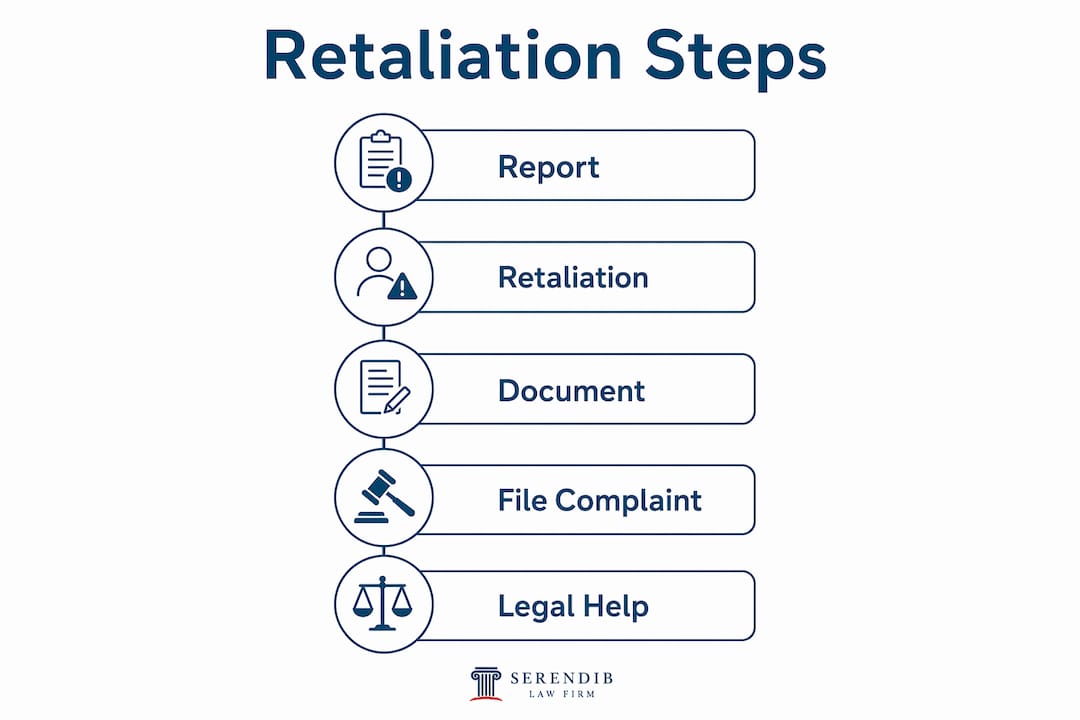
Common retaliation tactics include termination, demotion, reduced hours, unwarranted poor performance reviews, harassment, and exclusion from workplace activities. Timing is critical evidence. When adverse actions follow closely after a protected disclosure, courts treat that timing as a significant indicator of retaliation.

Subtle tactics are just as damaging as obvious ones. Employers may reassign you to undesirable shifts, exclude you from meetings you previously attended, or suddenly begin documenting minor errors they previously ignored. These behaviors create a hostile environment designed to push you out without triggering a formal termination.
The legal concept of “pretext” is central to retaliation claims. Courts look for evidence that an employer’s stated reason for an adverse action is inconsistent with past practices or contradicted by the timing of events. Negative feedback is not automatically retaliation if it is legitimate and consistent with how the employer has treated other employees. The distinction matters.
Pro Tip: Keep a private record of your performance history before any complaint. If your employer suddenly starts criticizing work they previously praised, that contrast becomes powerful evidence of pretext.
Watch for these specific warning signs after making a protected disclosure:
- Sudden changes in your performance evaluations with no prior warning
- Being excluded from team communications or meetings
- Reassignment to less desirable roles, locations, or schedules
- Increased scrutiny or micromanagement that did not exist before
- Colleagues being instructed to avoid you or document your behavior
How to document and report retaliation as a Newport Beach employee
Documentation is the foundation of every successful retaliation claim. A contemporaneous log that includes specific dates, times, locations, people involved, and witnesses carries far more evidentiary weight than a summary compiled from memory weeks later. Courts have consistently given greater weight to real-time records. Start your log the moment you suspect retaliation is occurring.
Follow these steps to build a strong evidentiary record:
- Start a private written log immediately. Record every incident with the date, time, location, what was said or done, and who witnessed it. Store this log somewhere your employer cannot access, such as a personal email account or a secure cloud folder.
- Preserve all relevant communications. Save emails, text messages, performance reviews, and any written feedback. Forward work emails to a personal account if your company policy allows it, or take screenshots.
- Report internally in writing. Reporting to HR or a compliance hotline creates a documented record of your protected activity. After any verbal report, follow up with a written email summarizing what you said and to whom.
- Request written responses. Ask HR to confirm receipt of your complaint in writing. This prevents the employer from later claiming they were unaware of your report.
- Note any changes in treatment after each report. The timeline between your protected activity and any adverse action is one of the most persuasive elements in a retaliation claim.
Pro Tip: After any verbal conversation with HR or a supervisor about your complaint, send a follow-up email that same day summarizing what was discussed. Write something like: “Per our conversation today, I reported X concern to you at Y time.” This creates a timestamped record that is very difficult to dispute later.
| Documentation type | Why it matters |
|---|---|
| Contemporaneous incident log | Carries the highest evidentiary weight in court |
| Preserved emails and texts | Provides direct proof of communications and employer knowledge |
| Written HR complaint records | Establishes the date and content of your protected activity |
| Performance review history | Reveals sudden changes inconsistent with prior evaluations |
| Witness contact information | Supports your account with corroborating testimony |
What agencies and legal options exist for Newport Beach whistleblowers?
Newport Beach employees have multiple enforcement channels available. Filing with the right agency depends on the type of misconduct you reported and the nature of the retaliation you experienced. In many situations, multiple complaints can be filed simultaneously when more than one statute applies.
| Agency | Handles | Best for |
|---|---|---|
| EEOC | Discrimination and retaliation under federal civil rights laws | Employees who reported harassment, discrimination, or civil rights violations |
| OSHA | Safety-related whistleblower complaints | Employees who reported workplace safety hazards |
| California Labor Commissioner | State wage, labor, and retaliation violations | Employees covered under California Labor Code Section 1102.5 |
| California Civil Rights Department | State discrimination and retaliation claims | Employees facing retaliation tied to protected characteristics |
Each agency has its own process and applicable statute of limitations. Prompt action is critical because retaliation claims are subject to filing deadlines that vary depending on the law and agency involved. Consulting an attorney before filing helps you avoid procedural mistakes that can permanently bar your claim.
Legal counsel specializing in whistleblower retaliation can evaluate the strength of your claim, assist with agency filings, and negotiate with your employer, often on a contingency basis. That means you pay nothing unless you recover. Early legal advice prevents the kind of missteps that weaken cases before they ever reach an agency or courtroom.
For Newport Beach employees specifically, working with an attorney familiar with Orange County courts and California employment law gives you a practical advantage. Local knowledge of how cases are handled in this jurisdiction matters.
What should you do immediately after experiencing retaliation?
The period immediately after retaliation occurs is the most critical time for protecting your claim. Your actions in the first days and weeks shape the strength of your case.
- Prioritize your personal safety and well-being. Retaliation is stressful. Seek support from a counselor, trusted friend, or employee assistance program if your employer offers one. Emotional stability helps you make clear decisions.
- Continue documenting every incident. Do not stop your log after the first adverse action. Retaliation often escalates, and a pattern of conduct is more compelling than a single event.
- Communicate carefully at work. Avoid confrontational exchanges with supervisors or HR that could be used against you. Keep communications professional and in writing whenever possible.
- Consult an employment attorney before taking major steps. Do not resign, sign any severance agreement, or make public statements about your employer without legal advice. Each of these actions can affect your rights.
- Understand the remedies available to you. Successful retaliation claims under California Labor Code Section 1102.5 can result in reinstatement, back pay, compensation for emotional distress, and punitive damages. Knowing what you can recover helps you make informed decisions about how to proceed.
Pro Tip: Never resign in response to retaliation without speaking to an attorney first. A resignation can complicate your claim significantly. If conditions become intolerable, an attorney can advise you on whether a “constructive discharge” claim applies, which treats a forced resignation as a termination under the law.
You can also review how to document workplace harassment for additional guidance on building a record that holds up in court.
Key takeaways
Newport Beach employees who report workplace misconduct are protected from retaliation under California Labor Code Section 1102.5 and multiple federal statutes, with remedies including reinstatement, back pay, and punitive damages.
| Point | Details |
|---|---|
| California law is specific and strong | Labor Code Section 1102.5 covers private, public, and nonprofit employees who report violations in good faith. |
| Timing is your best evidence | Courts treat adverse actions that follow closely after a protected disclosure as strong indicators of retaliation. |
| Document in real time | A contemporaneous log carries far more weight in court than a summary written from memory later. |
| Multiple agencies can help | EEOC, OSHA, and California state agencies each handle different types of retaliation claims, and you can file with more than one. |
| Act promptly and get legal advice | Statute of limitations deadlines vary by law and agency, making early consultation with an attorney critical. |
What I have learned from whistleblower cases in Newport Beach
After working with employees across Orange County, one pattern stands out clearly: the clients who come to us earliest almost always have the strongest cases. They started their documentation log within days of the first suspicious change in their treatment. They followed up verbal HR complaints with written emails. They did not resign out of frustration before understanding their options.
The emotional weight of being retaliated against at work is real. You trusted your employer enough to report a problem, and they responded by making your life harder. That experience is isolating. But the legal protections available to Newport Beach employees under California law are not symbolic. They are enforceable, and they carry real financial consequences for employers who violate them.
The biggest mistake I see is waiting. Employees often spend months hoping the situation will improve before seeking legal advice. By then, some documentation is lost, deadlines are closer, and the employer has had time to build a paper trail of their own. Internal reporting, even when it feels futile, creates a record of your protected activity that becomes the foundation of your claim.
If you work in Newport Beach and something changed at work after you reported a problem, trust that instinct. Get advice early. The law is on your side, and the protections are more robust than most employees realize.
How Serendib law can help Newport Beach whistleblowers
Serendib law represents employees across Orange County, including Newport Beach, who are facing retaliation for reporting workplace misconduct. The firm’s Newport Beach employment attorneys have direct experience with California Labor Code Section 1102.5 claims, EEOC filings, and OSHA complaints. Serendib law offers free consultations and handles select retaliation cases on a contingency basis, meaning you pay no attorney fees unless you recover. If you have experienced termination, demotion, or any adverse action after reporting wrongdoing, contact Serendib law’s California employment law team today to understand your rights and options before any deadlines pass.
FAQ
What qualifies as whistleblower retaliation in California?
Whistleblower retaliation in California is any adverse employment action taken against an employee because they reported illegal activity or a regulatory violation. This includes termination, demotion, reduced hours, harassment, and unwarranted negative performance reviews.
Does California law protect employees who report misconduct internally?
Yes. California Labor Code Section 1102.5 protects employees who report violations to a supervisor or internal compliance channel, not just to a government agency. The report must be made in good faith.
How do I prove my employer retaliated against me?
Proof of retaliation typically relies on the timing between your protected disclosure and the adverse action, evidence of pretext in the employer’s stated reason, and documentation showing a change in treatment after your report.
Can I file with both the EEOC and a California state agency?
Yes. When retaliation involves both federal and state law violations, you can file complaints with multiple agencies simultaneously. An employment attorney can help you identify which agencies apply to your specific situation.
What remedies can I recover if my retaliation claim succeeds?
Successful claims under California Labor Code Section 1102.5 can result in reinstatement to your position, back pay for lost wages, compensation for emotional distress, and punitive damages against the employer.
Recommended
- Retaliation After Whistleblowing in Yorba Linda – Employee Impact | Serendib Law Firm
- Whistleblower Retaliation Rights In Yorba Linda Accounting | Serendib Law Firm
- Whistleblower Protections in Santa Ana After Corruption Cases | Serendib Law Firm
- Whistleblower protections for government employees 2026 | Serendib Law Firm