

TL;DR:
- Legal hostility in Santa Ana workplaces requires severe, pervasive behavior linked to protected characteristics.
- Proper documentation, timely reporting, and understanding liability are crucial for successful claims.
- Employer and supervisor liability depend on the nature of harassment and employer response standards.
Working in Santa Ana means navigating one of Orange County’s most diverse and active job markets. But for many employees, the office isn’t always a safe place. When your work environment becomes hostile, it’s tempting to assume any uncomfortable interaction is legally actionable. That assumption can cost you. Courts consistently require more than a subjective feeling of discomfort. They require objective evidence of severe or pervasive conduct tied to a protected characteristic. Understanding where that legal line falls gives Santa Ana employees the clarity and power to act wisely.
Table of Contents
- What makes a Santa Ana office environment ‘hostile’ under the law?
- How to document and report hostile work environment incidents
- Who is responsible: Employer and supervisor liability explained
- What happens after a complaint: Local outcomes and recent case trends
- Why hostile environment cases are won or lost in the details
- Get legal help for your Santa Ana hostile work environment claim
- Frequently asked questions
Key Takeaways
| Point | Details |
|---|---|
| Legal definition matters | Not every uncomfortable workplace event is a hostile work environment—specific criteria must be met. |
| Timely action required | You must report and file complaints within set deadlines to keep your case viable. |
| Thorough documentation is crucial | Keeping detailed records of incidents, witnesses, and communications greatly strengthens your claim. |
| Liability varies by role | Employers are more readily liable for supervisor actions than coworker misconduct unless negligence is shown. |
| Expert help is valuable | Consulting experienced local employment attorneys can make the difference in complex hostile environment cases. |
What makes a Santa Ana office environment ‘hostile’ under the law?
Many employees confuse daily annoyances with legally actionable harassment. A manager who is rude, a coworker who talks too loudly, or a supervisor who assigns unfair workloads can all make your day miserable. But none of that, on its own, rises to the level of a hostile work environment under California or federal law. Let’s unpack what truly qualifies.
To be legally actionable, conduct must meet a specific standard. The harassment must be based on a protected characteristic such as race, gender, age, religion, national origin, disability, sexual orientation, or pregnancy. It must also be severe or pervasive enough that a reasonable person would find the work environment hostile or abusive. Both elements must be present at the same time.
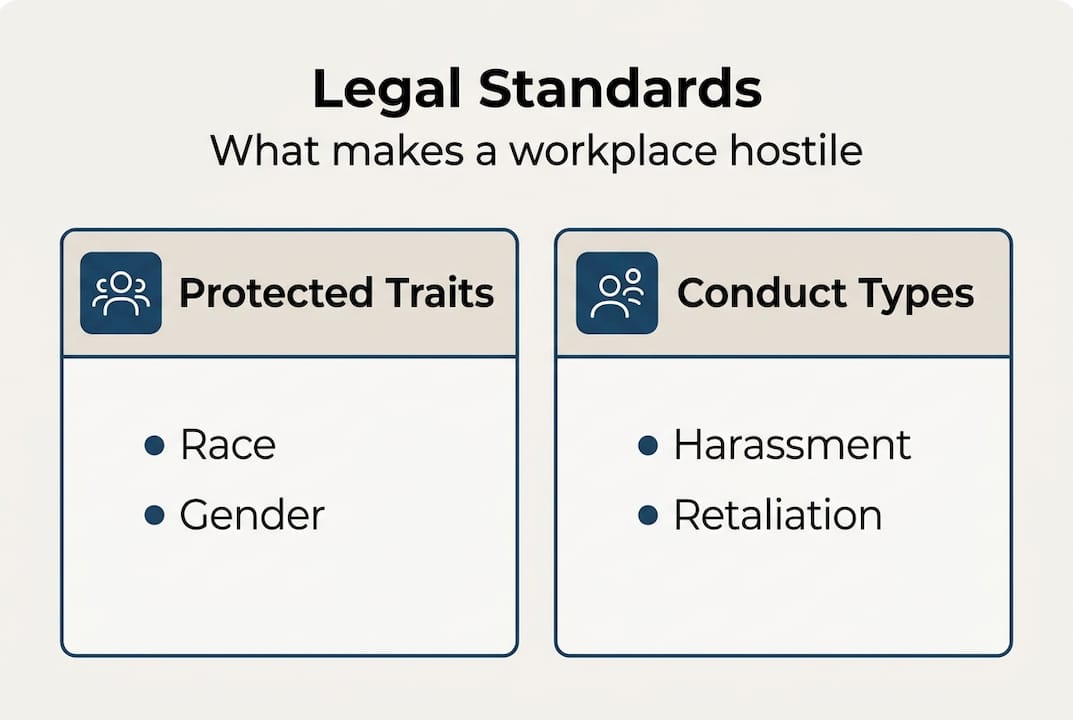
Here’s a quick breakdown of what separates general discomfort from a legally hostile environment:
| Scenario | Not legally hostile | Potentially hostile |
|---|---|---|
| Manager criticizes your work style | Harsh feedback, not protected | N/A |
| Coworker makes repeated racial jokes | N/A | Yes, based on race |
| Supervisor denies promotion after sexual advance | N/A | Yes, quid pro quo and hostile |
| Office feels tense and competitive | General stress, not protected | N/A |
| Digital harassment via work Slack based on religion | N/A | Yes, digital, still actionable |
Office environments introduce unique forms of harassment that many employees don’t immediately recognize as legally significant:
- Microaggressions: Repeated subtle comments about someone’s accent, appearance, or cultural background can collectively form a hostile pattern even if each comment seems minor alone.
- Digital harassment: Offensive messages sent through workplace email, Slack, or other platforms are fully actionable. The medium doesn’t reduce liability.
- Third-party conduct: Harassment by clients, vendors, or contractors can create employer liability if the company knows about it and fails to act.
- Retaliatory hostility: If conditions worsen after you report misconduct, that shift in treatment is its own separate legal issue.
“A single severe incident, such as a physical assault or an egregious slur, can qualify as a hostile work environment on its own under Bailey v. SF (2024). Subtle patterns of microaggressions and digital harassment also qualify, and retaliation is presumed if adverse action follows within 90 days of a complaint under SB 497.”
This is why working with experienced Santa Ana workplace harassment lawyers matters so much. The legal distinction between venting frustrations and having a viable claim can hinge on very specific facts, and reading those facts correctly requires legal training.
Understanding whether your situation meets the legal threshold is the first and most critical step. Once you have that clarity, you can move forward strategically.
How to document and report hostile work environment incidents
Once you understand what qualifies, the next challenge is gathering persuasive evidence and acting within the law’s tight deadlines. Documentation is where most employees either build a strong case or inadvertently weaken it.
Here’s a step-by-step process every Santa Ana office worker should follow:
- Start a private incident log immediately. Write down every incident as soon as it happens. Include the date, time, location, what was said or done, who was present, and how it affected you. Keep this log somewhere secure and separate from company property.
- Preserve all written communications. Screenshot or save emails, texts, Slack messages, and any other digital communications that document the harassing behavior. Courts treat digital evidence seriously, and losing access to work accounts can mean losing critical proof.
- Identify witnesses. Note the names of anyone who witnessed incidents, even if they didn’t speak up. Witnesses can corroborate your account later and significantly strengthen your case.
- Report internally using formal channels. Most employers have a written policy for reporting harassment. Use it, and do so in writing whenever possible so there is a record. Verbal complaints are harder to prove. Report to HR, a supervisor above the harasser, or through any anonymous hotline your employer provides.
- File a complaint with the California Civil Rights Department (CRD) or the EEOC. Under California law, you generally have 3 years from the last discriminatory act to file a CRD complaint. For federal claims through the EEOC, the deadline is 300 days. Missing these windows typically forfeits your right to sue.
- Obtain a right-to-sue notice. Before you can file a civil lawsuit, you need this notice from the CRD or EEOC. After you receive it, you have one year to file suit.
One legal principle that helps many employees is the continuing violation doctrine. If you experienced a pattern of harassment over time, the doctrine may allow you to include older incidents that fall outside the filing window, as long as at least one incident occurred within the deadline period. This can be the difference between a narrow and a powerful claim.

| Deadline type | Timeframe | Agency |
|---|---|---|
| California CRD complaint | 3 years from last act | California Civil Rights Department |
| Federal EEOC complaint | 300 days from last act | Equal Employment Opportunity Commission |
| Civil lawsuit after right-to-sue | 1 year from notice | State or federal court |
Pro Tip: Never use company devices or company email to store your documentation. Courts have allowed employers to access company-owned communications, which can expose your strategy. Use personal devices and personal email exclusively when documenting your experience and communicating with an attorney.
Knowing how to properly report matters just as much as knowing what to report. For a deeper look at reporting workplace harassment in Santa Ana, including what to expect from the investigation process, the right guidance can help you avoid missteps.
Who is responsible: Employer and supervisor liability explained
Identifying, documenting, and reporting are crucial, but it’s equally important to know whose actions can trigger legal consequences. California law draws meaningful distinctions between harassment by supervisors and harassment by coworkers, and those distinctions change the legal strategy significantly.
When a supervisor is the harasser, employers face a much stricter standard of liability. Under California’s framework, which mirrors federal standards established in Faragher v. City of Boca Raton and Burlington Industries v. Ellerth, employers are strictly liable when a supervisor’s harassment results in a tangible employment action, such as a demotion, termination, or pay cut. There is no defense available to the employer in that scenario.
When supervisor harassment does not involve a tangible employment action but still creates a hostile environment, employer liability is vicarious unless the employer can prove the Faragher-Ellerth defense. That defense requires showing the employer had a clear anti-harassment policy, that the employee unreasonably failed to use it, and that the employer took reasonable steps to prevent and correct harassment.
For coworker harassment, the standard is different. Employers are liable only if they knew or should have known about the harassment and failed to take prompt, effective action. This is a negligence standard, meaning you have to show the company dropped the ball after learning about the problem.
Here’s how these liability standards compare:
| Harasser type | Liability standard | Employer defense available? |
|---|---|---|
| Supervisor (tangible action) | Strict liability | No |
| Supervisor (no tangible action) | Vicarious liability | Yes, Faragher-Ellerth |
| Coworker | Negligence standard | Yes, if they acted promptly |
| Third party (client, vendor) | Negligence standard | Yes, if they acted promptly |
Key factors that affect an employer’s defense in Santa Ana office environments:
- Whether the company had a written anti-harassment policy distributed to all employees
- Whether the company trained managers and staff on harassment recognition and reporting
- Whether an internal investigation was prompt, neutral, and thorough
- Whether corrective action was taken against the harasser or whether it was ineffective or merely cosmetic
Pro Tip: If your employer conducted an investigation but took no real action, that half-hearted response can actually work in your favor. Courts have found that employers who investigate but fail to meaningfully address harassment can lose their affirmative defense and face greater exposure.
Understanding liability is especially important for Santa Ana workplace discrimination cases that overlap with hostile environment claims, since discrimination and harassment often occur together in the same workplace situations.
What happens after a complaint: Local outcomes and recent case trends
After you file a complaint, what can you expect? Local case results offer important lessons about how these claims actually play out in Orange County.
One recent and widely discussed example involves a $2.9 million jury verdict awarded in 2025 to a Santa Ana police department administrator who claimed retaliation and a hostile work environment. The outcome seemed decisive until an OC judge overturned the verdict in 2026 for insufficient evidence on the protected activity element. This case is a clear illustration that a jury’s sympathy alone cannot sustain a verdict. The evidence must objectively satisfy every legal element the law requires.
At the national level, the EEOC reported approximately 90,000 charges in 2024, a 9.2% increase over the prior year. Harassment charges have historically run around 30,000 per year, with 43.5% of sexual harassment charges also including retaliation claims. That retaliation overlap is significant because it shows that employees who speak up often face a second wave of mistreatment.
Here is a snapshot of charge trends that are relevant for Santa Ana workers:
| Charge category | National data | Key takeaway |
|---|---|---|
| Total EEOC charges (2024) | ~90,000 | Up 9.2% from prior year |
| Sexual harassment charges | ~30,000/year (historical avg.) | Retaliation often accompanies |
| Charges involving retaliation | 43.5% of sex harassment filings | Second claim frequently added |
| Women filing sexual harassment | 78% of charges | Strong demographic pattern |
What these trends reveal for Santa Ana employees:
- Retaliation is so common after harassment complaints that California law under SB 497 now presumes retaliation when adverse action follows a complaint within 90 days.
- Cases with multiple claims, such as harassment combined with retaliation or discrimination, tend to produce stronger evidentiary records because there are more documented incidents.
- High jury verdicts are regularly reviewed and overturned on appeal, which means the way your claim is built from the ground up determines how well it survives scrutiny.
- Employers increasingly invest in post-complaint investigations specifically to establish a Faragher-Ellerth defense, which is why your documentation before you report is so critical.
“The Santa Ana verdict reversal is a sobering reminder that what wins with a jury may still lose in post-trial review. Every element of the claim must be grounded in objective, admissible evidence.”
Working with attorneys who understand Santa Ana workplace retaliation patterns and Orange County appellate tendencies gives your case a structural advantage from day one.
Why hostile environment cases are won or lost in the details
Most employees come to us believing the law is straightforwardly on their side. They experienced something genuinely harmful. They felt targeted, humiliated, or unsafe. That is real, and it matters. But courts don’t measure harm by how bad it felt. They measure it by whether the conduct was objectively hostile to a reasonable person, whether it was tied to a protected category, and whether the evidence is strong enough to survive not just a jury but an appellate panel.
We’ve seen strong emotional claims fall apart because employees delayed documenting incidents, reported verbally instead of in writing, or didn’t preserve the digital evidence that sat right in front of them. We’ve also seen cases where an employer’s weak, checkbox-style investigation completely stripped away their Faragher-Ellerth defense, swinging liability back toward the company even when the original conduct seemed borderline.
Courts require objective hostility, not just hurt feelings, and employers know this. They invest in policies and investigations precisely to build a legal shield. The employees who succeed are the ones who document relentlessly, use formal reporting channels, and work with local employment law expertise that understands how to read the facts and build toward a claim that holds up at every stage.
Get legal help for your Santa Ana hostile work environment claim
If you’re reading this because something at work has crossed a line, you don’t have to figure out your next step alone. Hostile work environment and retaliation claims involve strict deadlines, complex liability standards, and evidence rules that can make or break your case long before trial. Our team represents Santa Ana employees in harassment, discrimination, and retaliation matters, and we offer free consultations to help you understand your options. Whether you work in Orange County or surrounding areas, our Lake Forest employment attorneys and Huntington Beach employment attorneys are ready to help. Connect with our Santa Ana employment law experts today.
Frequently asked questions
What is the deadline to file a hostile work environment claim in Santa Ana?
You must file a CRD complaint within 3 years of the last incident, or within 300 days if filing with the EEOC for federal claims. Missing either deadline typically ends your right to pursue the claim.
Can a single incident create a hostile work environment?
Yes, if the incident is severe enough, such as a physical assault or an egregious slur. Under Bailey v. SF (2024), one extreme event can satisfy the legal threshold without a repeated pattern.
Are employers liable if a coworker causes the hostile environment?
Only if the employer knew or should have known about the harassment and failed to act. This negligence standard means an employer who receives a complaint and does nothing becomes liable for what follows.
What should I document to support my claim?
Record dates, times, locations, specific words or actions, the names of any witnesses, and all employer responses. The continuing violation doctrine may allow older incidents to be included if recent incidents are within the filing window.
Can I be retaliated against for reporting a hostile work environment?
Legally, no. And under SB 497, retaliation is presumed if your employer takes adverse action against you within 90 days of your complaint, shifting the burden to the employer to prove otherwise.