

If your employer punished you for reporting harassment or otherwise exercising a protected right, that conduct is likely unlawful in California. We encourage Anaheim employees in this position to act now: document every adverse action, keep copies away from work systems, and speak with an employment attorney before more evidence disappears. California and federal law, through FEHA, the EEOC, and DLSE/CRD, give you real options.
TL;DR:
- Protected activity includes good faith complaints about suspected discrimination, harassment, or wage violations, accommodation requests, and investigation participation, even if no violation is found.
- Generally file CRD complaints within three years, EEOC charges within 300 days, and FEHA lawsuits within one year after receiving a Right to Sue letter.
- Close timing strengthens causation; preserve dated messages and reviews outside work systems, identify comparable coworkers, and record inconsistencies in management’s stated reason.
- Choose CRD for FEHA claims, DLSE for wage retaliation, or EEOC for federal claims; filing with CRD or EEOC generally preserves rights with both agencies.
Table of Contents
- What retaliation means under California and federal law
- Protected activities: the actions California law protects
- How retaliation commonly shows up at work
- Remedies and damages available for retaliation claims in California
- How to file a retaliation complaint in California
- How to prove retaliation: evidence, timing, and practical tactics
- Deadlines and timing: statute of limitations and why speed matters
- Local guidance from Serendib Law Firm and author credentials
- Explanation of employer’s possible defenses against retaliation claims
- Local resources and support for Anaheim employees facing retaliation
- Overview of the investigation process after filing a retaliation claim
- Practical perspective for Anaheim employees weighing next steps
- How we help Anaheim employees pursue a retaliation claim
- FAQ
- Sources
What retaliation means under California and federal law
Retaliation happens when an employer takes a materially adverse action against you because you engaged in legally protected activity. The EEOC’s enforcement guidance defines “materially adverse” broadly: an action counts if it would deter a reasonable person from reporting discrimination, filing a complaint, or otherwise asserting their rights. That standard reaches well beyond firing or demotion.
Under California’s Fair Employment and Housing Act (FEHA) and federal anti-discrimination statutes enforced by the EEOC, the question is not whether the adverse action was severe in isolation. The question is whether a reasonable employee in your position would think twice before speaking up again. A transfer to a worse shift, a sudden spike in disciplinary write-ups, or exclusion from meetings can all qualify, even when none of them alone would end your career.
The EEOC guidance also addresses pretext: an employer who claims a “legitimate” business reason for an action can still be liable if that reason is a cover for retaliatory motive. Poor performance can justify discipline, but if the real trigger was your complaint, the stated reason does not protect the employer.
A few examples show how this plays out in practice:
- An employee who files a harassment complaint gets passed over for a promotion she was previously on track to receive.
- A worker who requests a disability accommodation suddenly receives his first negative performance review in three years.
- A staff member who reports wage violations is reassigned to a less desirable location days later.
Each of these scenarios involves conduct that might look routine on its own, but the timing and context raise the retaliation question.
Protected activities: the actions California law protects
Before you can prove retaliation, you need to confirm that what you did counts as protected activity. California and federal law recognize two broad categories, plus several specific statutory protections.
- Opposition activity: speaking up against conduct you reasonably believe is unlawful, such as reporting harassment to HR, objecting to discriminatory scheduling, or confronting a supervisor about unequal pay.
- Participation activity: taking part in a formal process, including filing a charge with the EEOC or California’s Civil Rights Department (CRD), testifying in an investigation, or serving as a witness for a coworker’s complaint.
- Whistleblowing: reporting suspected violations of law to a government agency, law enforcement, or an internal compliance channel.
- Requesting accommodations: asking for a disability accommodation under the ADA or FEHA, or requesting leave under the Family and Medical Leave Act (FMLA) or California Family Rights Act (CFRA).
- Wage and hour complaints: raising concerns about unpaid overtime, missed meal breaks, or minimum wage violations, whether to a manager or to the Labor Commissioner’s office.
You do not need to prove the underlying conduct was actually illegal to be protected. The EEOC’s guidance makes clear that opposition activity is protected whenever you hold a reasonable, good-faith belief that what you reported violated the law, even if an investigation later finds no violation occurred.
How retaliation commonly shows up at work
Retaliation rarely announces itself. It often looks like ordinary management decisions that happen to follow close behind a complaint or accommodation request.
Some forms are direct and easy to recognize:
- Termination shortly after a complaint or protected request
- Demotion to a lower title or reduced responsibilities
- Pay cuts or denial of a previously expected raise or bonus
- Negative performance reviews that contradict a prior strong record
- Exclusion from meetings, projects, or communications you previously had access to
Other tactics are quieter but still legally significant. A manager who suddenly scrutinizes your timecard, assigns you the least desirable shifts, or encourages coworkers to distance themselves from you may be building a pattern of retaliation designed to push you out without an outright firing. When that pressure becomes so severe that a reasonable employee would feel forced to resign, the law treats it as a constructive discharge, which carries the same legal weight as a wrongful termination.
Timing matters enormously here. An employee who reports harassment on a Monday and receives a write-up for a minor infraction the following Friday, after years without disciplinary issues, has a timeline that supports a retaliation claim even without a smoking-gun statement from a manager.
Pro Tip: Write down the date and details of every adverse action the same day it happens, while the specifics are still fresh and before your employer’s version of events can shape your memory.
Remedies and damages available for retaliation claims in California
A successful retaliation claim can result in both monetary and non-monetary relief, depending on the forum and the facts of your case.
- Reinstatement to your former position, or a comparable one, if you were fired or demoted
- Back pay covering wages and benefits lost between the retaliatory action and resolution
- Front pay when reinstatement is not practical and future lost earnings need to be addressed
- Correction of employment records, removing retaliatory write-ups or negative reviews from your file
- Compensatory damages for emotional distress caused by the retaliation
- Punitive damages when the employer’s conduct was malicious, oppressive, or carried out with conscious disregard for your rights
- Attorney fees and costs, which can be recovered in many successful FEHA and federal claims
Retaliation is the most frequently filed discrimination issue the EEOC handles, according to the agency’s own analysis of retaliation trends. That volume reflects how often adverse reactions follow routine complaints, and it underscores why agencies and courts take these claims seriously.
Beyond individual compensation, agencies can order employers to change policies or retrain managers and supervisors as part of a resolution. These remedies aim to prevent the same conduct from happening to the next employee who speaks up, not just to compensate the one who already suffered harm.
How to file a retaliation complaint in California
Anaheim employees have both state and federal paths available, and understanding how they interact helps you choose the right strategy.
- File with California’s Civil Rights Department (CRD), the state agency that enforces FEHA. You can submit a complaint online, by mail, or in person, and the CRD investigates claims of retaliation tied to protected characteristics, complaints, or accommodation requests.
- File a wage-related complaint with the Division of Labor Standards Enforcement (DLSE) if your retaliation stems from a wage and hour complaint, such as unpaid overtime or missed breaks. DLSE handles claims specifically tied to Labor Code violations.
- File with the EEOC if your claim involves a federally protected category, such as race, sex, disability, or age discrimination. The EEOC and CRD have a work-sharing agreement, so filing with one agency generally preserves your rights under the other without requiring duplicate paperwork.
- Gather supporting documents before filing, including your complaint history, performance reviews, pay stubs, and any written communications referencing the protected activity or the adverse action.
- Request a Right-to-Sue letter once your state or federal complaint is filed, if you prefer to pursue the matter in court rather than wait for the agency’s full investigation. This can be strategically useful when you want more control over the pace and scope of your case, though it also shifts the burden of building your case onto you and your attorney rather than agency investigators.
Each path has its own timeline and evidentiary expectations, and the right choice often depends on how strong your documentation already is and how quickly you need relief. An employee with a well-documented timeline and clear comparator evidence might benefit from requesting an early Right-to-Sue, while someone still gathering evidence may prefer to let the agency’s investigation develop the record first.
How to prove retaliation: evidence, timing, and practical tactics
Winning a retaliation claim comes down to connecting your protected activity to the adverse action your employer took. The strongest cases build that connection with specific, contemporaneous evidence rather than general impressions.
- Keep a timeline noting every relevant date: when you complained, who you told, when the adverse action occurred, and who was involved at each step.
- Save emails, texts, and messages that reference your complaint, your accommodation request, or the adverse action, even informal ones between coworkers.
- Identify comparators, meaning coworkers who did not engage in protected activity and were not disciplined for similar or worse conduct.
- Collect witness names of anyone who saw the retaliatory treatment or heard relevant comments from management.
- Note inconsistencies between your employer’s stated reason for the action and your actual performance history.
Close timing between your protected activity and the adverse action is one of the most persuasive forms of circumstantial evidence, particularly when paired with a prior record that shows no performance problems.
Pro Tip: Forward relevant emails to a personal account or save screenshots on a personal device the same week they happen; once you’re locked out of a work account, that evidence can become unreachable.
Deadlines and timing: statute of limitations and why speed matters
Deadlines for retaliation claims are strict, and missing one can permanently bar your case regardless of its merits.
- California CRD complaints generally must be filed within three years of the retaliatory act.
- EEOC charges typically must be filed within 300 days of the retaliatory act in states like California that have a parallel state agency.
- Once you receive a Right-to-Sue letter, you generally have one year to file a lawsuit in court under FEHA.
Acting quickly protects more than your legal deadline. Witnesses forget details, emails get deleted during routine IT cleanups, and your own memory of exact dates fades. Anaheim employees can find agency intake assistance through the CRD’s regional offices serving Orange County, and speaking with an employment attorney early helps you decide which filing route and timeline fit your situation best.
Local guidance from Serendib Law Firm and author credentials
This article was prepared for Serendib Law Firm’s educational content on workplace retaliation. We represent employees across Orange County, including Anaheim, and we built our approach around the reality that retaliation cases are won or lost on documentation and timing.
- We offer consultations to evaluate whether your situation meets the legal standard for retaliation.
- We provide support in English and Spanish to help ensure understanding of your rights.
- We handle many employment matters on a contingency basis.
- We typically recommend employees preserve copies of relevant documents outside work systems and avoid signing any severance or disciplinary acknowledgment before speaking with counsel.
If you are weighing whether to file now or gather more evidence first, an early conversation with our team costs you nothing and can clarify your options before a deadline narrows them.
Explanation of employer’s possible defenses against retaliation claims
Employers facing a retaliation claim typically do not deny that an adverse action happened. Instead, they argue the action was unrelated to your protected activity.
Common defenses include asserting a legitimate, non-retaliatory business reason, such as a documented performance problem, a company-wide layoff, or a policy violation unrelated to your complaint. Employers may also argue that too much time passed between your protected activity and the adverse action to support an inference of retaliation, or that the decision-maker was unaware you had engaged in protected activity at all.
Another frequent defense is that the employer would have taken the same action regardless of the protected activity, sometimes called the “same decision anyway” defense. Employers may point to similar discipline given to other employees who did not engage in protected activity to argue the treatment was consistent, not retaliatory.
None of these defenses automatically defeat a claim. The EEOC’s guidance specifically addresses pretext: if the stated reason does not hold up under scrutiny, such as inconsistent application of a policy or a sudden change in treatment right after your complaint, that inconsistency itself becomes evidence supporting your claim.
Local resources and support for Anaheim employees facing retaliation
Anaheim employees have several resources within reach for both informational support and formal complaint filing. California’s Civil Rights Department maintains a regional office serving Orange County residents, where you can file a FEHA complaint in person or request assistance understanding the process. The EEOC also accepts intake inquiries online or by phone and coordinates with the CRD on overlapping claims.
For wage-related retaliation, the Labor Commissioner’s office handles DLSE complaints and can direct you to the appropriate local office for Orange County workers. Community legal aid organizations in the area often provide intake screening for employees who are unsure whether their situation qualifies for a formal complaint, which can be a useful first stop before committing to a specific filing strategy.
Beyond agencies, connecting with an employment attorney familiar with Orange County employers and local court practices gives you a clearer sense of how your specific facts measure up. We work with Anaheim employees regularly and understand the practical realities of pursuing a claim while still employed, including how to document concerns discreetly and protect your position during an active investigation.
Overview of the investigation process after filing a retaliation claim
Once you file with the CRD or EEOC, the agency typically opens an investigation that includes notifying your employer of the complaint and requesting a written response. Your employer will usually submit a position statement explaining its version of events and the reasons behind the disputed action.
The agency may request additional documents from both sides, interview witnesses, and review personnel files relevant to the claim. Some cases are resolved through mediation, where both parties attempt to reach a settlement before the investigation concludes. If mediation does not resolve the matter, the agency continues its investigation and eventually issues a determination: either a finding of reasonable cause to believe retaliation occurred, or a closure letter if the evidence does not support the claim.
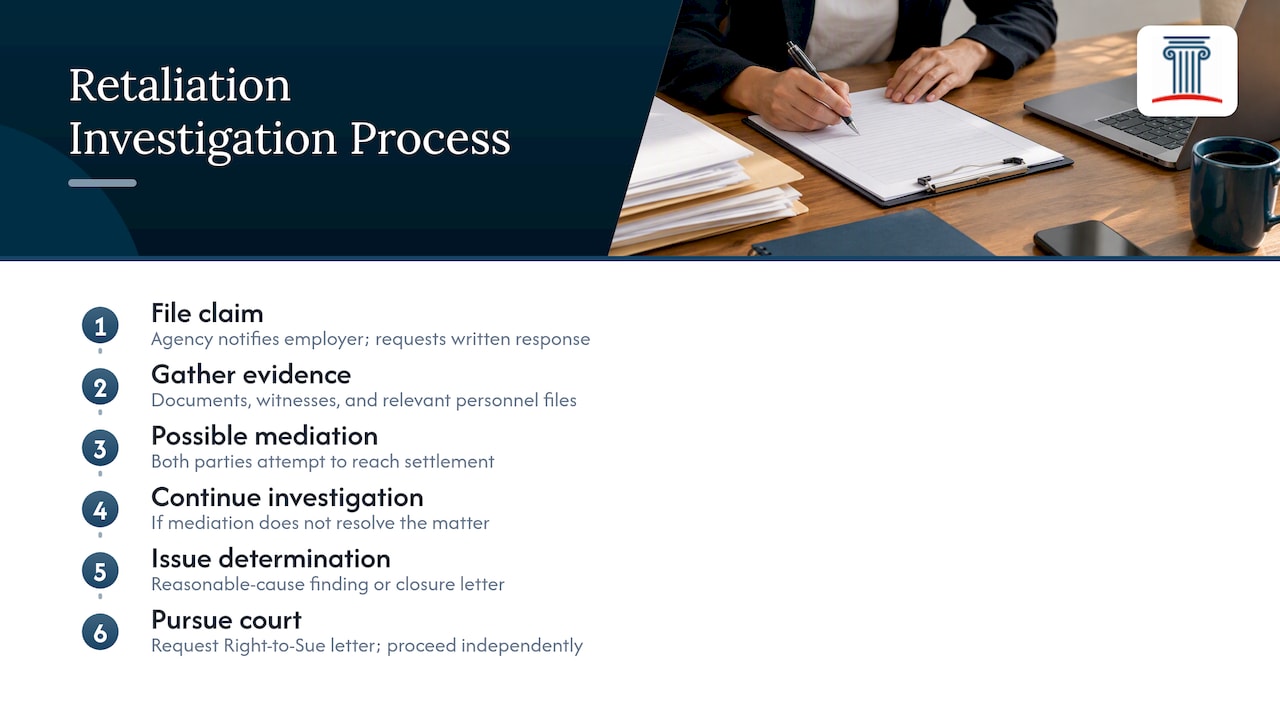
Even when an agency closes a case without a finding, you generally retain the right to request a Right-to-Sue letter and pursue the matter in court independently. The agency’s determination is not the final word on your legal options, and many employees proceed to litigation after an agency investigation closes without their preferred outcome.
Throughout this process, staying responsive to agency requests and keeping your own documentation organized helps ensure the investigation has access to the strongest version of your case.
Practical perspective for Anaheim employees weighing next steps
The honest answer is that timing decisions depend on what you already have. If your documentation is thin, spend a week gathering records before filing. If you have lost wages or your employer is escalating discipline, moving fast protects your deadline and your position. Severity should drive urgency more than confidence in your case. Bilingual intake and nearby agency offices make acting quickly realistic for most Anaheim employees, so hesitation rarely buys you anything but lost evidence.
— Maya Serkova
How we help Anaheim employees pursue a retaliation claim
Retaliation cases turn on documentation, timing, and knowing which agency or court route fits your facts, and that is exactly where we focus our work for Anaheim employees. We offer free consultations to review your situation without cost or obligation, and we handle many employment matters on contingency, so you are not paying hourly fees while we build your case.
- We provide employment law representation covering retaliation, wrongful termination, harassment, discrimination, and wage disputes.
- We serve clients in English and Spanish, removing language barriers from the legal process.
- We also represent clients in personal injury, business litigation, immigration law, and disability and workers’ compensation matters when those issues overlap with your case.
If you believe you are facing retaliation in Anaheim, visit our Anaheim workplace retaliation practice page to learn more about how we handle these cases, or contact us directly to schedule your free consultation.
This article is general information, not a substitute for advice from a qualified lawyer. Consult a qualified legal professional about your own circumstances before acting on anything here.
FAQ
What is the 7 minute rule in California?
California’s rounding rule for timekeeping allows employers to round work time to the nearest quarter hour as long as the rounding does not systematically shortchange employees over time. It applies to wage and hour calculations generally and is not specific to retaliation claims, though wage disputes involving rounding practices can sometimes lead to retaliation if an employee complains about it.
How to prove retaliation at work in California?
You prove retaliation by connecting your protected activity, such as a complaint or accommodation request, to a materially adverse action your employer took afterward. Strong evidence includes a documented timeline, close timing between the activity and the action, comparator employees treated differently, and any inconsistencies in your employer’s stated reasons, as outlined in EEOC enforcement guidance.
What qualifies as retaliation at work?
Retaliation includes any materially adverse action an employer takes because you engaged in protected activity, such as firing, demotion, pay cuts, negative reviews, or exclusion from projects. The standard covers any action that would deter a reasonable person from exercising their rights, even if it falls short of termination.
How much is a retaliation claim worth in California?
The value of a retaliation claim depends on factors like lost wages, emotional distress, and whether the employer’s conduct was severe enough to support punitive damages, so there is no fixed figure that applies to every case. An employment attorney can review your specific lost income, documentation, and the strength of your evidence to give you a realistic sense of potential value.