Losing your university position can feel both confusing and unfair, especially when complex contracts or tenure agreements are involved. For Fullerton staff and faculty, wrongful termination means more than job loss—it signals that your employer may have violated federal law or ignored established protections. This guide clarifies what wrongful termination in academia truly means, explains your unique rights in California, and outlines how to protect yourself if your dismissal crosses a legal line.
Table of Contents
- Defining Wrongful Termination In Academia
- Key Legal Protections For University Staff
- Types Of Wrongful Termination In Fullerton
- Rights Of Adjunct And Non-Tenured Faculty
- Due Process And University Termination Procedures
- Actions To Take After Wrongful Termination
Key Takeaways
| Point | Details |
|---|---|
| Understanding Wrongful Termination | Wrongful termination involves illegal firing practices such as discrimination or retaliation, violating legal agreements or protections. |
| Importance of Legal Protections | Federal and state laws provide multiple protections against unjust termination, including discrimination, whistleblower rights, and contractual entitlements. |
| Types of Wrongful Termination | Common forms include discriminatory terminations, retaliation for protected activities, breach of contract, and policy violations that undermine due process. |
| Actions Post-Termination | Immediate documentation of the termination circumstances, understanding the violation, and seeking legal counsel are crucial for protecting your rights and building a case. |
Defining wrongful termination in academia
Wrongful termination in academia doesn’t mean you were simply fired for performance issues or budget cuts. It means your institution violated the law or broke established agreements in removing you from your position. Wrongful termination occurs when an employee is fired for illegal reasons such as discrimination, retaliation for reporting violations, or breaching institutional policies that protect your employment.
University staff and faculty operate under different protections than typical corporate employees. Your employment contract, collective bargaining agreement, or tenure status creates specific legal guardrails that your employer cannot simply ignore. When Fullerton universities bypass these protections, you have grounds to challenge the termination.
Tenure protections represent a critical distinction in academic wrongful termination cases. Faculty with tenure cannot be dismissed arbitrarily—tenure and wrongful termination protections exist specifically to shield educators from arbitrary removal except under narrow circumstances like institutional financial distress or legitimate program discontinuance. Even without formal tenure, adjunct faculty and staff rely on employment contracts that outline specific conditions for termination.
The reality is this: your institution cannot fire you simply because they disagree with you, dislike your teaching methods, or want to replace you with someone cheaper. Illegal discrimination based on race, gender, age, disability, or religion remains off limits. Retaliation for whistleblowing—reporting safety violations, fiscal misconduct, or legal violations—is strictly prohibited. Breaching the terms of your employment agreement exposes the university to liability.
Common wrongful termination scenarios in universities include terminating faculty who reported Title IX violations, firing staff members for union organizing activities, removing educators based on protected characteristics, or dismissing instructors without following contractual procedures. Each situation carries different legal weight and different protections.
Pro tip: Preserve all written communications regarding your employment, including emails, performance reviews, contract documents, and any messages related to disputes or complaints before your termination—these become crucial evidence when establishing whether your firing violated legal protections or institutional agreements.
Key legal protections for university staff
You have more legal protection than you might realize. Federal and California state laws create a safety net specifically designed to prevent employers from firing you for illegal reasons. Understanding what these protections cover helps you recognize when your termination crossed a legal line.
Federal anti-discrimination laws prohibit termination based on race, color, religion, sex, national origin, age, and disability. Title VII of the Civil Rights Act protects you if someone fired you because of who you are or what you believe. The Equal Pay Act guarantees you cannot be dismissed for earning equal pay to colleagues doing substantially similar work. The Americans with Disabilities Act shields you from termination related to disability status or reasonable accommodation requests.
Whistleblower protections stand as another critical safeguard. You cannot be fired for reporting illegal activities, safety violations, wage theft, or violations of public policy. Whether you report workplace hazards to OSHA, financial misconduct to regulatory bodies, or Title IX violations to compliance officers, retaliation is illegal. These protections apply regardless of whether you report internally or to government agencies.
California adds state-level protections beyond federal law. You cannot be terminated for taking legally protected leave, serving on jury duty, voting, or refusing illegal orders. Union membership and collective bargaining rights receive full protection. Many Fullerton universities operate with union contracts that add contractual layers on top of statutory protections.
Tenure itself functions as a legal protection in many institutions. Once you achieve tenure status, your employer cannot dismiss you without cause. Cause typically requires documentation of performance issues, progressive discipline, or legitimate institutional reasons like program elimination.
Retaliation claims often carry special weight in wrongful termination cases. If you opposed discrimination, complained about illegal conduct, or participated in protected activities, your employer cannot punish you through termination, reduced hours, or schedule changes.
Pro tip: Document the date and details of any protected activity you engage in (complaints, reports, union activities, leave requests) and preserve any written responses from your employer to establish a clear timeline if retaliation occurs.
Types of wrongful termination in Fullerton
Wrongful termination takes many forms in university settings. Understanding the specific type affecting you matters because different violations require different legal strategies and evidence. Fullerton universities can violate your rights in distinct ways, each carrying its own legal implications.
Discriminatory termination represents the most visible form of wrongful dismissal. Your employer cannot fire you because of race, gender, age, religion, disability, national origin, or other protected characteristics. At Fullerton universities, discrimination might disguise itself as performance concerns when the real issue is who you are. Someone younger replacing you after years of satisfactory reviews suggests age discrimination. Sudden termination after disclosing a disability suggests discrimination despite your ability to perform.
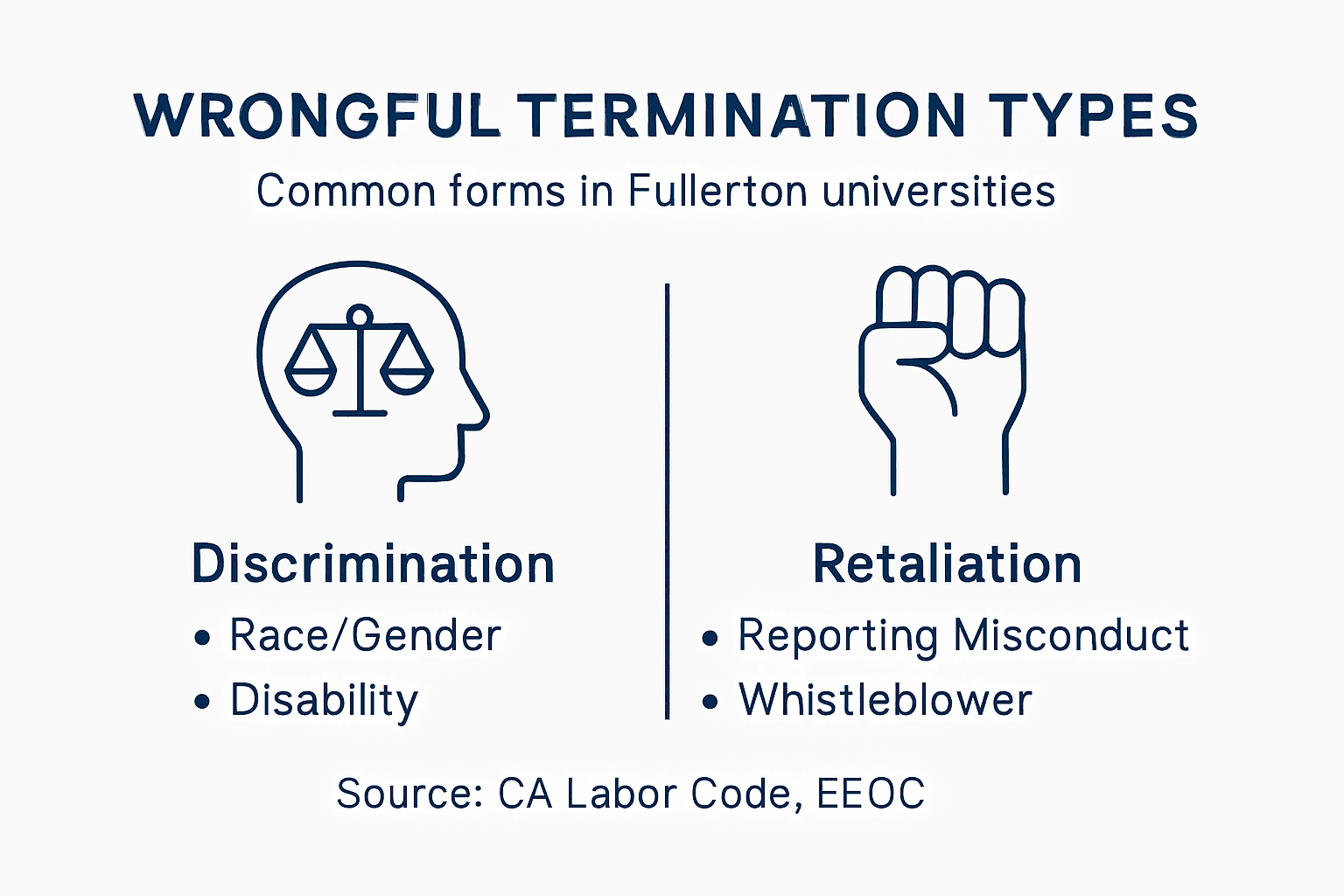
Retaliation termination occurs when your employer punishes you for protected activity. Wrongful termination types include retaliation for reporting illegal practices, whether you report Title IX violations, safety hazards, wage theft, or financial misconduct. If you complained about discrimination and faced termination shortly after, retaliation likely occurred. Union organizing, jury duty, military service, or voting cannot trigger termination either.
Breach of contract termination happens when your institution violates the terms of your employment agreement. If your contract requires specific procedures before termination, skipping those steps creates liability. Tenured faculty dismissed without following contractual cause-and-cure processes have clear breach claims. Adjunct faculty with multi-year agreements terminated mid-contract face similar violations.
Policy violation termination occurs when universities fail to follow their own documented procedures. Most institutions have handbooks outlining termination steps. Progressive discipline requirements, notice periods, appeal processes, and documentation standards exist to protect you. When administrators bypass these safeguards, you have grounds to challenge the termination regardless of the stated reason.
Constructive termination involves working conditions becoming so intolerable that reasonable resignation becomes necessary. Sudden hostile changes, deliberate isolation, impossible workload increases, or systematic retaliation can force qualified staff to quit. Some situations push employees toward resignation when direct termination would violate legal protections.
Here’s how different types of wrongful termination in academia compare:
| Termination Type | Key Legal Focus | Common Evidence Needed |
|---|---|---|
| Discriminatory | Federal/state law | Comparative records, demographics |
| Retaliation | Whistleblower/retaliation statutes | Complaint timelines, responses |
| Breach of Contract | Employment agreements | Written contract, procedural proof |
| Policy Violation | University policies | Handbook, policy documentation |
| Constructive | Work conditions | Communications, workload history |
Pro tip: Compare your termination circumstances against each wrongful termination type because most cases involve overlapping violations, strengthening your overall legal position and claim value.
Rights of adjunct and non-tenured faculty
Adjunct and non-tenured faculty occupy a vulnerable position at Fullerton universities. Your lack of tenure does not strip away your legal protections, even though institutions sometimes treat temporary status as a reason to ignore basic employment rights. You deserve the same legal safeguards as tenured colleagues in several critical areas.
Discrimination protections apply equally to adjunct and non-tenured staff. Your employer cannot fire you based on race, gender, age, disability, religion, or national origin regardless of your contract type. A temporary position does not create a loophole for illegal discrimination. If you were not renewed after reporting harassment or requesting accommodations, that termination likely violates federal law.
Whistleblower protections cover adjunct faculty too. You can report safety violations, financial misconduct, Title IX violations, or illegal conduct without fear of retaliation or non-renewal. Many adjuncts face non-renewal after speaking up about problems, creating clear retaliation claims. Your temporary status does not justify punishing you for protected speech.
Adjunct faculty have rights to minimum wage and overtime protections under the Fair Labor Standards Act. If your institution requires you to work beyond contracted hours without compensation, wage violations occur. Some universities misclassify adjuncts to avoid overtime obligations. Calculating actual hourly wages often reveals underpayment that creates additional legal claims.
Contract rights protect you when written agreements exist. If your contract specifies a term, renewal process, or termination procedures, your employer must follow those terms. Sudden termination mid-contract or failure to follow stated renewal processes constitutes breach. Even semester-to-semester arrangements create contractual expectations when procedures are documented.
Your employment contract status matters significantly. Year-to-year appointments carry more protection than semester contracts. Written agreements offer stronger protection than oral promises. Some adjuncts have implied contracts based on repeated rehiring patterns and established practices.
Pro tip: Obtain and preserve copies of every contract, offer letter, and email confirming your employment terms because these documents establish what protections apply to your specific situation.
Due process and university termination procedures
Due process matters more than you might think. Universities cannot simply decide to terminate you and execute that decision the same day. The law and most institutional policies require specific procedural steps that protect your rights before dismissal becomes final. When Fullerton universities skip these steps, they create legal vulnerability.
Notice requirements form the foundation of due process. Your employer must inform you of the reasons for potential termination with enough detail that you understand the specific concerns. Vague accusations like “performance issues” without documentation do not satisfy this requirement. You need clear information about what conduct or performance failed to meet standards.
Opportunity to respond is your essential right. Due process in higher education termination covers the rights of faculty and staff to fair procedures including notice and opportunity to respond before dismissal. You must receive a genuine chance to address the allegations, present your perspective, and provide evidence supporting your position. Universities cannot hold a predetermined conclusion while pretending to listen.
Investigation and documentation precede legitimate termination. Your institution should investigate complaints thoroughly, document findings, and provide you access to that documentation. One person’s complaint without corroboration should not trigger termination. The investigation process must be fair and impartial, not designed to confirm a predetermined outcome.
Contractual procedures carry legal weight. Universities must comply with due process requirements in staff termination through adherence to institutional policies and applicable laws. If your employee handbook specifies termination procedures, your university must follow them. Skipping required steps violates your rights even if the underlying termination decision itself might have been lawful.
Appeals mechanisms provide final safeguards. Most institutions offer appeal processes where you can challenge termination decisions before higher administrators. These appeals must be meaningful, not ceremonial rubber stamps.
Below is a concise overview of due process steps and their significance:
| Step | Purpose | Impact on Employee Rights |
|---|---|---|
| Notice of Termination | Inform reason and grounds | Enables preparation of response |
| Opportunity to Respond | Present employee’s side | Ensures fair hearing before action |
| Investigation & Documentation | Impartial fact-finding | Prevents arbitrary terminations |
| Appeals Process | Review by higher authority | Provides chance for reversal |
Pro tip: Request written explanations at every stage of any disciplinary process, and send written responses documenting your position, creating a clear record if procedures were violated or decisions were arbitrary.
Actions to take after wrongful termination
Your termination happened. Now what? The steps you take in the immediate aftermath determine your legal position and claim strength. Delay and inaction weaken your case, while swift, strategic action protects your rights and preserves evidence.
Document everything immediately. Write down detailed accounts of what happened, including dates, times, people involved, and specific statements made during your termination meeting. Preserve all emails, messages, performance reviews, and written communications related to your employment. Take screenshots of digital records before your access gets terminated. This documentation becomes your evidence foundation.
Understand your specific violation. Identify which legal protection your termination violated. Was it discrimination based on protected characteristics? Retaliation for reporting misconduct? Breach of your employment contract? Violation of institutional procedures? Your specific claim type determines which agency handles your case and what evidence matters most.
File discrimination complaints with the EEOC. If your termination involved illegal discrimination based on race, gender, age, disability, religion, or national origin, report discrimination to the EEOC within applicable timeframes. The EEOC investigates federal discrimination claims and can pursue enforcement actions against your employer. Federal law requires timely filing, so act quickly.
Report retaliation to appropriate agencies. Retaliation claims require reporting to OSHA if you reported safety violations, to the SEC if you reported financial misconduct, or to relevant regulatory bodies based on what you reported. Each agency has specific procedures and timeframes.
Consult an employment attorney. Wrongful termination law is complex and agency processes move slowly. An experienced attorney evaluates your specific circumstances, identifies all viable claims, and advises whether litigation becomes necessary. Many law firms like Serendib Law offer free consultations, allowing you to understand your options without upfront costs.
Preserve your financial records. Document lost wages, benefits, and other damages from your termination. Calculate what you earned before termination and what you have earned since. This documentation supports damage calculations in settlement negotiations or court.
Pro tip: Begin correspondence with your former employer through an attorney rather than directly, as attorney communication signals seriousness and creates formal documentation while protecting your statements from being used against you.
Protect Your Rights Against Wrongful Termination in Fullerton Universities
Facing wrongful termination in an academic setting can be overwhelming. Whether you are dealing with discrimination, retaliation, breach of contract, or violations of due process, these serious challenges demand expert legal support. You should never feel powerless when your employer ignores critical protections like tenure rights, whistleblower safeguards, and contract terms.
At Serendib Law, we understand the unique complexities of employment law in Fullerton and broader California. Our dedicated team is ready to fight for your rights, protect your livelihood, and hold your employer accountable. Explore our California Archives to learn more about state-specific protections and common workplace challenges. If wage or contract violations added to your troubles, we also offer focused help through our Wage Violations Archives.
Do not wait for your case to weaken or evidence to disappear. Take control of your situation now by contacting Serendib Law online at https://www.serendiblaw.com/ to schedule a free consultation. Your fight against wrongful termination begins with knowing you have trusted advocates on your side.
Frequently Asked Questions
What constitutes wrongful termination in academia?
Wrongful termination in academia occurs when an employee is fired for illegal reasons, such as discrimination, retaliation for whistleblowing, or breaching contractual protections, rather than for performance issues or budget cuts.
How do anti-discrimination laws protect university staff from wrongful termination?
Federal anti-discrimination laws prevent termination based on race, gender, age, disability, religion, and other protected characteristics. Understanding these laws helps staff recognize when they may have been wrongfully terminated.
What steps should I take if I believe I was wrongfully terminated from a university?
Immediately document all details of the termination, understand the specific legal violation involved, file a complaint with the appropriate agency (like the EEOC for discrimination), and consult with an employment attorney for legal advice.
Are adjunct faculty members protected from wrongful termination like tenured faculty?
Yes, adjunct faculty have legal protections against wrongful termination, including anti-discrimination and whistleblower protections. They also retain contract rights that must be followed by the institution, ensuring their rights are safeguarded even without tenure.
Recommended
- Wrongful Termination | Serendib Law Firm
- Wrongful Termination After Workers’ Compensation Claims | Serendib Law Firm
- Wrongful Termination Risks for High-Earning Employees
- Wrongful Termination After Medical Leave in Buena Park Retail | Serendib Law Firm
- Duty of Care for Employers: Complete Guide – Unparalleled Global Benefits
- Academic Integrity Policies: Building Member Trust|CS
- Kogi Poly Sacks Staff For Sexual Assault & Absenteeism / Naijatipsland