

Newport Beach projects calm wealth. Manicured offices, billion-dollar portfolios, and executives whose compensation packages rarely make the evening news. Yet Wall Street’s most publicized pay firestorm of recent years, the Goldman Sachs retention bonus controversy, carries lessons that reach far beyond Manhattan. Finance executives and HR professionals here may not see their names in headlines, but the same legal landmines exist beneath the surface. Understanding what triggered Goldman’s shareholder revolt and how California law treats executive compensation disputes is not just academic. It is essential protection for anyone managing or receiving executive pay in Orange County.
Table of Contents
- Executive bonus disputes: Rare in Newport Beach, but risks remain
- What Goldman Sachs teaches: The mechanics of executive pay controversies
- Legal triggers and dispute hotspots for bonuses in Newport Beach
- How to shield your firm: Practical safeguards and dispute prevention
- The uncomfortable truth: Why Newport Beach can’t ignore Wall Street’s lessons
- Get tailored legal advice for Newport Beach executive compensation
- Frequently asked questions
Key Takeaways
| Point | Details |
|---|---|
| Disputes are rare but risky | Newport Beach finance firms face underlying risks in executive compensation, even if headlines are scarce. |
| Wall Street sets warning signs | The Goldman Sachs pay case reveals that unclear or excessive bonuses can backfire—apply these lessons locally. |
| Prevention starts with detail | Tying bonuses to clear metrics and thorough documentation is your best safeguard. |
| Legal review matters | Regularly auditing bonus contracts and consulting employment counsel can help avoid disputes or costly litigation. |
Executive bonus disputes: Rare in Newport Beach, but risks remain
Newport Beach is home to respected wealth management firms like Beacon Pointe Advisors and Empirical Wealth Management, yet no reported pay controversies have surfaced publicly from these organizations. That silence is not the same as safety. Disputes over executive compensation in private finance firms rarely reach the press. They get resolved behind closed doors, through arbitration, or in sealed settlements that never enter public record.
What actually drives these hidden disputes? Most of the time, it comes down to contract ambiguity. A bonus described as “discretionary” in writing but communicated verbally as guaranteed is a lawsuit waiting to happen. Performance metrics that shift mid-year, or that are never written down at all, create the same problem. And when an executive is terminated shortly after a bonus period ends, the question of whether that bonus was earned becomes a serious legal fight.
“Executives rarely make news over pay locally, but legal risks run deep for the unwary.”
Common legal triggers for executive bonus disputes include:
- Breach of written or implied bonus agreements
- Wrongful termination timed to avoid bonus payouts
- Contract loopholes that allow clawbacks after the fact
- Ambiguous language around performance thresholds
- Failure to honor change-in-control provisions
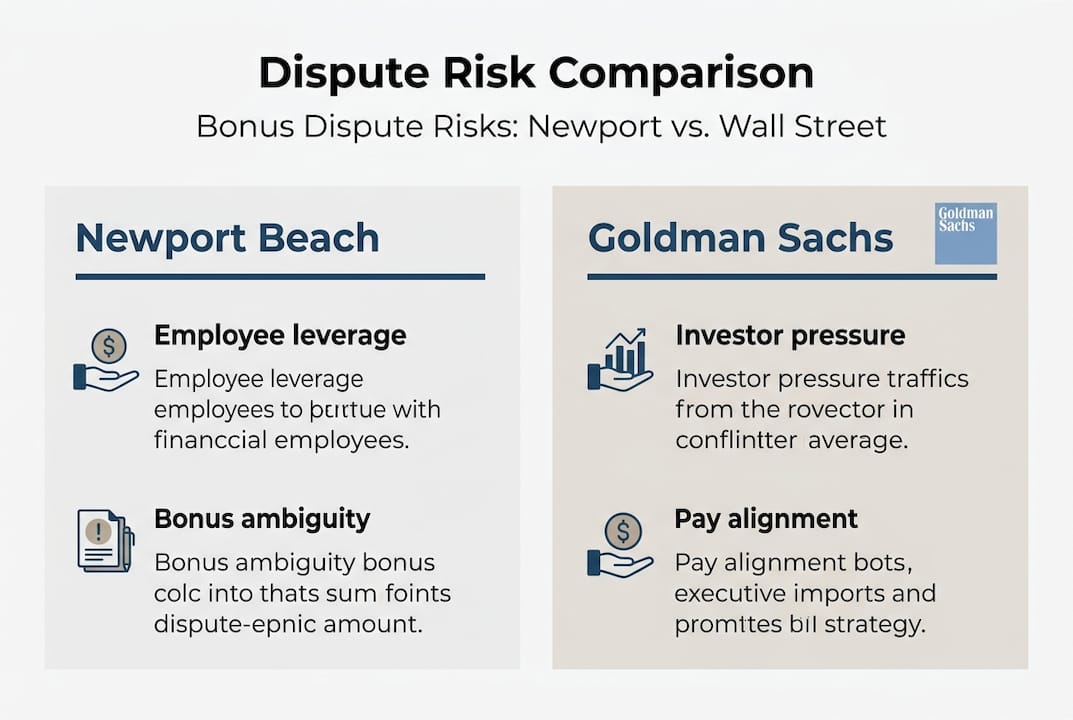
California’s Newport Beach employment law framework is notably employee-friendly, which means executives have real leverage when contracts are poorly drafted. The absence of publicized disputes in Newport Beach finance does not mean disputes are not happening. It means they are being handled quietly, often at significant cost to the firm. Understanding wrongful termination risks tied to compensation is the first step toward preventing them.
What Goldman Sachs teaches: The mechanics of executive pay controversies
The Goldman Sachs situation offers a rare window into how executive compensation disputes escalate from internal disagreement to full public firestorm. In early 2025, Goldman awarded $80M retention bonuses to CEO David Solomon and President John Waldron, on top of their existing $39M and $38M 2024 pay packages. The bonuses were time-vested, meaning they rewarded tenure rather than performance.
Proxy advisors ISS and Glass Lewis recommended voting against the packages, citing excessive size, lack of performance conditions, and misalignment with pay-for-performance principles. Shareholder support dropped from 86% to 66%. That 20-point swing represents a massive erosion of board credibility, even at a firm whose stock rose 53.5% in 2025.
Key stat: Goldman’s stock gained over 53% in 2025, yet pay alignment was still questioned by major institutional investors. Performance alone does not insulate a compensation structure from scrutiny.
Here is how Goldman’s pay framework compares to what Newport Beach finance executives typically see:
| Pay element | Goldman Sachs (2025) | Typical Newport Beach executive |
|---|---|---|
| Base salary | $2M+ | $250K to $600K |
| Annual bonus | $37M to $45M | $50K to $500K |
| Retention bonus | $80M time-vested | Rare; usually tied to M&A events |
| Performance vesting | Minimal conditions | Often tied to AUM or revenue targets |
| Shareholder scrutiny | High (public company) | Low (private firm) |
The mechanics matter here. A time-vested bonus with no performance link is legally defensible but reputationally fragile. For a private Newport Beach firm, the reputational risk is smaller, but the legal risk of a poorly structured retention bonus is identical.

Pro Tip: Never underestimate optics. Even in a private firm, how a bonus is documented and communicated internally shapes how a dispute plays out if it ever reaches arbitration or litigation. Start protecting bonus contracts before a problem arises, not after.
Legal triggers and dispute hotspots for bonuses in Newport Beach
Wall Street drama is instructive, but local legal exposure is where the real stakes sit. Newport Beach has seen its share of high-value employment disputes, even if they rarely involve private finance firms. A recent example: a Newport Beach City Manager severance dispute involving a $370,000 payout amid an active lawsuit. The legal mechanisms at play in that public sector case apply directly to private finance.
The four most common legal triggers for executive bonus disputes in California are:
- Breach of bonus contract. Written agreements that are vague about timing, conditions, or amounts become the foundation of most claims.
- Severance clawbacks. Firms that attempt to recapture paid bonuses after termination face serious legal pushback under California contract law.
- Perceived discrimination gaps. Gender or race-based pay disparities in bonus allocation trigger claims under FEHA (California’s Fair Employment and Housing Act).
- Ambiguous performance terms. Metrics defined loosely, or changed without written notice, create disputes over whether a bonus was actually earned.
Retention bonuses, in particular, are a legal minefield. They are often time-vested with minimal performance conditions, which means the only real question is whether the executive was still employed at the vesting date. If they were terminated before that date, the litigation question becomes whether the termination was legitimate or engineered to avoid the payout.
| Legal risk area | Governing framework | Risk level for Newport Beach |
|---|---|---|
| Breach of bonus contract | California contract law | High |
| At-will exceptions | Implied contract doctrine | Medium to high |
| FEHA discrimination | State civil rights law | Medium |
| Change-in-control provisions | Contract-specific | High if poorly drafted |
Pro Tip: California law gives well-documented employees significant leverage in wrongful termination risks cases tied to compensation. If your firm lacks written records of performance reviews and bonus rationale, you are already behind in any dispute. Consult with executive contract disputes specialists before your next compensation cycle.
How to shield your firm: Practical safeguards and dispute prevention
Knowing the risks is half the battle. Acting on them is where most Newport Beach firms fall short. The Goldman Sachs case, and California’s employee-friendly legal environment, make clear that reactive management of compensation disputes is far more expensive than proactive prevention.
California wrongful termination law consistently favors employees when contracts are ambiguous or performance documentation is thin. That means the burden of proof, in practice, often falls on the firm to show that a termination was legitimate and that a bonus was not earned.
Here is a practical checklist for Newport Beach finance leaders and HR professionals:
- Tie every bonus to objective criteria. Subjective or discretionary language in bonus plans is the single biggest source of disputes. Define metrics in writing before the performance period begins.
- Use precise contract language. Avoid terms like “at the discretion of management” without defining what that discretion is based on. Work with legal counsel when documenting bonus agreements.
- Audit severance and bonus triggers annually. Change-in-control provisions, clawback clauses, and vesting schedules should be reviewed every year, not just when a dispute arises.
- Document every compensation decision. Board minutes, email trails, and signed acknowledgment forms create a defensible record. If a decision is made verbally, follow up in writing the same day.
- Review comp plan changes with legal counsel. Even a “routine” adjustment to a bonus structure can create unintended legal exposure if it is not handled properly. Engage employment contract structuring expertise before rolling out changes.
One often-overlooked practice: document dissenting views in compensation committee deliberations. If a board member raises concerns about a bonus structure and those concerns are not recorded, the firm loses a key piece of its defense if that structure is later challenged.
The uncomfortable truth: Why Newport Beach can’t ignore Wall Street’s lessons
Here is what most local guides will not say plainly. The reason Newport Beach finance firms have no publicized executive pay disputes is not because they are doing everything right. It is because private firms have more tools to keep disputes quiet. Arbitration clauses, confidentiality agreements, and the sheer cost of litigation push most claims toward settlement before they become public.
That opacity is not protection. It is a warning sign. When Goldman’s pay gap controversy exploded, the firm had defenders pointing to a 53.5% stock gain. Critics, including ISS and Glass Lewis, pointed to the absence of performance vesting. Both were right. The lesson is not that high pay is wrong. It is that pay without process is indefensible.
“If executive pay can become a firestorm at Goldman, ignoring transparency and process locally is playing with fire.”
Local boards should treat Goldman’s experience as a predictive model, not a distant cautionary tale. The same institutional investors who challenged Goldman’s pay packages hold positions in Newport Beach-area firms. The same California courts that rule on wrongful termination claims apply the same legal standards regardless of firm size. Complacency, not controversy, is the real threat here.
Get tailored legal advice for Newport Beach executive compensation
For finance executives and HR leaders in Newport Beach, the path from understanding these risks to actually managing them runs through experienced legal counsel. At Serendib Law, our Newport Beach employment law specialists work directly with executives and HR teams to review compensation structures, identify hidden legal triggers, and build defensible documentation practices before disputes arise. When a dispute does emerge, we offer confidential resolution through employment arbitration experts who understand the nuances of California executive compensation law. Whether you are restructuring a bonus plan or facing a wrongful termination claim tied to pay, we offer free consultations to help you assess your exposure and your options.
Frequently asked questions
Are executive bonus disputes common in Newport Beach finance firms?
Publicized executive bonus disputes are rare in Newport Beach finance, but that reflects private resolution rather than absence of risk. Underlying legal risks still exist and general employment claims can arise from compensation disputes.
What lessons can Newport Beach finance executives learn from the Goldman Sachs pay gap controversy?
Tie bonuses to clear, measurable performance metrics and maintain thorough documentation of every compensation decision. The retention bonus backlash at Goldman shows that even strong financial performance does not protect poorly structured pay packages from legal and reputational challenge.
What triggers legal claims over executive bonuses in California?
The most common triggers are breach of written bonus agreements, ambiguous performance conditions, and wrongful termination timed to avoid a bonus vesting date.
How can firms prevent executive pay disputes?
Ensure all bonuses are tied to objective, written performance criteria, use precise contract language, and document every compensation decision thoroughly. Annual audits of severance and bonus triggers are essential for firms operating under California law.
Recommended
- Executive Bonus Disputes: Protecting Newport Beach Contracts | Serendib Law Firm
- Experienced Newport Beach Employment Law Attorneys
- Sexual Harassment Claims in Newport Beach Firms – Legal Steps and Protections | Serendib Law Firm
- Wrongful Termination Risks for High-Earning Employees
- Arbitrage dividendes et rémunération : le guide stratégique du dirigeant en 2026 – Balmont Conseil