

TL;DR:
- California law protects employees from wrongful termination even during layoffs labeled as business decisions.
- Red flags include discrimination, retaliation, or patterning that targets protected classes or activities.
- Acting promptly with legal advice is vital, as most wrongful termination claims go unfiled despite violations.
If you recently lost your job at Experian’s Costa Mesa office, you’re probably sorting through a mix of shock, confusion, and unanswered questions. Was your layoff truly a business decision, or could something illegal have happened? Many employees assume that because a company calls it a “layoff,” there’s nothing they can do. That assumption is wrong, and it costs people real money and real justice every year. California law offers strong protections against wrongful termination, even when employers use layoffs as cover. This guide breaks down exactly what your rights are, how to spot red flags, and what steps to take right now.
Table of Contents
- Understanding layoffs and wrongful termination at Experian Costa Mesa
- How to spot wrongful termination during Experian layoffs
- Your rights and protections under California law
- What to expect when seeking legal help for wrongful termination
- A hard truth: Most wrongful termination claims are never filed
- Connect with experienced employment law attorneys near Costa Mesa
- Frequently asked questions
Key Takeaways
| Point | Details |
|---|---|
| Layoffs aren’t always legal | Even official layoffs can be wrongful if they involve discrimination or retaliation. |
| Know your rights | California law provides protections and specific actions to take if you suspect wrongful termination. |
| Document and act fast | Keep records and consult a legal expert quickly—deadlines are strict in employment law cases. |
| No public cases doesn’t mean no violations | The absence of Experian lawsuits doesn’t mean no wrongful terminations occurred—evidence and action matter. |
Understanding layoffs and wrongful termination at Experian Costa Mesa
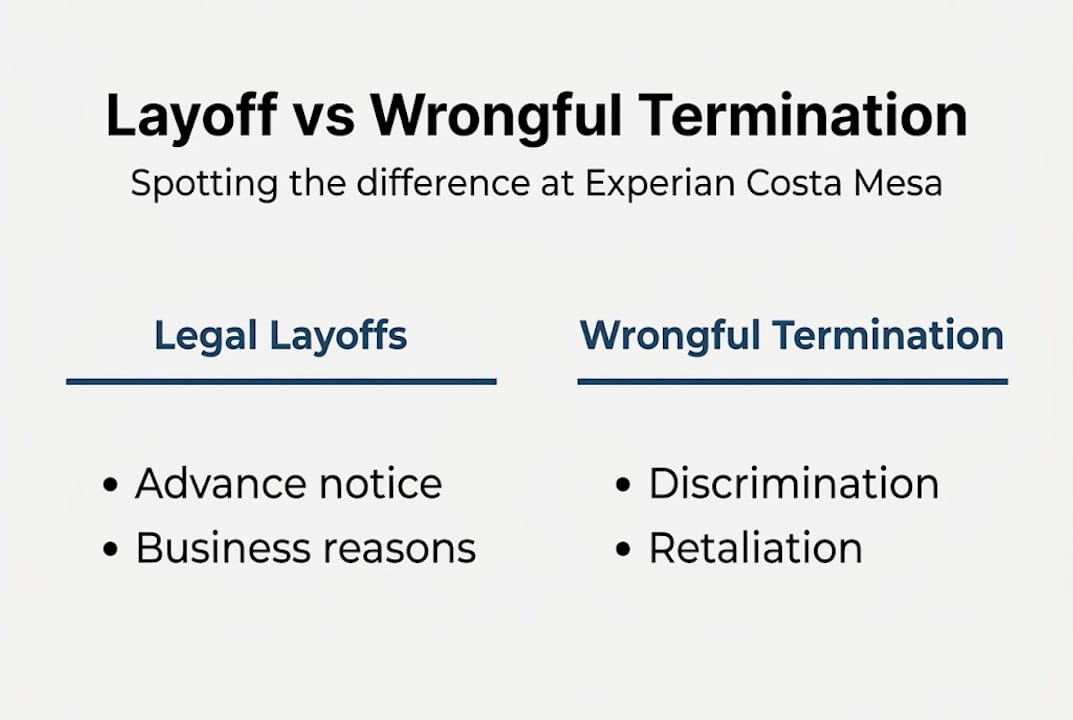
A layoff and a wrongful termination are not the same thing, even when they look identical from the outside. A lawful layoff happens when a company eliminates positions for genuine business reasons, like budget cuts or restructuring. Wrongful termination occurs when an employer fires or lays off someone for an illegal reason, such as discrimination, retaliation, or violation of a specific law. The tricky part is that wrongful termination can hide inside a legitimate-looking layoff round.
Experian made headlines when it filed a WARN notice for 28 permanent layoffs at its Costa Mesa location, effective December 11, 2026. The WARN Act (Worker Adjustment and Retraining Notification Act) requires large employers to give 60 days’ notice before mass layoffs. Experian followed that process publicly, which many employees took as a sign that everything was above board.
But here’s what most people miss: following WARN Act procedures does not automatically mean every individual termination within that layoff was legal. Employers can comply with WARN and still violate anti-discrimination or anti-retaliation laws at the same time. A wrongful termination increase at Experian during this period is a real concern worth examining closely.
Common myths about layoffs and wrongful termination:
- “If the company filed a WARN notice, everything was legal.” False. WARN compliance and discrimination law compliance are separate issues.
- “Layoffs are never wrongful termination.” False. Selection criteria within a layoff can be discriminatory.
- “No lawsuit means no wrongdoing.” False. Most victims never file, even when rights were violated.
- “At-will employment means employers can fire anyone for any reason.” False. California’s at-will rule has major exceptions for protected classes and illegal motives.
| Event | Detail |
|---|---|
| WARN notice filed | Experian Costa Mesa, 2026 |
| Number of layoffs | 28 permanent positions |
| Effective date | December 11, 2026 |
| Known lawsuits filed | None documented as of 2026 |
| Legal risk | Potential discrimination or retaliation within selection |
“Layoffs can mask wrongful termination when selection criteria are discriminatory or retaliatory. Employers sometimes use restructuring as a convenient reason to remove employees they wanted gone for illegal reasons.” This pattern has appeared in high-profile cases involving major tech companies, and it’s something employment attorneys watch for closely.
For a broader look at how this compares to other tech company situations, the layoff rights comparison at Blizzard in Irvine offers useful context.
How to spot wrongful termination during Experian layoffs
Knowing the definition of wrongful termination is one thing. Recognizing it in your own situation is harder, especially when corporate language is designed to sound neutral and final. Here are the red flags that employment attorneys look for first.
Protected classes and activities most at risk during layoffs:
- Employees over 40 (age discrimination)
- Employees who recently filed an HR complaint or reported harassment
- Workers who took FMLA or pregnancy leave
- Whistleblowers who reported legal or safety violations
- Employees who filed workers’ compensation claims
- Anyone who complained about wage theft or unpaid overtime
If you fall into any of these categories and were selected for the Experian layoff, that timing matters. Courts and investigators look at patterns. If most of the people laid off share a protected characteristic, or if the employees who complained about something were disproportionately chosen, that’s a serious red flag.
For legal rights in mass layoffs, employees should check for discriminatory selection, retaliation, or WARN violations, document everything, and review severance before signing. Documentation is your most powerful tool right now.
What to gather and preserve immediately:
- Your layoff notice and any written communications from HR
- Performance reviews from the past two years
- Emails referencing your complaints, leave requests, or protected activities
- Any notes from conversations with managers about your role
- Records of who else was laid off and who was retained
Also check whether Experian met all WARN Act requirements specific to your situation. If you didn’t receive proper notice, that alone may be a violation.
Pro Tip: Before signing any severance agreement, have an attorney review it. Many severance packages include broad waivers that give up your right to sue. Once you sign, it’s very hard to undo. If you reported anything to HR and were then laid off, HR report retaliation is a real legal theory worth exploring.
Your rights and protections under California law
California offers some of the strongest employee protections in the country. Understanding which laws apply to your situation gives you a real advantage.
Key laws protecting you:
- California Fair Employment and Housing Act (FEHA): Prohibits discrimination based on race, gender, age, disability, pregnancy, religion, and more.
- California Labor Code: Protects workers from retaliation for reporting violations or taking protected leave.
- Federal WARN Act: Requires 60 days’ notice for qualifying mass layoffs.
- Age Discrimination in Employment Act (ADEA): Federal protection for workers 40 and older.
- Family and Medical Leave Act (FMLA): Protects employees who take qualifying medical or family leave.
| WARN Act requirement | What Experian reported |
|---|---|
| 60-day advance notice required | WARN notice filed for Dec. 11, 2026 layoffs |
| Must cover 50+ employees or 33% of workforce | 28 employees affected (threshold applicability varies) |
| Written notice to employees and state | Public notice filed |
| Penalties for violations | Back pay and benefits for each day of violation |
No documented cases of wrongful termination lawsuits specifically at Experian Costa Mesa were found in court records as of 2026. That doesn’t mean rights weren’t violated. It means most employees didn’t pursue claims.
Steps to take if you suspect a violation:
- Write down everything you remember about your termination while it’s fresh.
- Collect all documents related to your employment and layoff.
- Contact an employment attorney for a case review.
- File a complaint with the California Civil Rights Department (CRD) if discrimination is involved.
- File with the Equal Employment Opportunity Commission (EEOC) for federal claims.
- Meet all deadlines. In California, you typically have one to three years depending on the claim type.
If your situation involves a hostile or toxic work environment before the layoff, toxic workplace claims may also apply. Local Costa Mesa legal help is available for employees navigating these exact situations.

What to expect when seeking legal help for wrongful termination
Most people have never hired an employment attorney before, and the process feels intimidating. It doesn’t have to be. Here’s what actually happens when you reach out.
The typical process:
- Initial consultation: You describe your situation. Most employment attorneys offer this for free. They ask about your role, the layoff, and any red flags you noticed.
- Case review: The attorney evaluates your documents, timeline, and potential legal theories.
- Investigation: If they take your case, they gather evidence, request records, and interview witnesses if needed.
- Demand or negotiation: Many cases resolve through a demand letter or settlement negotiation before any lawsuit is filed.
- Litigation: If settlement fails, the case may proceed to court or arbitration.
What to bring to your first meeting:
- Layoff notice and severance agreement
- Performance reviews and employment contract
- Any written complaints you made to HR
- Communications about your protected activities or leave
- Notes about who was laid off versus retained
One source notes a reported rise in wrongful termination concerns at Experian Costa Mesa in 2026, though independent verification of specific numbers remains limited. What matters is your individual situation and whether the facts support a claim.
Pro Tip: Act quickly. California’s statute of limitations for wrongful termination claims can be as short as one year for some claims. Waiting too long can eliminate your options entirely, even if your case is strong.
An attorney can help you recover lost wages, emotional distress damages, attorney fees, and in some cases reinstatement. If your termination connects to a workers’ comp claim, workers’ comp wrongful termination protections may apply. If medical leave was involved, medical leave employee rights add another layer of protection.
A hard truth: Most wrongful termination claims are never filed
Here’s something the legal industry rarely says out loud: the vast majority of employees who experience wrongful termination never do anything about it. Not because their cases are weak. Because they convince themselves the layoff was legitimate, or they’re afraid of being seen as difficult, or they simply don’t know their rights existed.
Corporate language is powerful. When HR hands you a polished packet and calls it a “workforce reduction,” it feels final and official. It’s designed to feel that way. But official-looking paperwork does not erase illegal conduct.
We’ve seen employees who waited too long, signed away their rights, and later learned they had a strong case. That’s genuinely painful. The employees who fare best are the ones who trust their instincts, document everything early, and get a legal opinion before signing anything.
Advocating for yourself after a layoff isn’t about being combative. It’s about understanding that the law exists precisely for these moments. Retaliation claims in layoffs are more common than most people realize, and they’re worth exploring with a professional before you assume nothing can be done.
Your instincts about your own termination matter. If something felt off, it’s worth a conversation.
Connect with experienced employment law attorneys near Costa Mesa
If you were laid off from Experian’s Costa Mesa office and something about it didn’t feel right, you don’t have to figure this out alone. At Serendib Law Firm, our attorneys understand the specific dynamics of tech company layoffs in Orange County and how California law applies to situations exactly like yours. We offer free initial consultations, and we handle many employment cases on contingency, meaning you pay nothing unless we recover for you. Whether you need help reviewing a severance agreement or want to explore a full wrongful termination claim, our team is ready. Reach out to our Costa Mesa employment law team, connect with our Lake Forest employment attorneys, or visit our employment law resources to learn more.
Frequently asked questions
What qualifies as wrongful termination during a layoff at Experian?
Wrongful termination happens if you’re let go due to discrimination, retaliation, or in violation of WARN Act rules rather than genuine business reasons. Layoffs can mask wrongful termination when selection criteria discriminate or retaliate against protected employees.
How do I know if I was targeted unfairly in the Experian Costa Mesa layoffs?
Look for patterns like protected class targeting, retaliation after complaints, or no clear business reason for your selection. Employees should check for discriminatory selection or retaliation as a first step.
What should I do before signing an Experian severance agreement?
Document all related events, review the agreement carefully, and consult an employment attorney to fully understand what rights you may be waiving before you sign anything.
Are there any known wrongful termination lawsuits against Experian in Costa Mesa?
No documented wrongful termination lawsuits against Experian’s Costa Mesa offices have been found in court records as of 2026, but the absence of lawsuits does not mean violations didn’t occur.
Is there a deadline for filing a wrongful termination claim after being laid off?
Yes, California’s statute of limitations for wrongful termination claims can range from one to three years depending on the legal theory, so contacting an attorney promptly is critical.
Recommended
- Wrongful Termination at Experian Costa Mesa: 10% Rise 2026 | Serendib Law Firm
- Wrongful Termination After HR Reports in Orange County | Serendib Law Firm
- Wrongful Termination After Workers’ Comp Claims: Huntington Beach Impact | Serendib Law Firm
- Executive Wrongful Termination In Villa Park: Rights & Options | Serendib Law Firm