

TL;DR:
- Remote work rights in California depend on company policies, individual team directives, and legal protections.
- Disputes often stem from policy changes, accommodation requests, or privacy concerns, requiring documentation.
- California law safeguards employee rights, including anti-discrimination protections and reasonable accommodations for disabilities.
Many tech employees at Google and Apple’s Southern California offices assume that a company-wide email settles the question of where they work. It does not. Remote work rights in California are shaped by a layered mix of company policy, individual team directives, disability accommodation law, and state anti-discrimination protections. What applies to a colleague in Mountain View may not apply to you in an Apple or Google office in Orange County, and the difference can mean the gap between keeping your job and losing it. This guide walks you through the real mandates, how disputes unfold, and exactly what you can do to protect yourself.
Table of Contents
- Google and Apple’s return-to-office mandates: What’s actually required?
- How remote work disputes arise: Common triggers and legal complexities
- Key rights and protections for Orange County tech employees
- Options and next steps if you’re facing a remote work policy dispute
- A candid perspective: What most Orange County tech employees overlook in remote work disputes
- Need guidance with a remote work dispute in Orange County?
- frequently asked questions
Key Takeaways
| Point | Details |
|---|---|
| Policy varies by team | At Google, return-to-office requirements often depend on your specific team, not just companywide rules. |
| Document everything | Keeping thorough records of requests and policy changes helps protect your legal rights during any dispute. |
| California law protects accommodations | You may have special protections if you need remote work for medical or mental health reasons. |
| Seek help early | Early consultation with an employment law expert can greatly improve your outcome if facing a mandate dispute. |
Google and Apple’s return-to-office mandates: What’s actually required?
With the stakes established, let’s clarify what employees in Google and Apple’s Southern California offices are actually facing from these policies.
Not all return-to-office (RTO) mandates are created equal, and the details matter enormously. Google units told remote employees they must come to the nearest office three days per week or risk job loss, according to internal documents cited by reporters in 2025. That is not a soft suggestion. For employees in Orange County, that means the nearest Google office location determines your commute burden, not your preference.
Apple’s approach is slightly different in structure but equally firm. Apple required most employees to return at least three days a week, a mandate that sparked documented employee backlash and a formal petition. The companywide framing sounds uniform, but enforcement and exceptions vary by role and team.
Here is a quick comparison of what each company currently requires:
| Company | Days required in office | Policy scope | Non-compliance consequences | Notable exceptions documented? |
|---|---|---|---|---|
| 3 days/week (select units) | Team-based, not companywide | Risk of job loss or forced exit | Limited; team-level discretion | |
| Apple | 3 days/week minimum | Company-wide hybrid mandate | Performance impact, escalation | Role-based, not broadly publicized |
A few common misconceptions are worth clearing up right now:
- “The company policy email applies to everyone equally.” False. Google’s RTO enforcement is team-based, meaning your manager’s interpretation carries real weight.
- “If I have a documented health condition, I’m automatically exempt.” Not automatically. You must formally request an accommodation and follow the correct process.
- “Remote work privacy rights don’t change when I’m called back.” They do. Understanding your remote work privacy rights is essential before you return to any hybrid arrangement.
Most large tech offices in the greater Orange County and Los Angeles area now operate under some form of hybrid schedule, making this the norm rather than the exception for 2026.
Pro tip: Always check your specific team or unit policy, not just the company-wide email. The two can differ significantly, and the team-level directive is often what HR will reference if a dispute arises.
How remote work disputes arise: Common triggers and legal complexities
Once you understand what’s required, it’s critical to see how these rules become personal legal disputes.
Most remote work disputes don’t start with a dramatic confrontation. They start with a policy change, a denied request, or a vague email that suddenly carries consequences. Understanding the triggers helps you recognize a dispute before it escalates.
| Source of dispute | What it looks like | Legal area triggered |
|---|---|---|
| Policy change without notice | New RTO directive with short timeline | Contract, implied agreement |
| Health accommodation denial | Doctor’s note ignored or delayed | ADA, California disability law |
| Performance action tied to RTO refusal | Poor review after declining to return | Anti-discrimination, retaliation |
| Privacy concerns during remote work | New monitoring software installed | Privacy rights, labor law |
Here is how a typical dispute unfolds, step by step:
- Company issues a new RTO directive, often by email.
- Employee raises a concern, either informally or through HR.
- HR responds with a general policy statement, not an individualized answer.
- Employee requests a formal accommodation (medical, disability, or otherwise).
- Request is delayed, denied, or ignored.
- Employee faces a formal consequence: a performance improvement plan, demotion, or termination.
- Legal action becomes the only remaining option.
One real-world example illustrates how serious this can get. A former Google employee filed a job bias suit over remote work accommodation requests tied to a diagnosis of post-traumatic stress disorder. The case highlights that when a company fails to engage in a genuine accommodation process, it opens itself to significant legal liability.
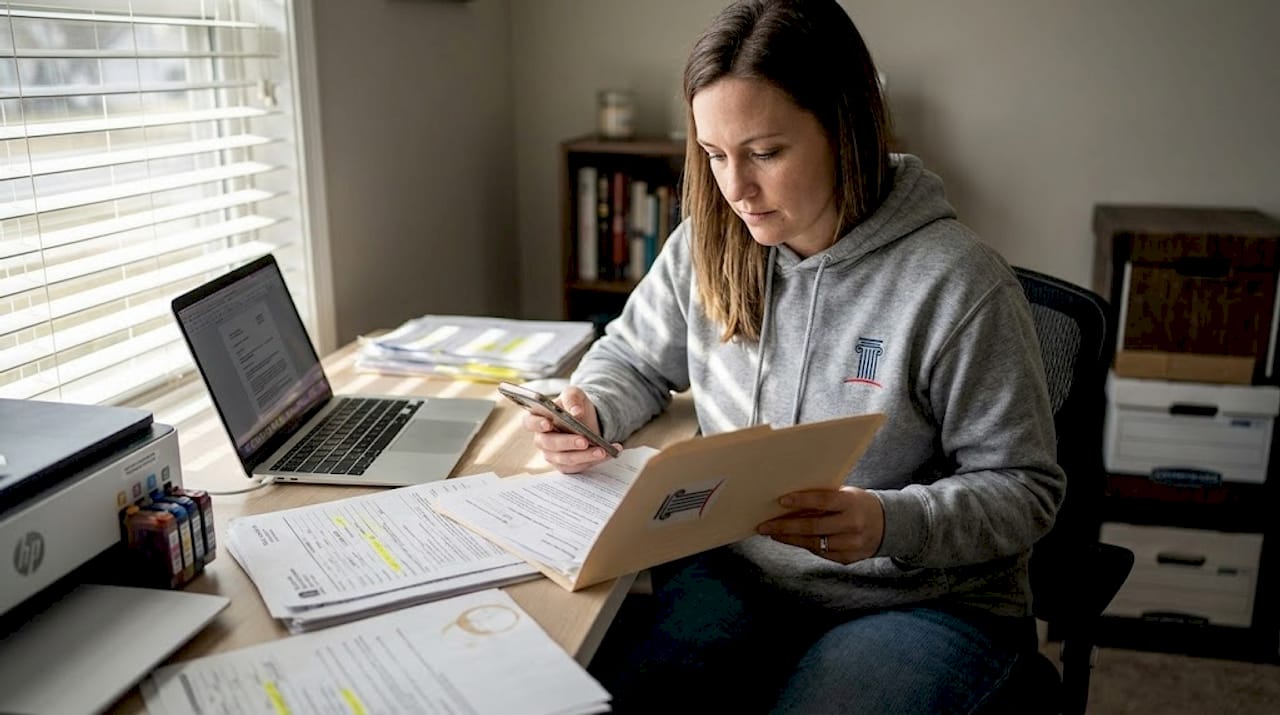
This is exactly where disability discrimination in remote work claims tend to emerge. The law requires employers to engage in what California calls an “interactive process,” meaning a real, documented conversation about your needs and possible solutions. A form letter does not satisfy that standard.
Pro tip: Keep detailed documentation from the first sign of conflict. Save every email, every mandate, every doctor’s note, and every HR response. Your ability to document workplace interactions thoroughly is often the single biggest factor in whether your case succeeds.
Key rights and protections for Orange County tech employees
Understanding dispute triggers is just the start. Here’s how to ensure you’re protected under California employment law.
California offers some of the strongest employee protections in the country, and they apply directly to remote work disputes. If you work at a Google or Apple office in the greater Orange County area, these rights are yours regardless of what the company’s internal policy says.
Anti-discrimination protections. California’s Fair Employment and Housing Act (now enforced through the Civil Rights Department) prohibits employers from discriminating based on disability, medical condition, or other protected characteristics. If a return-to-office mandate disproportionately burdens employees with disabilities, that is a potential legal violation.
Right to reasonable accommodation. You have the right to request a reasonable accommodation for any qualifying disability, including mental health conditions. Remote-work disputes frequently intersect with accommodation and anti-discrimination issues in California, making early documentation critical. Your employer must consider your request seriously, not just rubber-stamp a denial.
Mental health is covered. Many employees don’t realize that mental health accommodations are just as legally protected as physical ones. If anxiety, depression, or post-traumatic stress disorder affects your ability to work in an office environment, you have grounds to request remote work as an accommodation.
Protected leave rights. California Family Rights Act (CFR) and other state leave laws provide additional protection if your health condition requires time away from work during a dispute.
Union and collective advocacy. California unions are actively pushing for broader work-from-home protections through legislation, even as Governor newsom calls state employees back to offices. For private tech workers, collective action through petitions and organized advocacy can supplement individual legal rights.
If you believe your rights are being violated, here’s what to do:
- Put every accommodation request in writing, even if you first raised it verbally.
- Request a written response from HR to any denial.
- Keep copies of all communications outside company systems if possible.
- Note dates, names, and specific statements made by managers or HR.
- Know your whistleblower rights in tech if you’re facing retaliation for raising concerns.
Pro tip: If you have a health condition and receive a formal return-to-office directive, consult an employment attorney before you respond. What you say, and how you say it, can affect your legal options significantly.
Options and next steps if you’re facing a remote work policy dispute
Once you know your rights, smart action is your best defense. Here’s what to do if you’re now facing a dispute.
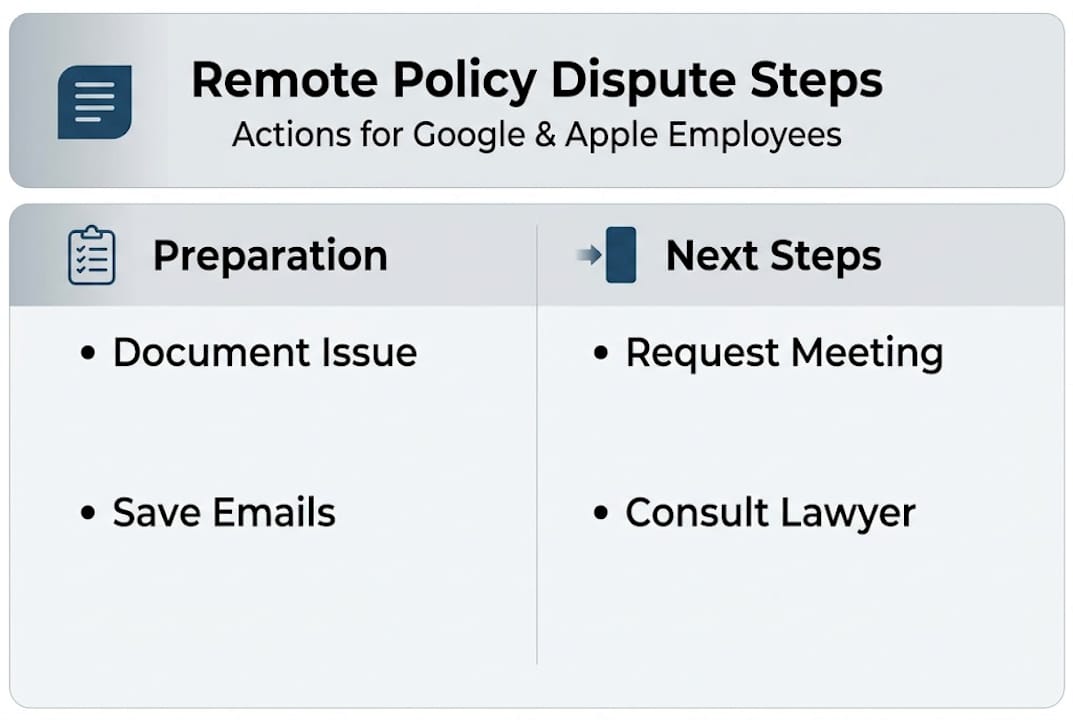
The most important thing to understand is this: accommodation and managerial decisions at the individual level drive most disputes, not a single universal company rule. That means your personal response matters more than you might think.
Here is a step-by-step approach:
- Review your employment contract and any written remote work agreements. These documents may create enforceable expectations.
- Request the specific policy in writing. Ask HR for the exact policy that applies to your team and role.
- Submit a formal accommodation request if you have a health concern. Use your employer’s official process and keep copies.
- Follow up in writing if your request is ignored or denied. A paper trail is your strongest asset.
- Contact an employment attorney for a confidential consultation. This step costs you nothing at most firms and can clarify your options quickly.
- Consider collective action. If colleagues share your concern, a coordinated petition or complaint carries more weight.
Understanding potential misclassification of remote workers is also worth exploring if your employment status changed alongside a policy shift.
Warning signs you need to act fast:
- You received a written warning tied to your refusal or inability to return.
- Your accommodation request has gone unanswered for more than two weeks.
- Your manager made verbal comments about your remote work preference that felt threatening.
- A sudden policy change came with an unusually short compliance deadline.
- You were placed on a performance improvement plan shortly after raising a concern.
A candid perspective: What most Orange County tech employees overlook in remote work disputes
All the practical advice aside, here’s the uncomfortable truth most Google and Apple employees miss when facing a remote work dispute.
Most people wait too long. They assume HR will be fair, that the company will honor informal agreements, or that their manager’s verbal assurances will hold up. They don’t. By the time an attorney gets involved, the most valuable evidence, the early emails, the verbal promises, the first denied requests, has often been lost or was never preserved.
The disputes that are won are almost never won because of the headline policy. They are won because one employee kept a careful, dated record of every interaction from the moment something felt wrong. That’s it. The law provides the framework, but your documentation provides the proof.
There’s another layer most employees miss entirely: remote work surveillance insights and retaliation risks. If you raise a concern and suddenly face increased monitoring, it’s worth noting that as part of your record too.
Change in this space, whether through internal policy reform or broader legislation, happens when individual action combines with peer support. Your situation is not isolated, and acting early protects not just your job but your colleagues’ options as well.
Pro tip: Start your documentation and internal inquiry at the first sign of tension, not after HR initiates formal action against you.
Need guidance with a remote work dispute in Orange County?
If you want legal guidance tailored to your situation, these resources can help you move forward with confidence.
At employment law services at the firm, we work with tech employees across Southern California, including those navigating RTO mandates at major companies in the Orange County area. We understand the local landscape, the specific employment law trends in Orange County, and what it takes to protect your rights when a large employer pushes back. Our experienced Orange County employment lawyers offer free consultations, so you can get a clear picture of your options before making any decisions. Don’t wait until a formal action is filed against you. Contact us today.
frequently asked questions
Can Google or Apple fire me if I refuse to return to the office in Orange County?
They may impose consequences for non-compliance, but your legal options depend on whether you have a disability, an accommodation request, or a contractual right to remote work. Some Google units warned employees of job loss, and Apple’s mandate has faced documented pushback, but individual circumstances determine your actual exposure.
Do I have special rights if I request remote work for mental health reasons?
Yes. California law protects employees who need reasonable accommodation for mental health conditions, and remote work disputes frequently intersect with accommodation rights. Always document your requests and your employer’s responses in writing.
What should I do first if I’m facing a remote work policy dispute?
Document everything immediately and submit any accommodation request in writing. Then consult an employment attorney to understand your specific options before responding formally to your employer.
Are there broader efforts to change remote work laws in California?
Yes. California union advocacy is pushing for a statewide work-from-home bill, though private tech firms currently operate under their own policies with limited state-mandated remote work protections.
Recommended
- Remote Work Surveillance Vs. Employee Privacy: Tesla’s Lessons | Serendib Law Firm
- Remote Work Disputes and Employee Privacy in Costa Mesa | Serendib Law Firm
- Understanding Disability Discrimination in Tech and Remote Work | Serendib Law Firm
- Know Your Rights: Blizzard Layoffs And Irvine Tech Protections | Serendib Law Firm
- Side Hustles & Second Jobs: UK Employment Law Guide 2026