

TL;DR:
- Nearly 75% of LA service workers miss overtime pay due to illegal off-the-clock work practices.
- Off-the-clock work includes tasks performed before or after shifts without pay, costing workers time and money.
- California law strongly protects employees, allowing recovery of unpaid wages and penalizing violations.
Nearly 75% of employees in the Los Angeles region, which includes Garden Grove, miss out on overtime pay because of illegal off-the-clock work practices. If you work in a restaurant, hotel, retail store, or any other service job in Garden Grove, chances are you’ve clocked out while still doing real work. Setting up a prep station, waiting for a manager to finalize your timesheet, answering texts about your schedule, cleaning up after your official shift ends. It all counts. And losing pay for it isn’t just unfair. Under California law, it’s illegal. This guide walks you through your rights, the real costs, and the steps you can take right now.
Table of Contents
- What is off-the-clock work in Garden Grove service jobs?
- How off-the-clock work impacts Garden Grove employees
- Your legal rights: California laws on off-the-clock work
- What to do if you suspect off-the-clock wage violations
- Why many service workers give up—what most guides miss
- Get expert help for off-the-clock wage claims
- Frequently asked questions
Key Takeaways
| Point | Details |
|---|---|
| Wage theft is common | Nearly three-quarters of local service employees lose pay to off-the-clock work each month. |
| You have strong protections | California law bans off-the-clock work and guarantees you the right to claim back wages. |
| Evidence matters | Document all unpaid work and keep records to strengthen your claim. |
| Take action | Reporting and seeking legal help can stop violations and recover your earnings. |
What is off-the-clock work in Garden Grove service jobs?
Off-the-clock work means any task your employer requires you to perform without paying you for the time spent doing it. It sounds straightforward, but in practice, it shows up in dozens of subtle and not-so-subtle ways across Garden Grove’s busy service sector.
Nearly 75% of LA area employees miss overtime pay because employers either formally or informally expect work before the clock starts or after it stops. In California, this is a wage violation regardless of whether it was intentional or written into any policy.
Common examples of off-the-clock work in Garden Grove service jobs include:
- Arriving early to set up equipment, prep food stations, or receive deliveries before being allowed to clock in
- Staying after your shift to clean, restock, or finish closing procedures after already punching out
- Attending mandatory meetings or trainings that are scheduled but not logged in the system
- Responding to manager messages, texts, or calls outside your paid hours
- Waiting in line to pass security checks or change into required uniforms before being allowed on the clock
The problem runs deeper than most workers realize. A server who spends 15 minutes setting up tables before clocking in might not think much of it in the moment. But over a five-day workweek, that’s over an hour of unpaid labor. Over a year, it could mean dozens of hours simply handed away to the employer for free.
Understanding your rights around California break laws is essential here, because the same rules that govern meal and rest breaks also tie closely into how paid time must be tracked and protected.
“Employers sometimes frame off-the-clock tasks as part of ‘team culture’ or ‘going the extra mile.’ In California, that framing doesn’t matter. If the work benefits the employer and you’re required to do it, you must be paid.”
Pro Tip: Even if your manager says “it’ll only take a minute,” verbal instructions to work without pay are still wage theft. Your legal rights don’t hinge on how the request was worded.
How off-the-clock work impacts Garden Grove employees
Understanding what off-the-clock work is shows why it’s a violation. Next, let’s see just how much it costs employees, both financially and emotionally.
The financial impact hits fast and compounds quickly. Retail workers lose between $30 and $200 per month because of off-the-clock practices, and service industry workers in hotels and restaurants often fare even worse depending on their hours and role.

Estimated monthly wage loss by service role
| Job Type | Estimated Monthly Loss | Yearly Impact |
|---|---|---|
| Restaurant server | $40 to $120 | $480 to $1,440 |
| Hotel housekeeper | $50 to $150 | $600 to $1,800 |
| Retail associate | $30 to $200 | $360 to $2,400 |
| Fast food crew | $25 to $80 | $300 to $960 |
| Hotel front desk | $40 to $130 | $480 to $1,560 |
These aren’t hypothetical numbers. When you factor in California’s minimum wage requirements and overtime rules, even 30 minutes of daily unpaid work can trigger overtime violations that result in substantial back pay owed to you.
What makes off-the-clock violations particularly damaging is the overtime claim surge many Garden Grove workers face when unpaid minutes push their actual hours worked past the 8-hour daily threshold or 40-hour weekly threshold for overtime. Under California law, overtime is calculated daily, not just weekly. So even one day where you work 8.5 hours but only get paid for 8 hours represents a missed overtime premium.
The emotional cost is just as real:
- Constant fatigue from working more than you’re compensated for
- Resentment toward employers who undervalue your time
- Financial stress from making less than you should
- Feeling powerless or unsure whether you can report the problem
Many service workers in Garden Grove carry this stress silently because reporting the problem feels risky or complicated. But the law is designed specifically to protect you in these situations, and understanding the numbers should motivate you to act.
Your legal rights: California laws on off-the-clock work
Knowing the stakes, it’s time to look at exactly what protections California law offers and how Garden Grove service employees can use them.
California has some of the strongest wage and hour protections in the country. The state’s Industrial Welfare Commission (IWC) Wage Orders, combined with the California Labor Code, create a framework that explicitly prohibits employers from requiring or even permitting off-the-clock work. The word “permitting” is important. An employer doesn’t have to formally order you to work off the clock for it to be a violation. If they knew you were doing it and let it happen, they’re liable.
Service employees frequently lose pay because they don’t know these rules exist or apply to them. Here’s a quick comparison between federal minimums and California’s actual requirements:
Federal vs. California off-the-clock protections
| Area | Federal Law (FLSA) | California Law |
|---|---|---|
| Overtime threshold | Over 40 hours/week | Over 8 hours/day OR 40 hours/week |
| Employer responsibility | Must pay for “suffered or permitted” work | Same, but with stronger enforcement tools |
| Penalty for violations | Back wages plus equal damages | Back wages, penalties, attorney fees, interest |
| Statute of limitations | 2 to 3 years | Up to 3 years for state claims |
| Rest break pay | Not required | Paid 10-minute breaks every 4 hours |
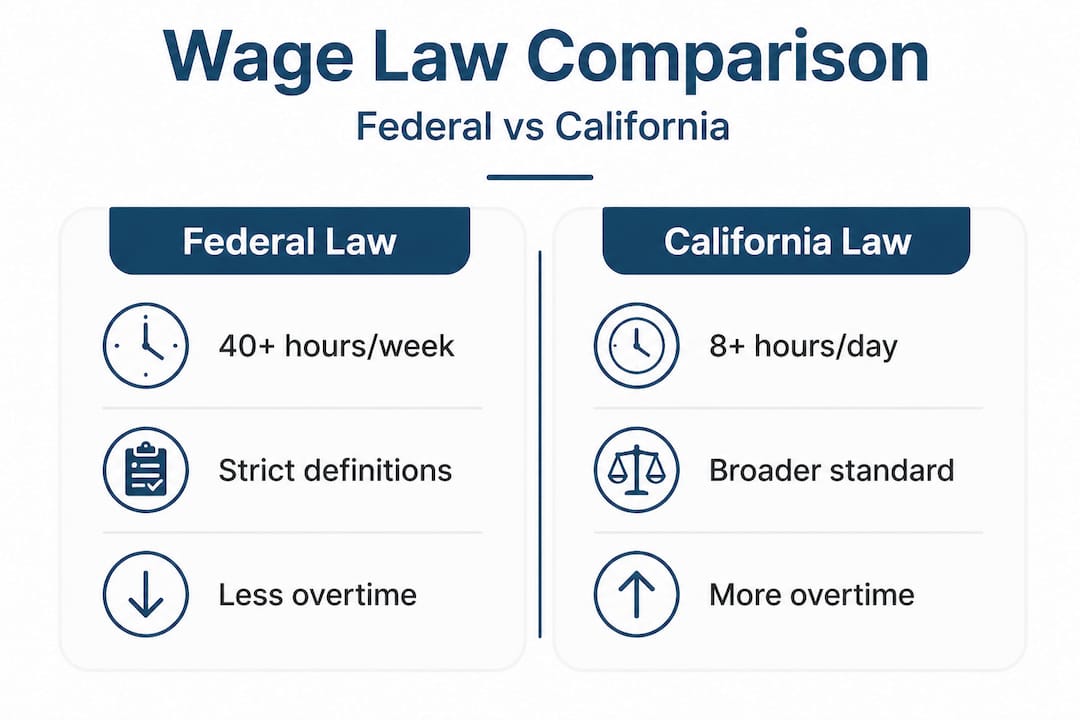
California’s rules beat federal minimums in almost every category. This means meal and rest break regulations also factor into your total unpaid time calculation. A missed 30-minute meal break is not just bad for your day. It’s an additional penalty of one hour of premium pay that your employer owes you.
What California employers are legally required to do:
- Track all time worked, including any time before or after scheduled shifts
- Pay for every minute of work that benefits the employer
- Prohibit off-the-clock work in writing and enforce that prohibition
- Maintain accurate payroll records for at least three years
- Provide compliant meal and rest breaks without exception
If you work in Garden Grove and your employer isn’t following these rules, Garden Grove legal support is available to help you evaluate your situation and take the right steps.
Pro Tip: California’s “suffered or permitted” standard means if your manager texts you after your shift asking work-related questions and you respond, that’s compensable time. Save those texts. They’re evidence.
What to do if you suspect off-the-clock wage violations
The law is on your side, but action is necessary to get the pay you’re owed. Here’s what to do if you suspect you’ve been working off the clock.
The biggest mistake workers make is waiting too long or assuming there’s nothing they can do. The good news is you don’t need a perfect paper trail to start. You just need to begin building one now.
Step-by-step actions to take:
- Start recording your actual hours. Use your phone to note the real time you start and stop working each day. Include any pre-shift and post-shift tasks you perform.
- Save all communications. Work-related texts, emails, and messages from managers that arrived outside your scheduled hours are valuable evidence of off-the-clock requests.
- Document your paystubs. Compare what you were paid to what your own records show you worked. Look for discrepancies in daily totals and overtime.
- Note witnesses. Colleagues who can confirm they also performed unpaid tasks may be useful if you pursue a claim.
- Report internally if safe. Use your employer’s HR process or complaint channel if you feel comfortable. Document that you made the report in writing.
- Consult an employment attorney. Before filing anything with a state agency, a quick legal consultation helps you understand your strongest options and protect yourself from mistakes.
California’s whistleblower protections mean your employer cannot legally fire you or cut your hours because you reported a wage violation. And workplace retaliation advice is available specifically for situations where workers face pushback after speaking up.
Common pitfalls to avoid:
- Don’t rely on memory alone. Start recording your hours immediately.
- Don’t sign any document your employer presents that waives your right to past wages
- Don’t assume a verbal promise to “fix it” is enough. Get everything in writing.
- Don’t wait out the clock. California’s statute of limitations is three years for many wage claims, but the sooner you act, the stronger your case.
Retail workers lose between $30 and $200 monthly to these violations. Over three years, that could mean thousands of dollars owed to you. The statute of limitations makes timing critical.
Pro Tip: Take a photo of the clock or your phone each day when you actually start and stop working, even if you haven’t clocked in yet. These time-stamped photos can serve as independent evidence that’s hard to dispute.
Why many service workers give up—what most guides miss
Even with clear steps and legal protections in place, most workers hesitate. Let’s be direct about why, and why it’s still worth pushing through.
The legal community often focuses on the mechanics of a wage claim. Document this, file that, report here. What most guides skip is the very human reason most workers never make it to step one. Fear. Fear of losing the job, being labeled a troublemaker, being cut from shifts, or facing icy silence from coworkers who don’t want to get involved.
Nearly 75% of service employees miss out on pay because reporting feels too risky or too futile. That statistic isn’t just about ignorance. It’s about workplace dynamics that discourage speaking up.
Here’s something that often gets glossed over: many employers rely on this silence. They know most workers won’t report. That’s the business model. When you work off the clock without complaint, you’re essentially subsidizing a company that’s already making a profit from your labor.
Building even a simple paper trail matters more than most workers think. You don’t need to file anything or confront anyone to start. Just documenting your real hours privately, for your own records, costs you nothing and puts you in a position of strength if you decide to act later. That small step changes the power dynamic.
Reviewing recent claim increases in the region shows something encouraging: when individual employees do speak up, it often triggers audits and enforcement that benefit dozens or even hundreds of coworkers who were too afraid to act themselves. You might feel like your single claim is small. In practice, one well-documented case can force an employer to fix illegal practices across an entire workforce.
The uncomfortable truth is that staying silent costs you money and changes nothing. Speaking up, even quietly through a legal consultation, has the potential to recover real wages and create better conditions for everyone working the same job behind you.
Get expert help for off-the-clock wage claims
If you’ve identified signs of off-the-clock violations at your Garden Grove workplace, the next move is getting professional guidance. California wage law is detailed, and the difference between a strong claim and a missed opportunity often comes down to how evidence is gathered and presented in the early stages.
Our employment law team works directly with service industry workers across Orange County, providing clear advice on unpaid wages, overtime violations, and retaliation concerns. Whether you’re in Garden Grove or a nearby city, Lake Forest employment law help and Huntington Beach employment lawyers are also available through our network of local legal support. We offer free consultations and handle select wage cases on contingency, meaning you pay nothing unless we recover wages for you. Don’t leave money on the table. Contact us today to learn what your claim could be worth.
Frequently asked questions
How common are off-the-clock wage violations in Garden Grove?
Nearly 75% of service employees in the LA region, which includes Garden Grove, miss overtime pay because of illegal off-the-clock work practices, making this one of the most widespread wage violations in California’s service sector.
What counts as off-the-clock work under California law?
Any time your employer requires or permits you to perform work before or after your scheduled shift, during meal breaks, or outside paid hours without compensation counts as off-the-clock work and must legally be paid under California’s Wage Orders and Labor Code.
How much money could I lose from off-the-clock work?
Retail and service workers lose between $30 and $200 per month due to off-the-clock violations, which can add up to $2,400 or more in a single year depending on your role and hours.
Can my employer retaliate if I file an off-the-clock wage claim?
California law explicitly prohibits retaliation for reporting wage violations or filing a wage claim, and any adverse action taken against you after reporting may itself be an additional legal violation your employer can be held accountable for.
Should I talk to a lawyer about my off-the-clock work issue?
Consulting an employment attorney is the smartest early step because an experienced lawyer can assess your records, explain your strongest legal options, and help you avoid costly procedural mistakes before you file any claim.
Recommended
- Experienced Garden Grove Workplace Harassment Lawyers
- Experienced Garden Grove Workplace Discrimination Lawyers
- Experienced Garden Grove Employment Law Attorneys
- Garden Grove Overtime Violations: 25% Surge in Claims | Serendib Law Firm
- Beverly Grove Retail Wrongful Termination: Your Rights Explained – Law Office of Brian Y. Shirazi, PC