
TL;DR:
- Many Fountain Valley workers overlook their protections under California law when shifts are canceled or cut short, often due to lack of awareness. Reporting time pay requires employers to compensate employees for at least half of their scheduled hours when sent home early, with a minimum of two hours’ pay. Proper documentation and prompt legal action through the DLSE can ensure workers recover owed wages and protect their rights.
Many Fountain Valley workers walk away from cancelled or cut-short shifts assuming there is nothing they can do. You showed up, your employer sent you home, and that time feels like a loss you just have to absorb. But California has built real protections into its wage laws that many employees never use, simply because they don’t know the rules exist. This guide cuts through the confusion, explains exactly what you’re owed under state law, and gives you a practical roadmap to protect your paycheck when your schedule gets disrupted.
Table of Contents
- Understanding reporting time pay in Fountain Valley
- Split-shift, fair workweek, and local scheduling laws
- How to respond to shift cancellations and wage violations
- Common mistakes and how to avoid them
- Why most employees overlook their strongest reporting time pay rights
- Take action: Legal support for Fountain Valley workplace pay disputes
- Frequently asked questions
Key Takeaways
| Point | Details |
|---|---|
| Know your pay rights | Reporting time pay and related premiums protect Fountain Valley workers when shifts are cut or canceled. |
| Document everything | Keep records of your scheduled and actual hours, plus all communication with your employer about changes. |
| Use the right process | Filing a wage claim with the California Labor Commissioner is the key route for recovery if informal resolution fails. |
| Distinguish pay types | Understand differences between reporting time pay, split-shift, and fair workweek premiums to strengthen your claim. |
| Legal help matters | Expert employment law support boosts your chances in tough cases and prevents common mistakes. |
Understanding reporting time pay in Fountain Valley
Reporting time pay is one of the most underused protections in California employment law. The rule is straightforward: if you show up to work as scheduled but your employer provides you with less than half of your scheduled shift hours, you must be paid for at least half those hours. The minimum is two hours of pay, and the maximum is four hours, even if you worked zero minutes. This applies whether your shift was cancelled last minute, you were sent home early, or you showed up for a mandatory meeting that lasted only fifteen minutes.
This protection exists under California’s Industrial Welfare Commission Wage Orders, which cover most industries in the state, including retail, food service, hospitality, logistics, and manufacturing. These are all common employment sectors in and around Fountain Valley and the broader Orange County area.
Who qualifies? Generally, if you’re a non-exempt hourly employee in California, you’re covered. That means if you’re paid hourly and don’t hold a managerial or administrative exemption, reporting time pay almost certainly applies to you. Even some salaried workers who are misclassified as exempt may qualify, which is worth exploring if you’re unsure of your status.
Here are the most common situations where reporting time pay kicks in:
- You’re scheduled for an eight-hour shift and get sent home after two hours due to slow business
- You report for a four-hour shift and are told to leave immediately because the manager overscheduled
- You arrive for a mandatory all-hands meeting that ends in thirty minutes
- Your employer calls you in for a “quick task” that turns into an hour of unpaid waiting
“Reporting time pay is not a penalty against employers for poor planning. It’s a wage protection designed to compensate workers for the real cost of getting to work, arranging childcare, and restructuring their day around a shift that never materialized.”
It’s also important to know the difference between reporting time pay and two related concepts: the split-shift premium and predictive scheduling premiums. Reporting time pay covers showing up to a shift that gets cancelled or cut short. The split-shift premium covers a single workday broken into two or more non-consecutive segments. Predictive scheduling premiums are tied to local ordinances that require advance notice of schedule changes. They are related but legally distinct, and confusing them weakens your claim.
To protect yourself, keep detailed records. Save your original schedule, any texts or emails about changes, and a personal log noting when you arrived, when you were sent home, and what you were told. These records become critical evidence if you file a claim.

Pro Tip: Screenshot your work schedule every week and store it in a dedicated folder on your phone or cloud storage. Schedule screenshots are time-stamped and carry strong evidential weight in wage disputes.
If you believe your employer has violated reporting time pay rules, a solid first step is to speak with Fountain Valley employment lawyers who understand the specific wage order rules that apply to your industry. On the administrative side, the wage-claim workflow through California’s Labor Commissioner (DLSE) involves submitting your claim, attending a settlement conference, and if the matter isn’t resolved there, going before a deputy labor commissioner for a hearing.
Split-shift, fair workweek, and local scheduling laws
Now that you understand standard reporting time pay, let’s see how split-shift rules and fair workweek laws can offer further protections.
The split-shift premium adds another layer of protection. Under California’s split-shift rules, a split shift is a workday schedule that is interrupted by a non-paid, non-working gap set by the employer. Meal and rest periods don’t count. A classic example: you work 8 a.m. to 11 a.m., get unpaid time off until 4 p.m., then work 4 p.m. to 8 p.m. That gap in the middle is the employer’s doing, not yours. The law requires your employer to pay you one additional hour at the applicable minimum wage on top of your regular pay for that day.
The split-shift premium is reduced if your hourly rate is already high enough above minimum wage to offset it, but for most hourly workers in Orange County earning close to the minimum, you’ll see a real dollar impact.
Fair workweek and predictive scheduling ordinances go a step further. These local laws, where enacted, require employers to post schedules in advance (often two weeks), give written notice of any changes, and pay a premium when last-minute changes reduce your hours. California’s largest employers in jurisdictions like Los Angeles County are subject to these requirements, including advance notice and premium pay when schedule changes result in lost work time for employees.
Fountain Valley itself operates primarily under California state law rather than a city-specific fair workweek ordinance. However, if you work for a large chain employer that also operates across LA County or other covered jurisdictions, the corporate policy shaped by those ordinances may still benefit you.
Here’s a quick comparison of the three key protections:
| Protection type | Trigger | What you’re owed |
|---|---|---|
| Reporting time pay | Show up, given less than half your shift | Half of scheduled hours (min 2, max 4) |
| Split-shift premium | Employer-created unpaid gap in workday | One hour at minimum wage, added to daily pay |
| Fair workweek premium | Last-minute schedule change (covered employers) | Varies by ordinance; typically 1-4 hours premium |
Notice that these protections are not mutually exclusive. You can qualify for more than one on the same workday if the facts support it.
Pay close attention to how meal and rest break rules interact with split-shift definitions. A genuine employer-mandated meal break does NOT trigger a split-shift premium. But an unpaid gap that goes well beyond a standard meal break, or an interruption in the middle of a shift that isn’t a meal period, very likely does.
Pro Tip: If your employer texts you a new schedule less than 48 hours before your shift, document that message immediately. Advance notice violations are a key element in any fair workweek claim, and the timestamp on that text is direct evidence. These patterns also support wage-and-hour class actions when the same employer does it to multiple workers.
“Many workers assume that if they weren’t physically at work, they can’t be owed anything. That assumption costs California workers millions in unclaimed wages every year.”
How to respond to shift cancellations and wage violations
Knowing the law is only half the battle. Here’s how to put your knowledge to work when your rights are at risk.
Step 1: Document everything immediately. The moment a shift is cancelled or cut short, write down the date, your scheduled start and end time, the time you actually arrived, what your supervisor said, and when you left. Send yourself an email with this information so there’s a time-stamped record outside your employer’s control.
Step 2: Gather supporting materials. Collect any text messages, emails, scheduling app screenshots, or paper schedules that show your original schedule and any changes. Pay stubs from the affected period are also critical. They show what you were actually paid versus what you should have been paid.
Step 3: Calculate what you’re owed. Use your regular hourly rate and your scheduled hours to figure out the gap. If you were scheduled for eight hours, you may be owed pay for four hours (or at minimum two). If a split-shift premium also applies, add one hour at minimum wage on top.
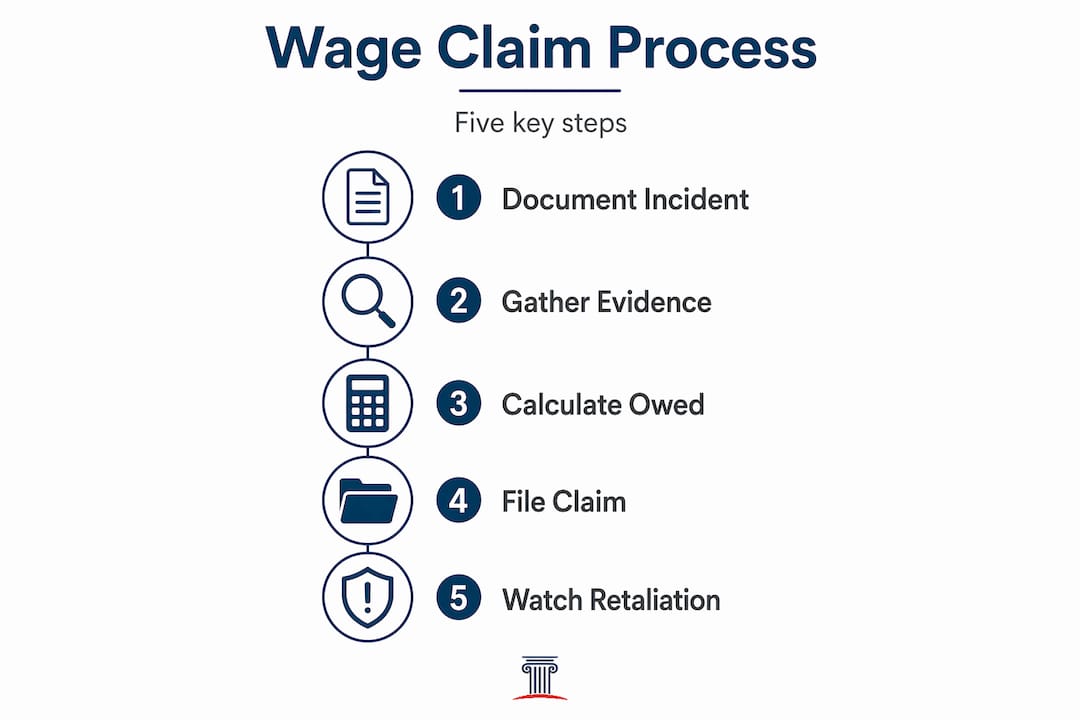
Step 4: File a wage claim with the DLSE. The wage-claim process through the Labor Commissioner is an administrative path that doesn’t require a lawyer to start. You submit your claim, your employer is notified, and both sides attend a settlement conference. If no agreement is reached, a hearing is scheduled before a deputy labor commissioner who can order payment.
Step 5: Watch for retaliation. If your employer starts cutting your hours further, changes your schedule punitively, writes you up for unrelated reasons, or talks to you differently after you raise wage concerns, that may be retaliation. California law protects you from employer retaliation for asserting your wage rights, and a separate retaliation claim can significantly increase the value of your case. Consult workplace retaliation protections to understand what behaviors qualify.
Here’s a reference table for key elements of your claim:
| Element | What to collect | Why it matters |
|---|---|---|
| Original work schedule | App screenshots, printed copies | Proves what you were promised |
| Schedule change notice | Texts, emails, manager notes | Shows when and how changes were made |
| Time records | Timesheets, clock-in/out data | Confirms actual hours worked |
| Pay stubs | All stubs from affected period | Shows the payment gap |
| Witness information | Coworker names and contact info | Corroborates your account |
If you suspect off-the-clock work claims are also part of your situation, such as being told to clock out but continue tasks, document those separately. Combining multiple wage violations into one coordinated claim strengthens your position.
Pro Tip: Before filing anything, organize your evidence into a timeline. A clear, dated sequence of events makes your claim easier to evaluate and harder for an employer to challenge.
Common mistakes and how to avoid them
While taking action, it’s vital you avoid the errors that lead so many claims to falter.
The biggest mistake workers make is treating all scheduling-related pay disputes as the same issue. Reporting time pay, split-shift premiums, and fair workweek premiums are legally distinct pay types. Mislabeling your claim or lumping them together without distinguishing the facts can lead to a weaker case or an unnecessary denial.
Other common errors include:
- Failing to track hours accurately. Many workers rely on memory. Memory is unreliable in a hearing. Your employer’s timekeeping records may not reflect reality, so your independent records matter enormously.
- Missing filing deadlines. Wage claims in California have statutes of limitations (legal deadlines for filing). These vary depending on the type of claim and how it’s pursued. Don’t assume you have unlimited time. Each situation should be evaluated individually by an attorney or the DLSE.
- Ignoring signs of discrimination. Sometimes shift cancellations aren’t random. If you notice your hours are being cut disproportionately based on your age, race, gender, national origin, disability, or another protected characteristic, you may have a separate discrimination claim. Connecting those dots early matters. Workplace discrimination support is available if you suspect this is the case.
- Waiting too long to act. Workers often hope the situation will resolve itself. It rarely does. Employers are aware of deadlines and sometimes count on employees waiting until it’s too late.
Pro Tip: Before filing your wage claim, categorize your specific dispute. Ask yourself: did I show up to a cancelled shift? Was my workday split by an employer-imposed gap? Did I receive less than two weeks’ notice of a schedule change from a covered employer? Each answer points to a different protection, and clearly identifying which applies makes your claim far more persuasive.
Why most employees overlook their strongest reporting time pay rights
Beyond knowing what the law says and what process to follow, let’s talk about what separates a successful claim from a frustrating dead end.
In our experience, the majority of reporting time pay cases are not lost because the law doesn’t support the worker. They’re lost because the worker didn’t keep records, waited too long, or couldn’t tell their story in a clear, organized way. Employers, especially large retailers and restaurant chains, understand this dynamic. They count on the fact that most employees won’t document a single cancelled shift carefully enough to prove it later.
There’s also a psychological barrier. Many workers feel that one incident isn’t worth the effort. But legally, one incident is enough to justify a claim. You don’t need a pattern of violations. If your employer failed to pay you correctly on one workday, that’s a cognizable (legally recognizable) wage claim. Workers who bring collective legal action with coworkers who’ve had the same experience do achieve larger recoveries, but you don’t need to wait for others to act.
The employees who succeed are the ones who start documenting the moment something feels wrong, seek legal guidance early before records disappear or memories fade, and understand clearly what type of claim they have before they file. Don’t let confusion about which protection applies stop you from protecting yourself. Get a professional evaluation, sort out the categories, and move forward with confidence.
Take action: Legal support for Fountain Valley workplace pay disputes
If you’re ready to protect your rights or need more support, reliable help is closer than you think.
Wage disputes involving reporting time pay, split-shift premiums, and scheduling violations can get complicated fast, especially when employers dispute the facts or push back through HR. Having experienced employment law specialists on your side makes a real difference. Our team works specifically with employees in Orange County and Fountain Valley, and we understand the local workplace landscape, the industries operating here, and how California wage law plays out in real disputes. If you want a plain-language evaluation of your situation, our local employment law attorneys offer consultations to help you understand your options before you commit to any course of action. You don’t have to figure this out alone.
Frequently asked questions
What qualifies as a ‘split shift’ under California law?
A split shift is a work schedule interrupted by an employer-mandated, unpaid break between non-consecutive work periods, not counting bona fide meal or rest periods. The split-shift premium rules under California’s Wage Order framework require an additional hour of pay at minimum wage when this occurs.
How much reporting time pay am I owed if my shift is canceled?
If you report to work but are given less than half your usual hours, California law generally requires you to be paid for at least half your scheduled shift, but never less than two hours and never more than four hours of pay.
Can I claim both reporting time pay and a split-shift premium?
Yes, if both requirements are met on the same workday, you may be eligible for both forms of compensation. These are legally distinct premiums that can stack when the facts support each one independently.
What local ordinances affect scheduling and pay rights in Fountain Valley?
Fountain Valley is governed primarily by California state laws, but neighboring jurisdictions may have additional standards. For example, Los Angeles County’s fair workweek law requires advance notice and premium pay for last-minute schedule changes from covered employers.
How do I file a wage claim for shift cancellation or reporting time pay in Fountain Valley?
You can file a wage claim with California’s Labor Commissioner (DLSE). The wage-claim process involves submitting documentation and potentially attending a settlement conference or a hearing before a deputy labor commissioner if the matter isn’t resolved early.
Recommended
- Disneyland Shift Scheduling Lawsuits: Why Anaheim Workers Should Care
- Scheduling, Overtime, And Wage Claims Guide For Disneyland Cast Members | Serendib Law Firm
- Retail worker rights after Starbucks and Target Tustin complaints | Serendib Law Firm
- Off-The-Clock Work Claims: Protect Your Garden Grove Rights | Serendib Law Firm