
The California Family Rights Act (CFRA) is defined as a state law granting eligible Fullerton employees up to 12 workweeks of unpaid, job-protected leave per 12-month period for qualified family and medical reasons. CFRA leave in Fullerton, CA, your rights under California law, covers everything from caring for a seriously ill family member to bonding with a newborn. Eligibility requires at least 12 months of employment and 1,250 hours worked for an employer with 5 or more employees. The California Civil Rights Department enforces these protections, including strict prohibitions against employer retaliation and interference. Knowing these rights puts you in a position to use them without fear.
What are your CFRA leave rights in Fullerton, CA?
CFRA grants Fullerton employees the right to take protected leave without losing their job or health benefits. The law applies to employers with 5 or more employees, which covers the vast majority of workplaces in Fullerton. Leave is unpaid by default, but California offers wage replacement options through other programs, which are covered below.
The core protections under CFRA are direct. Your employer cannot deny a valid leave request, pressure you to return early, or discipline you for taking time off. The California Civil Rights Department investigates violations and can order reinstatement, back pay, and damages. These are not soft guidelines. They are enforceable legal rights.

CFRA also covers a broader range of family relationships than most employees realize. The law includes a “designated person” category, meaning any person you identify as family qualifies for care-related leave. That expansion alone makes CFRA significantly more protective than its federal counterpart.
Who is eligible for CFRA leave in Fullerton?
Eligibility under CFRA rests on three requirements, and all three must be met at the time you request leave.
- Employment duration: You must have worked for your employer for at least 12 months. These months do not need to be consecutive. California law allows a look-back period of up to seven years, so prior service with the same employer counts even if there was a gap.
- Hours worked: You must have logged at least 1,250 hours in the 12 months immediately before your leave begins. That works out to roughly 24 hours per week on average.
- Employer size: Your employer must have 5 or more employees. This threshold is far lower than the federal Family and Medical Leave Act (FMLA), which requires 50 or more employees.
Many Fullerton employees wrongly assume they are ineligible because they worked part-time or had a break in service. The seven-year look-back rule corrects that assumption. Employers frequently apply continuous employment criteria instead of the seven-year look-back, which leads to wrongful denials. If your employer denied your leave on eligibility grounds, that denial deserves a second look.
Pro Tip: Keep a personal record of your start date, any breaks in service, and your hours worked each pay period. This documentation becomes critical if your employer disputes your eligibility.
What reasons qualify for CFRA leave under California law?
CFRA covers a wider set of qualifying reasons than most employees expect. The law recognizes the following grounds for protected leave:
- Your own serious health condition: Any illness, injury, impairment, or physical or mental condition requiring inpatient care or continuing treatment by a health care provider qualifies.
- Bonding with a new child: This applies to birth, adoption, and foster care placement. You have 12 months from the date of birth or placement to use this leave.
- Caring for a family member with a serious health condition: Covered family members include a spouse, domestic partner, child, parent, parent-in-law, grandparent, grandchild, and sibling.
- Designated person: Any person the employee identifies as family qualifies, even if there is no legal or biological relationship. You can designate one person per 12-month period.
- Military exigency: Leave is available for qualifying urgent needs related to a family member’s active duty or call to active duty in the U.S. Armed Forces.
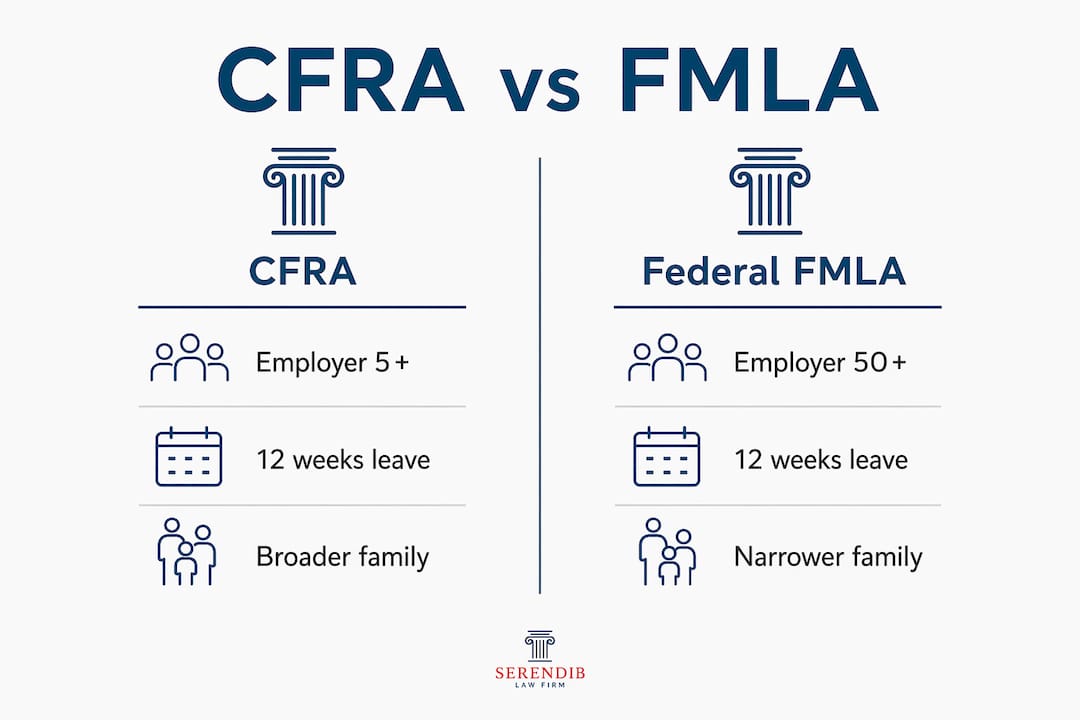
The table below shows how CFRA compares to the federal FMLA on key coverage points.
| Coverage area | CFRA | Federal FMLA |
|---|---|---|
| Employer size threshold | 5+ employees | 50+ employees |
| Covered family: siblings | Yes | No |
| Covered family: grandparents | Yes | No |
| Covered family: parent-in-law | Yes | No |
| Designated person category | Yes | No |
| Employee’s own health condition | Yes | Yes |
CFRA’s family definition is the most meaningful difference from FMLA. Fullerton employees who care for a sibling, grandparent, or a close friend they consider family have rights under CFRA that federal law simply does not provide. For a deeper look at how these two laws interact, the Serendib Law Firm article on CFRA vs. FMLA coordination explains the overlap in detail.
How does CFRA protect Fullerton employees from retaliation and interference?
California law creates two distinct legal claims for employees whose leave rights are violated: interference and retaliation. Understanding the difference matters because each claim has its own legal standard.
Interference occurs when an employer denies, obstructs, or discourages leave regardless of intent. The employer does not need to act with bad motive. If your leave was denied or delayed without a valid legal reason, that is interference. Retaliation requires proof that your employer punished you because you used or requested leave. Examples include termination, demotion, schedule reduction, or negative performance reviews tied to your leave.
- Recognize illegal employer actions. Denying a valid leave request, pressuring you to return before your leave ends, and disciplining you for absences covered by CFRA are all unlawful.
- Understand what counts as protected activity. Requesting leave verbally triggers legal protection from that moment. You do not need to file a formal complaint or submit paperwork first.
- Know the reasonable belief standard. A good-faith belief that you are eligible for leave protects you from retaliation, even if you later do not meet every technical requirement.
- Document everything. Write down dates, times, and the exact words used in every conversation about your leave. Save emails and text messages. This record becomes your evidence.
- Report violations to the California Civil Rights Department. The Department investigates interference and retaliation claims and has authority to order reinstatement and compensation.
Requesting CFRA leave, even informally and verbally, is a protected activity under California law. From the moment you raise the subject of leave with your employer, you are legally shielded from retaliation. No paperwork, no formal process, and no written request is required to trigger that protection.
Pro Tip: After any conversation with your employer about leave, send a follow-up email summarizing what was said. This creates a written record that is difficult to dispute later.
For employees who have already faced a denial, the Serendib Law Firm resource on medical leave denials and retaliation outlines the specific legal protections that apply.
How does CFRA coordinate with other California leave benefits?
CFRA does not exist in isolation. It works alongside several other California programs, and understanding how they fit together protects both your income and your job.
| Program | What it provides | How it works with CFRA |
|---|---|---|
| Federal FMLA | Up to 12 weeks unpaid leave | Runs concurrently with CFRA when both apply |
| California Paid Family Leave (PFL) | Partial wage replacement | Can be used during CFRA leave for wage support |
| State Disability Insurance (SDI) | Partial wage replacement for own illness | Coordinates with CFRA for employee’s own health condition |
| Employer-provided paid leave | Accrued vacation or sick pay | Employer may require use, but only under specific conditions |
CFRA leave is generally unpaid but can be coordinated with California Paid Family Leave or State Disability Insurance for partial wage replacement. That coordination means you can maintain income during leave without sacrificing job protection. Combining these programs requires some planning, but the result is meaningful financial support during a difficult time.
Your job restoration rights are firm. After CFRA leave ends, your employer must return you to the same or equivalent position with the same pay, benefits, and working conditions. Your employer must also continue your group health insurance on the same terms during leave. These are not optional accommodations. They are legal obligations.
CFRA also permits intermittent leave and reduced schedule leave when medically necessary. A Fullerton employee managing a chronic condition, for example, can take leave in blocks of hours or days rather than all at once. This flexibility makes CFRA practical for employees who cannot step away from work for a continuous 12-week period.
For employees in nearby communities, the Serendib Law Firm guide on CFRA eligibility in Yorba Linda covers the same core rules with local context.
Key Takeaways
CFRA gives Fullerton employees up to 12 weeks of job-protected leave, and California law prohibits any employer from retaliating against workers who request or use that leave.
| Point | Details |
|---|---|
| Eligibility threshold | Work 12 months and 1,250 hours for an employer with 5+ employees to qualify. |
| Seven-year look-back | Non-consecutive months of service count toward eligibility within a seven-year window. |
| Broad family definition | CFRA covers siblings, grandparents, parent-in-law, and any designated person you name as family. |
| Retaliation protection | Verbally requesting leave triggers legal protection before any paperwork is filed. |
| Wage replacement options | Coordinate CFRA with California PFL or SDI to receive partial pay during unpaid leave. |
What I’ve learned watching Fullerton employees navigate CFRA
Most employees who contact an employment attorney after a CFRA problem share one thing in common. They waited too long to act because they were not sure their situation was serious enough. That hesitation is understandable, but it costs people real leverage.
The detail that surprises employees most is the designated person rule. CFRA’s broad definition of “family” means you can take protected leave to care for a close friend, a neighbor who raised you, or anyone you genuinely consider family. Most workers have no idea this protection exists. Employers often do not volunteer that information, and some actively discourage leave by implying the request does not qualify.
The other pattern I see repeatedly is employees who fail to document their leave conversations. A verbal denial from a supervisor is hard to prove months later. A follow-up email sent the same day is not. That one habit, writing down what was said and when, changes the outcome of more cases than any legal argument.
If your employer has denied your leave, cut your hours after you returned, or given you a negative review that appeared right after you took time off, those facts matter. California law does not require you to prove the employer acted with malice. The connection between your leave and the adverse action is often enough. Seek legal advice before you assume nothing can be done.
— Maya Serkova
Serendib Law Firm is ready to help Fullerton employees
Serendib Law Firm represents employees throughout Orange County, including Fullerton, in California employment law matters. If your employer denied your CFRA leave request, retaliated against you for taking time off, or interfered with your right to return to your position, you have legal options. The firm handles leave denial, retaliation, and interference claims with direct, personalized representation. Consultations are available in English and Spanish. To discuss your specific situation with an employment attorney, contact Serendib Law Firm and get clear answers about what your rights are and what steps you can take.
FAQ
What is the employer size requirement for CFRA in Fullerton?
CFRA applies to employers with 5 or more employees, which is far lower than the federal FMLA threshold of 50 employees. Most Fullerton workers are covered.
Can I take CFRA leave for a close friend who is not a legal relative?
Yes. California law includes a “designated person” category, which allows you to name any person you consider family for care-related leave, regardless of legal or biological relationship.
Does CFRA leave have to be taken all at once?
No. CFRA permits intermittent leave and reduced schedule leave when medically necessary, so you can take leave in hours or days rather than a continuous block.
Is CFRA leave paid?
CFRA leave itself is generally unpaid, but you can coordinate it with California Paid Family Leave or State Disability Insurance to receive partial wage replacement during your time off.
What should I do if my employer retaliates against me for taking CFRA leave?
Document every adverse action with dates and details, then consult an employment attorney. California law prohibits retaliation for requesting or taking leave, and applicable statutes of limitations should be evaluated on a case-by-case basis.