
If your employer in La Habra has failed to pay earned wages, denied overtime, skipped required meal or rest breaks, or required you to work off the clock, you likely have an enforceable claim under California law. The two most important things to do right now: preserve every piece of evidence you have and either file with the California Labor Commissioner’s Office (DLSE) or contact Serendib Law Firm for a free intake consultation. The California Labor Code affords remedies to workers for wage violations, and the claim process is designed to be accessible to employees.
Your immediate action checklist (next 24–72 hours):
- Write down your hours, shifts, and any missed breaks from memory, going back as far as you can recall, and date each entry today.
- Gather every paystub, schedule, text message, or email related to your pay or hours and store copies somewhere your employer cannot access.
- Contact the DLSE or an employment attorney before taking any other action, including confronting your employer directly.
Pro Tip: Do not wait for your employer to “fix it.” Every day you delay is a day closer to a filing deadline. California’s statute of limitations on wage claims varies by claim type and factual circumstances and should be evaluated case by case by qualified counsel.
Key Takeaways
La Habra employees who act quickly to preserve evidence and file with the DLSE or consult an attorney give themselves the strongest possible foundation for recovering unpaid wages, overtime, and break premiums under California law.
| Point | Details |
|---|---|
| Preserve evidence immediately | Start a personal time log today; save paystubs, schedules, and work communications before they disappear. |
| File with DLSE or get counsel | Submit your claim online, by mail, or in person; an attorney strengthens complex or high-value claims significantly. |
| Retaliation is unlawful | Employers cannot legally punish you for asserting wage rights; file a separate retaliation complaint if they do. |
| Immigration status is not a barrier | DLSE does not ask about immigration status and keeps personal information confidential during the claims process. |
| Serendib Law Firm serves La Habra | Free consultations, bilingual intake, and contingency representation are available for qualifying wage-and-hour claims. |
Table of Contents
- What wage-and-hour rights do La Habra employees have under California law?
- How do you know if you have a valid wage-and-hour claim?
- How do you file a wage claim with the California Labor Commissioner’s Office?
- What happens after you file a wage claim with the DLSE?
- Can an employer fire you for filing a wage claim?
- When does hiring an employment attorney make sense for La Habra workers?
- An editorial perspective on wage claims in La Habra
- How Serendib Law Firm helps La Habra employees recover unpaid wages
- Where to find official forms, DLSE contacts, and local help
- Sources
What wage-and-hour rights do La Habra employees have under California law?
California employee wage laws are among the strongest in the country, and they apply to virtually every worker in La Habra regardless of industry, immigration status, or how an employer labels the job.
Core rights that commonly produce claims:
- Minimum wage: California sets a statewide minimum wage, and local ordinances may set a higher floor. Every hour worked must be compensated at or above the applicable minimum wage rate applicable to the locality and employer.
- Overtime: Non-exempt employees earn overtime at 1.5 times the regular rate for hours in excess of certain daily or weekly thresholds, and double time for exceptionally long workdays, as provided by California law.
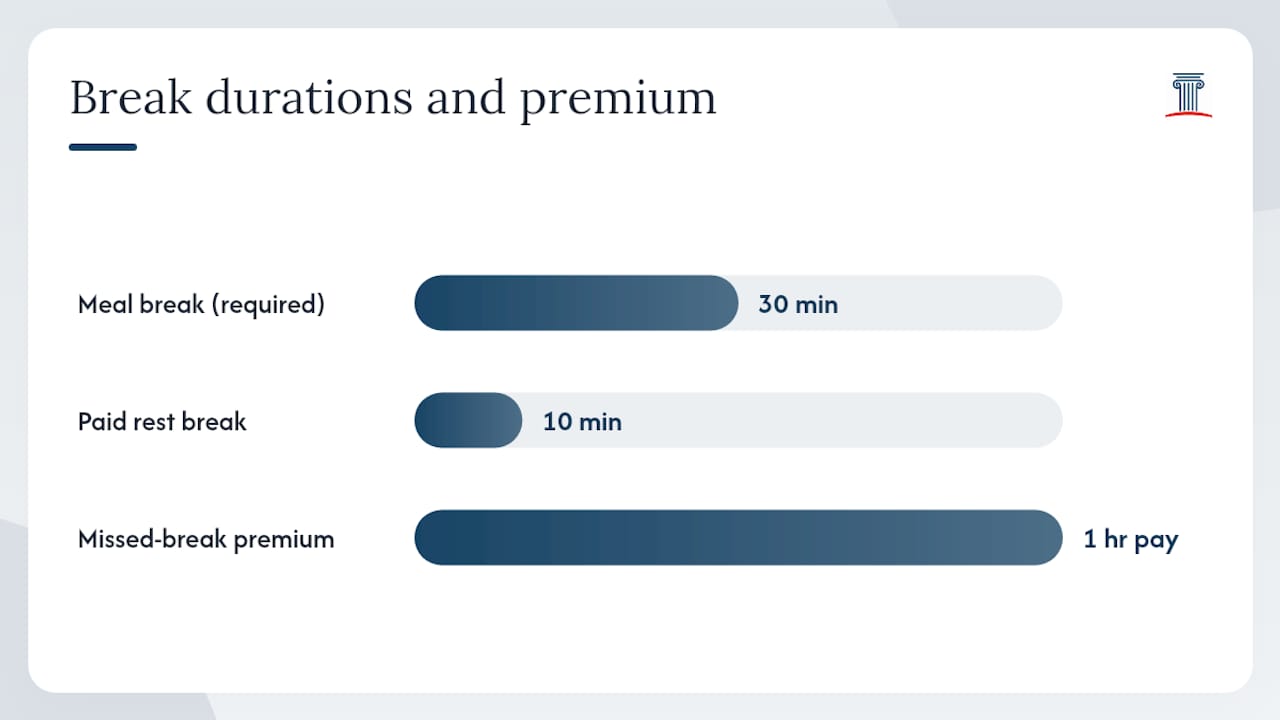
- Duty-free meal breaks: A 30-minute, uninterrupted meal period is required for shifts over five hours. If an employer requires a restaurant server in La Habra to stay on the floor, monitor tables, or remain available during that break, the break is not legally duty-free and may be compensable.
- Paid rest breaks: A 10-minute paid rest period is required for every four hours worked, or major fraction thereof. Retail clerks, warehouse associates, and construction day laborers in La Habra are all covered.
- Itemized wage statements: Every paystub must show hours worked, pay rates, gross and net wages, deductions, and employer information. Missing or inaccurate entries are themselves a violation.
- Business expense reimbursement: Employers must reimburse necessary work-related expenses, including mileage, tools, and phone use.
- Tips, commissions, and bonuses: Tips belong entirely to the employee and cannot be pooled with management. Commissions and non-discretionary bonuses factor into the regular rate of pay for overtime calculations.
According to DLSE guidance, employers must provide required meal and rest breaks under Industrial Welfare Commission orders, and each missed break may entitle the employee to one additional hour of pay at the regular rate as a premium.
Pro Tip: Keep a contemporaneous time log in a personal notebook or phone app, separate from any employer system. When employer records are incomplete or falsified, DLSE regularly relies on employee logs as supporting evidence.
For workers in hospitality and food service, the meal and rest break rules for La Habra-area workers follow the same IWC wage order framework that governs neighboring cities.
How do you know if you have a valid wage-and-hour claim?
Common claim scenarios — check whether any apply to your situation:
- You regularly worked more than eight hours a day but were paid straight time only.
- Your employer automatically deducted 30 minutes for a meal break even on days you worked through lunch.
- You were paid a flat daily rate regardless of how many hours you actually worked.
- Your employer classified you as an independent contractor but controlled your schedule, tools, and work methods.
- Commissions or bonuses were promised but never paid, or were not included in your overtime rate.
- Wages were paid late, shorted, or withheld entirely at termination.
- Illegal deductions were taken from your paycheck for uniforms, cash register shortages, or breakage.
Evidence that will matter most:
| Evidence Type | Why It Matters |
|---|---|
| Paystubs | Show pay rate, hours recorded by employer, and deductions |
| Personal time log | Fills gaps when employer records are missing or inaccurate |
| Work schedules and shift records | Establish expected vs. actual hours |
| Text messages and emails | Prove instructions to work off the clock or skip breaks |
| Co-worker names and contact info | Corroborate patterns of violations |
| Vehicle mileage or GPS records | Support reimbursement and hours-worked claims |
On misclassification: If your employer called you an independent contractor but set your hours, provided your equipment, and controlled how you did your work, California’s ABC test likely means you were an employee all along. That status change can unlock unpaid overtime, missed break premiums, and expense reimbursements going back years. Document every way the employer directed your work.
If you lack employer records, your own detailed notes and co-worker witness names are still valuable. DLSE investigators are experienced at reconstructing hours from incomplete records.
How do you file a wage claim with the California Labor Commissioner’s Office?
The DLSE accepts wage claims online, by mail, email, or in person, and the process does not require an attorney, though having one significantly strengthens complex claims.
Step-by-step filing process:
- Gather employer information: Full legal name of the employer, business address, and any known payroll or HR contacts.
- Complete DLSE Form 1 (Initial Report or Claim): This is the primary filing document. Be specific about dates, hours, and amounts owed.
- Attach supplemental forms if needed: DLSE Form 55 covers variable-hour calculations; DLSE Form 155 covers unpaid commissions.
- Include supporting copies: Paystubs, personal time logs, schedules, dishonored checks, and any written notices. Submit copies only, never originals.
- Estimate hours if records are incomplete: The DLSE form instructions provide guidance on how to calculate approximate hours owed when employer records are unavailable.
- Submit your claim: File online through the DLSE portal, mail to the appropriate district office, or visit in person. For Orange County and La Habra workers, the Santa Ana district office serves this area.
- Request bilingual assistance: DLSE offers Spanish-language services. Request them when you file or call the office directly.
Document checklist for your filing:
- Copies of all paystubs covering the claim period
- Your personal time log or written notes
- Work schedules, shift assignments, or manager texts
- Any written employment agreements or commission plans
- Copies of dishonored or shorted checks
Statute of limitations periods vary by claim type and factual circumstances. A California statute of limitations guide underscores why consulting counsel before filing is advisable, since the applicable window must be evaluated case by case.
What happens after you file a wage claim with the DLSE?
Filing triggers a formal DLSE review, and most claims follow a predictable sequence. Understanding each stage helps you prepare the right materials at the right time.
The typical sequence:
- Claim intake and review: DLSE staff review your submission for completeness and may contact you for additional information.
- Investigation: A deputy labor commissioner may contact your employer, request records, and compare them against your account.
- Settlement conference: Both parties are invited to a conference where a DLSE officer facilitates resolution. Many claims settle here.
- Hearing (if settlement fails): If the settlement conference does not resolve the dispute, DLSE schedules a formal hearing where a hearing officer takes sworn testimony and reviews evidence. The hearing record is legally binding.
- Order and enforcement: A favorable order may award back wages, meal and rest break premiums, waiting-time penalties (up to 30 days of wages for late final pay), and civil penalties for wage statement violations.
Possible remedies:
- Unpaid wages and overtime at the correct rate
- One hour of premium pay per missed meal or rest break
- Waiting-time penalties for wages not paid at termination
- Civil penalties for inaccurate wage statements
- Interest on unpaid amounts
If the order is in your favor and the employer refuses to pay, you can convert the DLSE order to a court judgment and pursue collection. An employment attorney can help enforce an order if the employer is uncooperative.
Can an employer fire you for filing a wage claim?
No. Retaliation against an employee for asserting wage-and-hour rights is unlawful under California law, and you can file a separate retaliation complaint with the DLSE. That protection applies whether you filed a formal claim, complained internally to HR, or simply asked your manager about your pay.
Red flags that may signal retaliation:
- Sudden schedule cuts or shift eliminations after you raised a pay concern
- Unexplained demotion or change in job duties
- New disciplinary write-ups that appeared only after you asked about wages
- Threats related to your immigration status or employment authorization
- Termination within days or weeks of a wage complaint
Documenting retaliation effectively:
- Record the exact date, time, location, and words used in any adverse action.
- Note who was present and who witnessed the interaction.
- Save any written communications, including texts and emails, that show the timing between your protected activity and the employer’s response.
- Timing is everything: a disciplinary action that arrives three days after a wage complaint tells a clear story.
Pro Tip: File the retaliation complaint separately from your wage claim. DLSE handles them through different processes, and an employment attorney can coordinate both tracks simultaneously to protect your position.
DLSE protections apply to all workers regardless of immigration status, and DLSE staff do not ask about immigration status when processing claims. Workers concerned about background or prior history should know that employment rights enforcement remains available regardless of those factors.
When does hiring an employment attorney make sense for La Habra workers?
Contact an employment lawyer when your claim involves significant back pay, retaliation, misclassification, unpaid commissions, a pattern of violations affecting multiple workers, or when your employer has refused to cooperate with DLSE. An attorney changes the dynamic of every stage of the process.
What an employment attorney does that DLSE cannot:
- Calculates the full value of your claim, including overtime, break premiums, waiting-time penalties, and interest
- Represents you at DLSE settlement conferences and hearings
- Conducts a wage audit using employer payroll records obtained through discovery
- Negotiates settlements that often exceed what DLSE alone would award
- Evaluates whether your situation qualifies for a class or representative action under California’s Private Attorneys General Act (PAGA), which can multiply recoveries significantly
- Files parallel retaliation and wrongful termination claims when the facts support them
Serendib Law Firm offers free consultations, contingency-based representation in qualifying matters, and bilingual intake in English and Spanish for La Habra workers. The firm’s California employment law resources cover the full range of wage-and-hour rights and can help you assess your claim before you decide how to proceed.
When you come in for intake, bring your paystubs, your personal time log, any written communications with your employer about pay, and the names of co-workers who witnessed the same conditions. The consultation is free, and what you share is confidential.
For workers who have also faced wrongful termination alongside wage violations, Serendib Law Firm’s La Habra wrongful termination page explains how those claims intersect and what additional remedies may be available.
An editorial perspective on wage claims in La Habra
The workers who come to us with wage claims in La Habra most often work in restaurants, retail, construction, and light manufacturing. Many have been underpaid for months or years because they did not know the law protected them, or because they feared that speaking up would cost them their job or create immigration problems. Both fears are understandable, and both are addressable.
We typically recommend two things before anything else: start your personal time log today, and get a legal opinion before you file on your own. The DLSE process is accessible, but a claim filed without proper documentation or with the wrong form can delay your recovery significantly. The industries most common in La Habra, including food service and construction, also tend to involve the most complex break and overtime calculations, where an attorney’s involvement makes a measurable difference in the final recovery.
DLSE does not ask about immigration status. Language services are available. And Serendib Law Firm conducts intake in both English and Spanish, so the conversation can happen in the language where you are most comfortable. If you are ready to talk, reach out for a free consultation.
How Serendib Law Firm helps La Habra employees recover unpaid wages
Serendib Law Firm represents employees in La Habra and throughout Orange County in wage-and-hour claims, retaliation complaints, and DLSE hearings. Where a DLSE self-filing gives you access to the process, Serendib gives you an advocate who knows how to calculate the full value of your claim, present evidence effectively at a hearing, and negotiate from a position of strength.
The firm handles intake, evidence review, back pay and penalty calculations, hearing representation, and bilingual support in Spanish and English. Qualifying matters are handled on contingency, meaning you pay no attorney fees unless the firm recovers for you. Statute of limitations periods vary by claim type and must be evaluated case by case, so the sooner you reach out, the more options remain available.
To speak with an employment attorney about your situation in La Habra, contact Serendib Law Firm for a free, confidential consultation.
Where to find official forms, DLSE contacts, and local help
- How to File a Wage Claim (DLSE): Filing options (online, mail, email, in person), process overview, and district office locator.
- DLSE Form 1 and Instructions: The Initial Report/Claim form, supplemental forms (DLSE Form 55, DLSE Form 155), and document attachment guidance.
- Wage Hearing Information (DLSE): What to expect at a formal hearing, how testimony is taken, and how orders are issued.
- Meal and Rest Break Rules (DLSE): Employer obligations, premium pay rules, and retaliation protections in plain language.
- Workers’ Rights Guide (DLSE): Confirms that all workers may seek enforcement regardless of immigration status; includes language access and immigration helpline information.
- California Employment Law Rights (Serendib Law Firm): Comprehensive worker rights overview and local intake resource for La Habra and Orange County employees.
- Contact Serendib Law Firm: Free consultation, bilingual intake (English/Spanish), and representation for qualifying wage-and-hour claims in La Habra.
This article provides general legal information, not legal advice. Statute of limitations periods and claim eligibility vary by situation. Consult a qualified employment attorney to evaluate your specific circumstances.
This article is general information, not a substitute for advice from a qualified lawyer. Consult a qualified legal professional about your own circumstances before acting on anything here.
Sources
- How to File a Wage Claim (DLSE)
- Instructions for Filing a Wage Claim (DLSE Form Guide)
- Wage Hearing Information (DLSE)
- Wages, breaks and retaliation (DLSE – Small Business Guide)