
If you were fired in Orange County and something about it felt off, you may have grounds for a wrongful termination claim. California is an at-will state, but that rule breaks down fast when the real reason behind a firing is discrimination, retaliation, a violation of public policy, or a broken contract promise. If any of those apply to you, the clock is already running.
Here is what to do in the next 48 hours, before memories fade and documents disappear:
- Write down the exact date your employment actually ended. Not the date you got a heads-up. Not the date HR “recommended” you resign.
- Save every email, text, Slack message, pay stub, and performance review you can access, ideally before your accounts get cut off.
- Start a dated log of what happened, who said what, and who witnessed it.
- Call an employment attorney for a free consultation before you sign anything, including a severance agreement.
Pro Tip: Under Romano v. Rockwell, the statute of limitations begins on your actual last day of employment, not the day you were told you’d eventually be let go. Get that date right, because most FEHA claims must go to the Civil Rights Department (CRD) before you can ever step into a courtroom.
Key Takeaways
Wrongful termination claims in California hinge on the exceptions to at-will employment, and the statute-of-limitations clock starts on your actual last day of work, not the day you were warned.
| Point | Details |
|---|---|
| Know the legal bases | Discrimination, retaliation, public policy violations, and contract breach are the four main grounds for a claim. |
| Track your real end date | Romano v. Rockwell confirms the limitations clock starts at actual termination, not notice of future termination. |
| File within three years | FEHA claims generally require filing with the CRD within three years, or requesting an immediate right-to-sue. |
| Document inconsistencies | Save emails, reviews, and any shifting employer explanations, since inconsistency often proves pretext. |
| Talk to Serendib Law Firm | Free consultations and contingency fees make it possible to evaluate your Orange County claim without upfront cost. |
This article is general information, not a substitute for advice from a qualified lawyer. Consult a qualified legal professional about your own circumstances before acting on anything here.
Table of Contents
- What Wrongful Termination Orange CA Employee Rights Actually Cover
- What Are the Most Common Illegal Reasons for Firing an Employee?
- What Evidence Do You Need to Prove Wrongful Termination?
- How Long Do You Have to File a Wrongful Termination Claim in California?
- What Compensation Can You Recover From a Wrongful Termination Claim?
- What Should You Do Right Now If You Were Fired in Orange County?
- Why Orange County Employees Turn to Serendib Law Firm
- What This Guide Gets Right That Most Advice Doesn’t
- Get a Free Case Review From Serendib Law Firm
- Sources
What Wrongful Termination Orange CA Employee Rights Actually Cover
California employment is “at-will,” meaning an employer can fire you for almost any reason, or no reason at all, without notice. That sounds bleak until you look at the exceptions, because those exceptions are where most wrongful termination cases live.
You likely have a claim if your firing falls into one of these buckets:
- FEHA violations: You were fired because of your race, age (40+), sex, disability, pregnancy, religion, gender identity, or sexual orientation.
- Retaliation: You were fired for reporting harassment, filing a wage complaint, or exercising a legal right.
- Public policy violations (Tameny claims): You were fired for refusing to break the law or for exercising a protected right, like taking jury duty leave.
- Contract breach: You had a written or implied promise of continued employment that your employer ignored.
The California Civil Rights Department enforces FEHA against employers with five or more employees for discrimination claims, and against virtually all employers for harassment. Separately, Labor Code §1102.5 protects whistleblowers who report suspected legal violations internally or to a government agency. If you worked for a smaller Orange County business and assumed FEHA didn’t apply to you, check the employer’s size before ruling anything out. Learn more about what counts as wrongful termination in California.
What Are the Most Common Illegal Reasons for Firing an Employee?
Employers rarely admit the real reason for a firing. They usually offer a plausible cover story, “restructuring,” “poor performance,” “attitude issues”, while the actual motive is something the law forbids. Recognizing the pattern is the first step toward building a claim.
- Discrimination based on a protected characteristic. Race, age over 40, sex, pregnancy, disability, religion, national origin, gender identity, sexual orientation, and veteran status are all protected under FEHA.
- Retaliation for protected activity. Filing a wage complaint, reporting a safety hazard, or filing a workers’ compensation claim and getting fired shortly after is a red flag. Labor Code §98.6 creates a rebuttable presumption of unlawful retaliation when the adverse action happens within roughly 90 days of the protected activity.
- Interference with protected leave. Firing someone for taking medical leave, family leave, or pregnancy disability leave is almost always illegal.
- Whistleblowing. Reporting suspected fraud, safety violations, or legal noncompliance, internally or to a regulator, triggers specific statutory protection.
- Constructive discharge. If your employer made conditions so intolerable that a reasonable person would have quit, the law can treat your resignation as a forced termination.
Pro Tip: If you were fired within about three months of filing a complaint or reporting a problem, note both dates immediately. That 90-day window under Labor Code §98.6 can shift the burden onto your employer to prove the firing was unrelated.
What Evidence Do You Need to Prove Wrongful Termination?
Wrongful termination cases usually turn on documentation, not dramatic courtroom moments. The employer will offer a reason for the firing. Your job, with your attorney, is to show that reason doesn’t hold up.
Evidence that consistently matters includes emails and text messages with timestamps, written warnings or performance reviews (especially ones that contradict a sudden “poor performance” excuse), pay stubs, meeting notes, and the names of coworkers who witnessed key events. Common evidence in wrongful termination claims also includes your personnel file, which you can request in writing from your former employer.
- Screenshot conversations with visible dates and sender information, not just cropped text.
- Request your full personnel file in writing; California law generally entitles former employees to a copy.
- Identify at least two coworkers who can independently corroborate your account.
- Avoid recording conversations without consulting an attorney first, since California requires consent from all parties in most situations.
Discrimination and retaliation cases follow a burden-shifting framework. You show you belong to a protected group and suffered an adverse action; your employer then has to offer a legitimate reason; you get the chance to show that reason is pretext, often through inconsistencies, shifting explanations, or comparisons to how similarly situated coworkers were treated.
Pro Tip: If your employer gives you one reason for the firing verbally and a different reason in writing, write both down with dates. That inconsistency is often the single most persuasive piece of evidence in a wrongful termination case.

How Long Do You Have to File a Wrongful Termination Claim in California?
Deadlines vary by legal theory, and missing one can end an otherwise strong case before it starts.
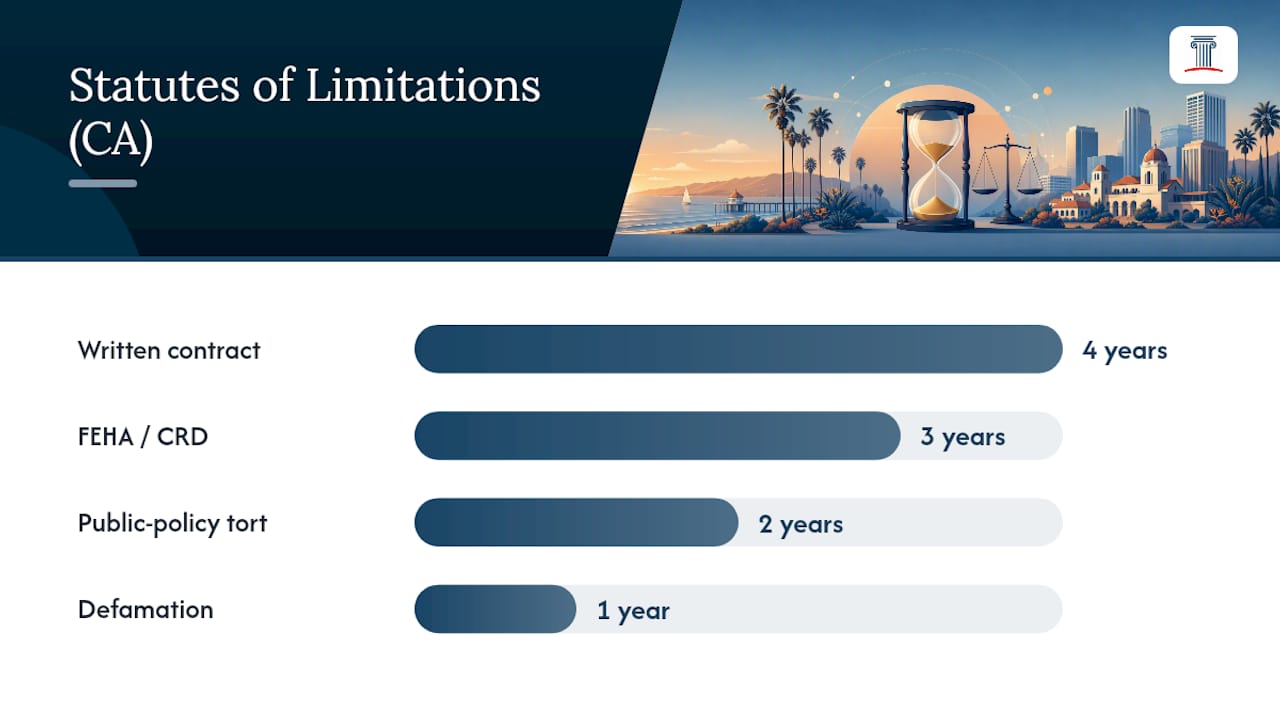
- FEHA/CRD administrative complaint: three years from the date of termination. You can request an immediate right-to-sue notice from the CRD instead of waiting for an investigation.
- Wrongful discharge in violation of public policy (tort claim): two years from the termination date.
- Breach of a written employment contract: four years from the breach.
- Defamation (for false statements made about you during or after termination): one year.
These statutes of limitations run from the date your employment actually ended, not the date you were warned it was coming. That distinction comes directly from Romano v. Rockwell, where the California Supreme Court held that notice of a future termination does not start the clock. Employers sometimes give weeks of notice before an official end date, and confusing the two can cost you months of filing time you didn’t know you’d lost.
Because FEHA requires administrative exhaustion, you generally cannot skip straight to court on a discrimination or retaliation claim. File with the CRD first, or request an immediate right-to-sue if you’d rather proceed directly to litigation. If your situation might involve federal law too, cross-filing with the EEOC preserves that separate track.
What Compensation Can You Recover From a Wrongful Termination Claim?
Money is rarely the only goal, but it’s usually the practical one. What you can recover depends on the legal theory and the facts of your case.
- Back pay: wages and benefits lost between termination and resolution.
- Front pay: projected future lost earnings when reinstatement isn’t realistic.
- Reinstatement: getting your job back, though this is requested less often than you’d think.
- Emotional distress damages: compensation for the psychological toll of an unlawful firing.
- Punitive damages: available when an employer acted with malice, oppression, or fraud.
- Attorney’s fees and costs: FEHA claims often allow a prevailing employee to recover these separately from damages.
FEHA’s remedies tend to be broader than a straightforward breach-of-contract claim, which typically caps recovery at the value of what the contract promised. How much a case is actually worth depends heavily on how long you were out of work, whether you mitigated damages by searching for comparable employment, and how egregious the employer’s conduct was. A firing built on a documented pattern of retaliation tends to carry more punitive exposure than a single ambiguous decision.
What Should You Do Right Now If You Were Fired in Orange County?
Momentum matters. The longer you wait, the more evidence degrades and the more deadlines creep closer.
- Lock in your timeline. Write a one-page, dated account of the events leading to your termination, and note your actual last day of work.
- Preserve documents immediately. Export email threads, screenshot text messages, and photograph any physical evidence before access disappears.
- File where it counts. Submit a CRD complaint within the three-year window, or request an immediate right-to-sue. If you also have wage claims, the Labor Commissioner’s office handles those separately. Retaliation after an HR complaint often involves overlapping claims worth flagging early.
- Prepare for your consultation. Bring your termination letter, employment agreement, performance reviews, pay records, and any written correspondence with HR or management.
Pro Tip: Ask about contingency fee arrangements during your first call. Many employment cases are handled this way, meaning you don’t pay unless the case recovers money for you.
Why Orange County Employees Turn to Serendib Law Firm
Serendib Law Firm handles employment law cases throughout Orange County, including wrongful termination, retaliation, discrimination, and harassment claims. Being based locally matters when deadlines, agency offices, and courts are all part of the process.
- Local Orange County practice with direct familiarity with regional employers and court practices.
- Bilingual intake in English and Spanish, so language isn’t a barrier to understanding your rights.
- Free initial consultations to evaluate whether your firing likely violates California law.
- Contingency-based representation available for eligible employment cases, so upfront cost isn’t the obstacle to getting help.
During intake, having your termination date, any written explanation from your employer, and a rough timeline of events speeds up the evaluation considerably. If retaliation is part of your story, our workplace retaliation practice page walks through how those claims typically unfold. Ready to talk specifics? Contact Serendib Law Firm to schedule your free consultation.
What This Guide Gets Right That Most Advice Doesn’t
Most wrongful termination content treats the legal test and the deadline as separate problems. They’re not. The single biggest mistake I see in how this topic gets discussed is the assumption that “you have three years” means three years from whenever things started going sideways. It doesn’t. Romano v. Rockwell draws a hard line at your actual last day of work, and conflating that with the day you got bad news is how legitimate claims get filed too late.
The second overlooked point is how much weight inconsistency carries. Readers fixate on finding a smoking gun, an email with a slur, a text admitting bias, when in practice, an employer contradicting its own stated reason for firing you is often the more persuasive evidence. Courts don’t need a confession. They need a story that doesn’t hold together.
If you take one thing from this guide, let it be this: figure out your actual termination date today, and write down what happened while it’s still fresh. Everything else, agency filings, evidence gathering, legal strategy, moves faster once that foundation is set.
— Maya Serkova
Get a Free Case Review From Serendib Law Firm
Serendib Law Firm gives Orange County employees a direct path to a real legal opinion, not a generic online quiz or a form letter. Unlike piecing together advice from forums or general legal websites, you get a free consultation with an attorney who reviews your specific timeline, your documents, and your termination date against the deadlines that actually apply to your case. For employees who qualify, representation is available on a contingency basis, meaning legal fees come from any recovery, not from your pocket upfront. Our team also handles intake in English and Spanish, so nothing gets lost in translation when you’re explaining what happened. If you were fired in Orange County and something about the reason doesn’t add up, schedule your free consultation with Serendib Law Firm and find out where you actually stand.
Sources
- Romano v. Rockwell Internat., Inc. – California Supreme Court Resources
- Employment | CRD
- Laws that Prohibit Retaliation and Discrimination (DLSE resource)
- California Wrongful Termination Statute of Limitations: Deadlines to Sue (Employment Law Aid)
- California wrongful termination claims – FindLaw