
If you’ve worked for your Fountain Valley employer for at least 12 months and logged 1,250 hours in the past year, you likely qualify for job-protected leave under either the federal Family and Medical Leave Act or California’s CFRA, or both. Employer size determines which law applies: FMLA covers employers with 50 or more employees within 75 miles, while CFRA reaches much smaller workplaces with just five or more employees. That gap matters in Fountain Valley, where small medical offices, retail shops, and family businesses cluster alongside larger employers near Warner Avenue and Brookhurst Street. CFRA also protects a wider circle of family relationships than FMLA does.
Pro Tip: Don’t wait for your employer to bring up leave rights. Put your request in writing the same day you know you’ll need time off.
Take these steps now:
- Notify your employer in writing that you need leave and why
- Request the Notice of Eligibility and Rights form immediately
- Save every piece of medical paperwork, dated and copied
- File for SDI or PFL through EDD if you need income during unpaid leave
Key Takeaways
Job-protected leave in Fountain Valley depends on meeting the 12-month and 1,250-hour tests, and CFRA often covers more family relationships than federal FMLA does.
| Point | Details |
|---|---|
| Eligibility threshold | You need 12 months of service and 1,250 hours worked, with CFRA applying at employers of five or more. |
| CFRA covers more family | Grandparents, siblings, grandchildren, and a designated person qualify under CFRA but not FMLA. |
| Wage pay isn’t job protection | SDI and PFL replace income through EDD but don’t guarantee reinstatement on their own. |
| Notice timing is strict | Give 30 days’ notice when foreseeable; employers must respond within five business days. |
| Get legal help early | Serendib Law Firm reviews documentation and pursues claims when employers violate leave rights. |
Where to Read the Official Rules and File Your Claims
For the federal rules and forms, DOL’s FMLA page covers eligibility tests and certification requirements directly. California’s CFRA quick reference guide breaks down state-specific family coverage and posting requirements. EDD’s Paid Family Leave portal walks through SDI and PFL filing steps and deadlines.
- DOL FMLA guidance and forms
- CFRA fact sheet (California Civil Rights Department)
- EDD PFL filing instructions
- Pregnancy leave and CFRA/FMLA in Fountain Valley
Table of Contents
- FMLA, CFRA, PDL, SDI, and PFL: What Each One Actually Covers
- Do You Qualify for FMLA Leave in Fountain Valley, CA?
- How Do Federal and State Leave Laws Work Together?
- When and How Should You Notify Your Employer?
- Getting Paid While Your Job Stays Protected
- What Your Employer Must Do Once You Take Leave
- What Goes Wrong, and How to Fix It
- Before You Call Serendib Law Firm
- What Fountain Valley Employees Get Wrong About Leave Rights
- Get Help Securing Your Leave Rights in Fountain Valley
- Sources
FMLA, CFRA, PDL, SDI, and PFL: What Each One Actually Covers
These five acronyms get tangled together constantly, and the confusion costs employees their jobs. Here’s the split that matters: some of these laws protect your position, others just replace part of your paycheck, and mixing them up is the single most common mistake we see.
FMLA grants job-protected leave for a qualifying period in a year and requires your employer to keep your group health coverage active. CFRA mirrors that 12-week structure but extends coverage to grandparents, grandchildren, siblings, and a designated person you name, not just a spouse, child, or parent. Pregnancy Disability Leave adds a period of leave on top of CFRA in many pregnancy-related situations, running separately rather than eating into your 12 CFRA weeks.
SDI and PFL, both run through EDD, replace a portion of your wages while you’re out. Neither one, by itself, guarantees you get your job back:
- FMLA/CFRA = job protection, unpaid
- PDL = additional pregnancy-related protection, can stack with CFRA
- SDI/PFL = partial wage replacement, no job protection attached
Do You Qualify for FMLA Leave in Fountain Valley, CA?
Eligibility comes down to three tests, and all three have to pass. You need 12 months of employment with your current employer (they don’t have to be consecutive months, so a prior stint with the same company still counts toward the total). You need 1,250 hours worked in the 12 months right before your leave starts, roughly 24 hours a week averaged out. And your employer has to clear the size threshold for the law you’re relying on.

Here’s where Fountain Valley’s mixed economy of employers creates real differences. A ten-person medical billing office near Talbert Avenue meets CFRA’s five-employee threshold easily, so an employee there gets CFRA protection even though the company is far too small for federal FMLA to apply. A regional employer like a hospital system or a large retail chain with locations spanning Orange County almost certainly clears both thresholds, which means an eligible employee there can draw on whichever law offers stronger protection for their specific situation.
A few categories get special treatment worth knowing:
- Public agency employees are generally covered by FMLA regardless of the 50-employee count
- Public and private elementary and secondary school employees have distinct notice rules under federal law
- Military caregiver leave under FMLA can extend job protection up to 26 weeks in a single 12-month period for a covered servicemember’s care
How Do Federal and State Leave Laws Work Together?
When both FMLA and CFRA apply to your situation, you don’t have to pick one. You’re entitled to whichever law gives you more protection on the specific point in question, and the two run concurrently rather than stacking to give you 24 weeks. Most of the time that means 12 weeks total, not 12 weeks under each.
Where CFRA pulls ahead is family coverage. FMLA protects leave for a spouse, child, or parent. CFRA adds:
- Grandparents and grandchildren
- Siblings
- A “designated person” you identify, related by blood or affinity
Pro Tip: If you’re caring for a sibling or grandparent, say so explicitly when you request leave. CFRA covers it even though FMLA does not, and naming the relationship correctly on your paperwork avoids a denial based on the wrong law being applied.
Intermittent leave, taken in blocks rather than one continuous stretch, is allowed under both laws when medically necessary. Employers can track usage in the smallest increment their payroll system uses, often in hourly blocks, so keep your own log to cross-check theirs.
When and How Should You Notify Your Employer?
Timing rules are strict, and missing them can cost you protection you’d otherwise have earned.
- If your need for leave is foreseeable, such as a scheduled surgery or expected birth, give your employer advance notice as early as possible when the need is foreseeable.
- If it isn’t foreseeable, notify your employer as soon as practicable, meaning as soon as circumstances allow.
- Your employer must then respond with a written Notice of Eligibility and Rights within five business days of your request.
- Medical certification can confirm the need for leave and expected duration, but CFRA limits what your employer can demand. They cannot require your specific diagnosis.
- If your employer misses the five-day window or demands medical detail beyond what’s allowed, put your objection in writing and keep a copy before escalating further.
Getting Paid While Your Job Stays Protected
FMLA and CFRA leave is unpaid on its own, which is why coordinating wage replacement matters as much as securing the leave itself.
- File your SDI or PFL claim with EDD as soon as your leave begins; both have their own filing deadlines separate from your leave paperwork
- Confirm whether your employer requires you to use accrued vacation or sick leave concurrently with unpaid leave, or whether that’s optional
- Keep copies of every EDD filing and the date you submitted it
The gap employees fall into most often: they assume an approved PFL claim automatically means their job is protected. It doesn’t. PFL pays you. FMLA and CFRA protect your position. You need both pieces in place, filed on their own timelines, to avoid a gap in either income or reinstatement rights.
What Your Employer Must Do Once You Take Leave
Your employer carries real obligations once your leave request is in motion, and knowing them lets you spot when something’s being skipped.
- Post CFRA and FMLA notices where employees can see them, typically in a breakroom or near time clocks, and include the policy in any employee handbook
- Continue your group health coverage under the same terms as if you were actively working
- Reinstate you to the same position, or one that is nearly identical in pay, benefits, and duties, when your leave ends
Pro Tip: Ask for the reinstatement guarantee in writing before you go on leave, not after you return. A short email confirming “same or comparable position” creates a record that’s hard to dispute later.
Reinstatement isn’t absolute. If your position would have been eliminated in a legitimate layoff regardless of your leave, your employer isn’t required to create a job that no longer exists. That exception gets abused sometimes, which is exactly why documentation matters.
What Goes Wrong, and How to Fix It
Most FMLA and CFRA disputes trace back to a handful of repeated mistakes, not complicated legal questions.
- Employees give verbal notice only, with nothing in writing to fall back on
- Medical certification gets submitted late or without the dates and expected return the employer needs
- Workers assume a PFL approval alone secures their job, then get replaced while out on leave
Watch for retaliation signs: a sudden performance review after years of clean ones, a schedule change timed to your leave request, or termination shortly after you return. Document every instance with dates and, where possible, an email trail. You can file a complaint with the U.S. Department of Labor, the California Civil Rights Department, or EDD depending on which right was violated. When retaliation is involved, it’s worth reading our guide on workplace retaliation in Fountain Valley before deciding your next move, and an employment attorney should review your case if your employer denied leave outright or fired you during it.
Before You Call Serendib Law Firm
Walking into a consultation prepared makes the conversation faster and more useful. Gather your employer’s written notices (or the lack of one), the dates you requested leave, your pay records for the period in question, and any medical certification you submitted.
Serendib Law Firm evaluates whether your FMLA or CFRA rights were violated, handles administrative filings with the relevant agency, and represents you in negotiation or litigation when an employer won’t correct course voluntarily…
What to bring to that first call:
- Every written communication with your employer about the leave
- Pay stubs from before and after your leave request
- Copies of any medical certification forms submitted
What Fountain Valley Employees Get Wrong About Leave Rights
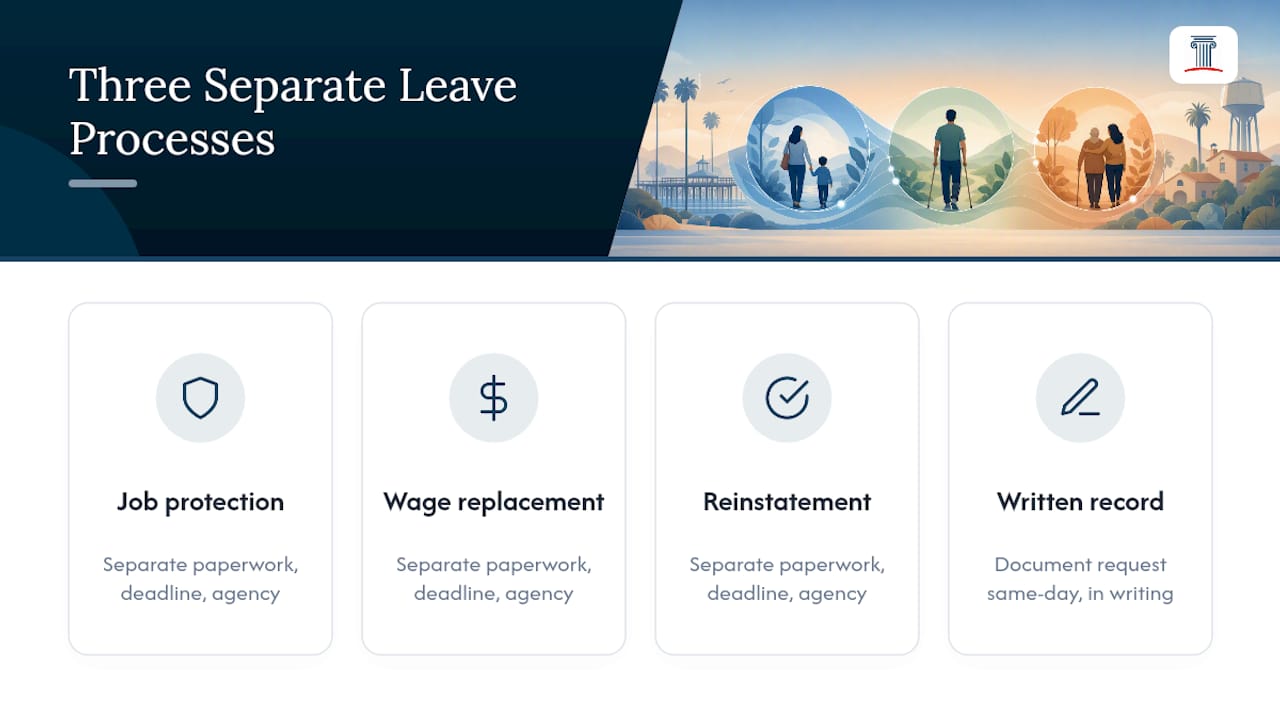
The conventional advice on FMLA and CFRA treats them as interchangeable, and that’s where employees lose ground. I’d argue the bigger failure isn’t ignorance of the law, it’s employees treating leave as a single event rather than three separate processes running on three separate clocks: job protection, wage replacement, and reinstatement. Each has its own paperwork, its own deadline, and its own agency.
What’s overrated is the assumption that a sympathetic employer will handle the details correctly. Most don’t, not out of malice but because HR departments juggling CFRA’s broader family definitions against FMLA’s narrower ones make mistakes constantly, especially at smaller Fountain Valley employers who rarely deal with these claims.
What should come first, before anything else, is the written record. An employee who requests leave verbally and never follows up in writing hands their employer every advantage in a later dispute. That single habit, documenting the request the same day it’s made, determines more outcomes than any other factor in these cases.
— Maya Serkova
Get Help Securing Your Leave Rights in Fountain Valley
Serendib Law Firm is the direct alternative to guessing your way through FMLA and CFRA paperwork alone. Where a generic HR hotline or a national payroll company’s leave portal gives you a form letter, Serendib Law Firm gives you a Fountain Valley attorney who reviews your specific documentation, tells you which law actually protects you, and steps in when an employer misses a deadline or retaliates after you return. Free consultations mean you get that assessment before committing to anything, and bilingual support in English and Spanish means the details don’t get lost in translation. If you’re dealing with a denied leave request, a missed eligibility notice, or termination that followed your return from leave, contact Serendib Law Firm today to have your situation reviewed directly.
Sources
- Family and Medical Leave Act (U.S. Department of Labor)
- Family Care and Medical Leave: Quick Reference Guide (California Civil Rights Department)
- Paid family leave (EDD)
- Family Care and Medical Leave Fact Sheet (California Civil Rights Department)
- DE 2511 — Paid Family Leave (EDD)