
If you were fired after complaining about unpaid wages, taking protected leave, or reporting harassment, California law likely gives you a claim under FEHA, Labor Code retaliation protections, public-policy doctrine, or an implied contract theory. Act now: preserve every document and text tied to your firing, write down every relevant date, and check your filing window before it closes. Legal firms can help Anaheim employees triage these deadlines during a free consultation.
TL;DR:
- Filing a claim within three years for FEHA discrimination or within 180 to 300 days for EEOC claims is crucial for preserving your wrongful termination rights.
- The 90-day window after retaliation or protected activity triggers a rebuttable presumption in your favor, but employers can still mount legitimate defenses with pre-existing documentation.
- Damages typically include back pay, front pay, and possible emotional distress or punitive damages, with final pay and unused vacation wages payable immediately upon termination.
- Early evidence gathering, including documenting warnings, emails, and employer responses, significantly influences the strength and speed of your case.
- Consulting a lawyer promptly and understanding local filing deadlines can prevent claim losses and reduce legal costs through contingency arrangements.
Table of Contents
- What Counts as Wrongful Termination Under California Law?
- What Are the Deadlines for Filing a Wrongful Termination Claim?
- What Compensation Can You Recover From a Wrongful Termination Claim?
- Evidence and Immediate Steps to Preserve Your Claim
- What Happens After You File Your Claim?
- How Damages and Compensation Are Calculated
- How Long Does a Wrongful Termination Case Take to Resolve?
- What Does Wrongful Termination Litigation Cost?
- What Defenses Do Employers Use Against Wrongful Termination Claims?
- Local Insight for Anaheim Employees
- Talk to an Anaheim Employment Lawyer Before Your Deadline Closes
- Sources
- FAQ
What Counts as Wrongful Termination Under California Law?
California employment is “at will,” meaning your employer can fire you for almost any reason, or no reason at all. But at will has limits, and those limits are where wrongful termination claims live.
FEHA discrimination is the most common theory. The Fair Employment and Housing Act generally applies to employers with five or more employees, and it bars firing someone because of race, sex, age, disability, pregnancy, religion, national origin, or sexual orientation, among other protected traits. Harassment protections can reach even smaller employers. If you were let go shortly after disclosing a pregnancy or requesting a disability accommodation, that timing alone is worth examining.
Labor Code retaliation covers a different set of triggers: wage complaints, safety reports to Cal/OSHA, jury duty, whistleblowing, or refusing to break the law. Under Labor Code section 98.6, if your employer takes adverse action within 90 days of your protected activity, the law creates a rebuttable presumption of retaliation. Your employer can still fight back with a legitimate independent reason, but the presumption shifts real weight in your favor early.
Wrongful termination in violation of public policy applies when a firing is substantially motivated by a violation of a fundamental public policy, such as retaliating against you for refusing to commit fraud. CACI No. 2430 lays out the elements juries must find: employment, discharge, a substantial motivating public-policy reason, resulting harm, and causation. Constructive discharge, where you resign because conditions became intolerable, can qualify under this same theory.
Implied or express contracts matter too. An employee handbook promising progressive discipline, or verbal assurances of continued employment, can override at-will status in limited circumstances.
- Fired after reporting unpaid overtime: likely Labor Code retaliation
- Fired after requesting FMLA or CFRA leave: likely FEHA or retaliation
- Fired after refusing an illegal instruction: likely public-policy violation
What Are the Deadlines for Filing a Wrongful Termination Claim?
Missing a filing window can end a valid claim before it starts, so timing drives every early decision in these cases.
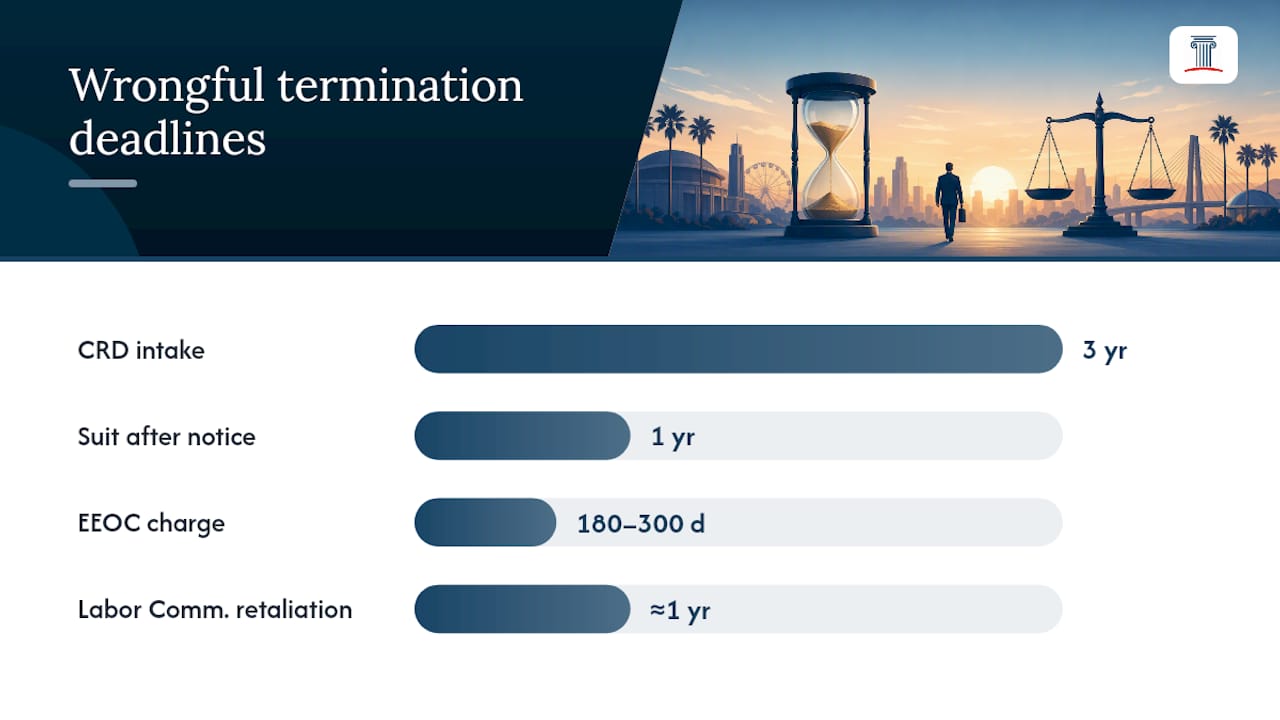
For FEHA claims, you generally must submit an intake with California’s Civil Rights Department within three years of the discriminatory act. Once CRD issues a Right-to-Sue notice, either at your request or after investigation, you then have one year from that notice to file a lawsuit. Federal discrimination claims run on a separate clock: the EEOC generally allows 300 days to file a charge in California, though some claims fall under a shorter 180-day window depending on the circumstances.
Deadline snapshot: CRD intake, up to 3 years. Suit after Right-to-Sue notice, 1 year. EEOC charge, generally 180 to 300 days. Many Labor Commissioner retaliation complaints have a filing deadline around one year, with some exceptions for certain claims ranging from six months to two years.
Wage-related retaliation complaints filed with the Labor Commissioner’s office typically carry their own timelines, and final-pay waiting-time penalty claims move on yet another track.
The strategic fork comes early: request an immediate Right-to-Sue notice if you need to get into court fast, or ask CRD to investigate first if you want the agency’s fact-finding behind you. There is no universally correct choice. It depends on how strong your documentation already is and how quickly you need leverage.
What Compensation Can You Recover From a Wrongful Termination Claim?
Remedies split into two buckets: what you lost financially, and what the law adds as a penalty for the employer’s conduct.
- Back pay covers wages and benefits lost from termination through judgment or settlement
- Front pay compensates for future lost earnings when reinstatement isn’t practical
- Reinstatement to your former position, available in some retaliation cases under section 98.6
- Emotional distress damages, and in egregious cases, punitive damages
- Attorney’s fees, often recoverable under FEHA and several Labor Code provisions
Final-pay issues run separately from wrongful-discharge damages. California generally requires all earned wages, including unused vacation, to be paid at the time of discharge. Willful failure to pay on time can trigger waiting-time penalties calculated as daily wages for a limited period. Note that accrued paid sick leave is treated differently. Under California’s paid sick leave law, unused statutory sick leave generally isn’t payable at termination unless your employer’s policy folds it into general PTO.
Evidence and Immediate Steps to Preserve Your Claim
What you do in the first two weeks after termination often determines how strong your case looks a year later.
- Build a dated timeline of every relevant event: warnings, complaints, leave requests, the termination meeting itself.
- Collect documents including your termination letter, performance reviews, emails, texts, HR correspondence, and pay stubs.
- Write down witness names while memories are fresh, even if you don’t yet have formal statements.
- Save your final paycheck details and note whether all earned wages and vacation pay were included.
- Never delete anything from employer systems or personal devices connected to your work.
- File your agency intake before the deadline, even with an incomplete file.
Pro Tip: You don’t need a perfect evidence file to start. CRD accepts incomplete intakes and lets you add documents later, but a missed filing deadline usually can’t be fixed at all.
If your termination followed a safety complaint or wage dispute, our Anaheim workplace retaliation guide walks through what evidence carries the most weight in those specific claims.
What Happens After You File Your Claim?
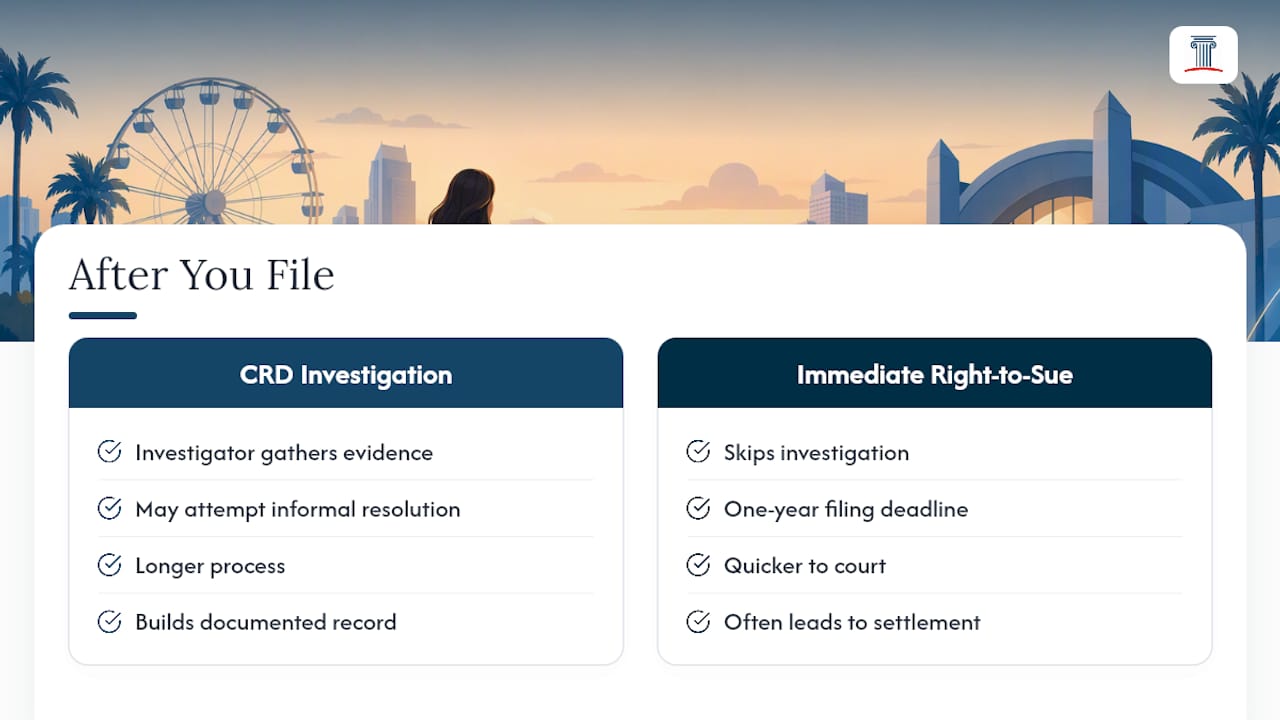
Once your intake is filed, the path forks again. Requesting CRD investigation means an agency investigator gathers evidence and may attempt informal resolution before you ever see a courtroom, which takes longer but builds a documented record. Requesting immediate Right-to-Sue skips that step entirely and puts the clock on you to file in court within a year.
For Labor Commissioner wage or retaliation complaints, the DLSE investigates and can issue an order for back wages or penalties, with appeal rights if either side disagrees.
Most wrongful termination cases, whether they proceed through litigation or settlement, resolve before trial. Settlement discussions frequently open once your employer’s counsel reviews the strength of your documentation, and cases with clear timelines under the 90-day retaliation presumption tend to move faster toward resolution.
How Damages and Compensation Are Calculated
Calculating what a wrongful termination claim is worth starts with your wage history, not a flat formula. Attorneys typically build a back-pay figure by multiplying your prior salary or hourly rate by the time between termination and resolution, then subtract any income you earned elsewhere during that gap, since California law requires mitigation.
Front pay adds a forward-looking layer when reinstatement isn’t realistic, often based on how long a similarly situated worker might reasonably take to find comparable employment. Emotional distress damages are harder to quantify and depend heavily on documented impact, such as therapy records or a treating physician’s notes, rather than a set multiplier.
Punitive damages require proof of malice, oppression, or fraud, and California courts weigh the employer’s financial condition when setting that figure. Attorney’s fee awards under fee-shifting statutes like FEHA are calculated separately from your personal damages and don’t reduce your recovery.
The strength of your 90-day timing evidence under section 98.6’s rebuttable presumption can meaningfully shift settlement value upward, since it shifts the burden onto your employer early in negotiations. Every case is different, and no article can predict your specific number. What matters is documenting your wage history and job search efforts from day one.
How Long Does a Wrongful Termination Case Take to Resolve?
Timelines vary widely depending on which path you choose at the filing stage. A claim resolved through direct settlement negotiation, without a lawsuit, can sometimes wrap up in a matter of months once both sides exchange documentation and demand letters.
Cases that proceed through CRD investigation add time upfront, since the agency conducts its own inquiry before deciding whether to issue findings or a Right-to-Sue notice. Once a lawsuit is filed, expect a longer arc: written discovery, depositions, and possibly mediation, often stretching well beyond a year before trial or settlement.
Labor Commissioner wage claims tend to move faster than full civil litigation, since the DLSE hearing process is designed to be more streamlined than court. Complex discrimination or retaliation cases involving multiple parties or extensive document review generally take longer than straightforward wage disputes.
The single biggest factor within your control is how early you preserve evidence and file your agency intake. Waiting months to act doesn’t just risk missing a deadline. It also gives your employer more time to reshape the narrative around your termination before you’ve locked in your own version of events with dated documentation.
What Does Wrongful Termination Litigation Cost?
Many employees delay contacting an attorney because they assume legal representation is out of reach financially. That assumption often doesn’t hold up in employment cases.
Many employment attorneys, including those handling wrongful termination and retaliation matters, take these cases on contingency, meaning you pay no upfront attorney fee and the firm is compensated from a percentage of your recovery if the case succeeds. This structure exists specifically because FEHA and several Labor Code provisions allow prevailing employees to recover attorney’s fees from the employer, which reduces the financial barrier to pursuing a legitimate claim.
Costs beyond attorney fees can include filing fees, deposition transcripts, and expert witness fees in cases involving disputed damages calculations, though many firms advance these costs and recover them only if you win. Self-filing with the Labor Commissioner or CRD costs nothing directly, but going it alone through litigation without counsel raises the risk of missing procedural requirements that can weaken an otherwise strong claim.
The financial risk of doing nothing is often higher than the risk of consulting an attorney. A missed deadline forecloses your claim entirely, while a free consultation costs you nothing but time.
What Defenses Do Employers Use Against Wrongful Termination Claims?
Employers rarely admit a firing was retaliatory or discriminatory. Instead, they typically build a defense around a legitimate, nondiscriminatory business reason.
Common defenses include documented performance problems, workforce reductions or restructuring, policy violations, or attendance issues unrelated to protected leave. Employers will often point to a paper trail of warnings or reviews that predates your protected activity, arguing the termination decision was already in motion before you complained or requested leave.
Under the section 98.6 presumption, if adverse action follows protected activity within 90 days, the burden shifts to your employer to articulate that legitimate reason. But a shifted burden isn’t a guaranteed win. Employers can and do rebut the presumption successfully when their documentation genuinely predates your protected activity.
Another frequent defense involves reframing a resignation as voluntary rather than a constructive discharge. California courts have held that a resignation can still support a wrongful termination claim if working conditions were objectively intolerable and tied to a public-policy violation, a principle rooted in Foley v. Interactive Data Corp. This is exactly why documenting the sequence of events leading to any resignation matters as much as documenting an outright firing.
Local Insight for Anaheim Employees
Deadline mistakes are the most preventable and the most costly errors in wrongful termination cases. Legal firms work with employees across Anaheim and Orange County who need clarity fast: which filing window applies, what evidence matters most, and whether their situation points toward a FEHA claim, a Labor Code retaliation claim, or both.
We offer free consultations and handle many employment matters on contingency, and our team serves clients in English and Spanish. An initial case review typically covers a deadline check against your specific dates, a walk-through of the evidence checklist, and a clear read on which filing path fits your situation.
Local counsel matters here because Orange County’s agency offices, court procedures, and typical settlement patterns differ from other regions. Our Anaheim employment law team brings that regional familiarity to every case triage.
Talk to an Anaheim Employment Lawyer Before Your Deadline Closes
Legal firms can provide an alternative to guessing at your own deadlines and drafting agency paperwork alone. They may offer free consultations that turn confusion into a clear plan: which filing window still applies to your case, which legal theory fits your facts, and what documentation you still need to gather.
Bring your termination letter, any performance reviews, pay stubs, and copies of relevant emails or texts to your consultation. We’ll walk through deadline triage first, since a missed CRD or EEOC window can end a valid claim regardless of how strong the underlying facts are. From there, legal counsel may discuss likely claims and next steps in plain language, not legal jargon.
If your termination happened recently, treat the filing clock as already running. Reach out through our contact page or explore our employment law practice to schedule your free consultation today. We also represent clients in personal injury, business litigation, immigration law, and disability and workers’ compensation matters across Orange County.
This article is general information, not a substitute for advice from a qualified lawyer. Consult a qualified legal professional about your own circumstances before acting on anything here.
Sources
- Employment Discrimination | Civil Rights Department (California)
- California Labor Code §98.6
- Timeliness | EEOC Los Angeles
- Paid Sick Leave | California Department of Industrial Relations
FAQ
Can I sue my employer for wrongful termination in California?
Yes, if your firing violated FEHA, Labor Code retaliation protections, public policy, or an employment contract. You generally need a CRD Right-to-Sue notice before filing a FEHA lawsuit, and the complaint process requires intake within roughly three years of the discriminatory act.
What is the average payout for wrongful termination in California?
There is no fixed average since outcomes depend heavily on your wage history, mitigation efforts, and whether emotional distress or punitive damages apply. Back pay, front pay, and attorney’s fees are calculated individually for each case rather than following a standard formula.
What are the odds of winning a wrongful termination suit?
Outcomes depend on documentation strength and timing evidence. Cases where adverse action followed protected activity within 90 days benefit from the rebuttable presumption under section 98.6, which shifts the initial burden to your employer, though employers can still rebut it with legitimate documentation.
What should you avoid saying during a termination meeting?
Avoid admitting fault, signing releases or severance agreements on the spot, or making promises about not pursuing legal action. Ask for the reason in writing, take notes on exactly what was said, and consult an attorney before signing anything.