
You may have a wrongful termination claim under California law if your firing was tied to discrimination, retaliation or whistleblowing, breach of contract, or a violation of public policy. If that sounds like your situation, preserve every email, text, and performance record now, note names and dates while they are fresh, and reach out to counsel promptly because strict filing deadlines apply.
TL;DR:
- California discrimination claims can allow 300 days for an EEOC charge; FEHA lawsuits generally require a Right to Sue notice and a separate deadline.
- Whistleblower claims can fail if an employer proves it would have made the same decision anyway, so document complaint dates and termination timing.
- If an employer willfully withholds final wages, California can impose a separate waiting time penalty of up to 30 days’ wages, beyond other damages.
- Download work emails to a personal account on termination day, since employer access may end within hours, and gather your personnel file and pay records.
Table of Contents
- What Counts as Wrongful Termination Under California Law
- Common Legal Grounds With Concrete Red-Flag Examples
- Where and When to File: EEOC, CRD, and Right-to-Sue Rules
- Remedies and Likely Outcomes in a Wrongful Termination Case
- Practical Next Steps: Evidence Checklist Before Your Consultation
- Serendib Law: Local Huntington Beach Employment Law Resources
- Practitioner Perspective: What Recent Rulings Mean for Your Case
- Request a Free Case Evaluation From Our Employment Team
- FAQ
- Sources
What Counts as Wrongful Termination Under California Law
California is an at-will employment state, which means an employer can generally end a job for almost any reason, or no reason at all, without warning. That default has real limits, and those limits are where most wrongful termination claims live.
The California Fair Employment and Housing Act (FEHA) bars firing someone because of a protected characteristic such as race, sex, age, disability, or pregnancy. The California Labor Code separately protects workers who report illegal conduct, request medical leave, or file wage complaints. Courts have also recognized a public-policy exception: an employer cannot fire you for refusing to break the law or for exercising a legal right, such as serving on a jury.
For employees in Huntington Beach, these protections play out across a mix of hospitality, retail, tourism, and small professional employers along the coast, many of which lack dedicated human resources departments. That gap often means managers make termination decisions without documenting the real reason, which can work in a fired employee’s favor once a claim is investigated. Having a bilingual attorney nearby matters too, since Orange County’s workforce includes many Spanish-speaking employees who may not otherwise know their rights were violated.
- At-will employment allows termination without cause, but not for an illegal reason.
- FEHA protects against firing based on protected characteristics.
- Labor Code sections protect whistleblowers, leave requesters, and wage-complaint filers, with filing windows that vary.
- Public-policy violations cover firings for refusing illegal orders or exercising legal rights.
Common Legal Grounds With Concrete Red-Flag Examples
Some firings carry obvious warning signs once you know what to look for. Recognizing the pattern early helps you preserve the right evidence before it disappears.
Discrimination claims often arise when an employee is replaced shortly after disclosing a pregnancy, a disability, or a protected status, or when a supervisor makes comments tied to age, race, or gender before the termination. Retaliation claims follow a similar pattern: an employee reports harassment, requests medical leave, or complains about unpaid wages, and within weeks faces a sudden demotion or termination with no clear performance issue. Whistleblower protections under the Labor Code cover employees who report suspected violations of state or federal law to a government agency or to a supervisor with authority to investigate, though recent court rulings have clarified that not everyone qualifies, and that employers can raise a “same-decision” defense by showing they would have made the same call regardless of the protected activity. Breach of contract or implied promise claims can arise from an offer letter, an employee handbook promising progressive discipline, or verbal assurances of continued employment that the employer later ignores.
- Discrimination: termination following disclosure of pregnancy, disability, or another protected trait.
- Retaliation: termination soon after reporting harassment, requesting leave, or disputing wages.
- Whistleblowing: termination after reporting illegal conduct, subject to employer defenses.
- Breach of contract: termination contrary to handbook policies or written assurances.
Where and When to File: EEOC, CRD, and Right-to-Sue Rules
Timing drives almost everything in a wrongful termination case, and the agency you choose depends on the type of claim you have.
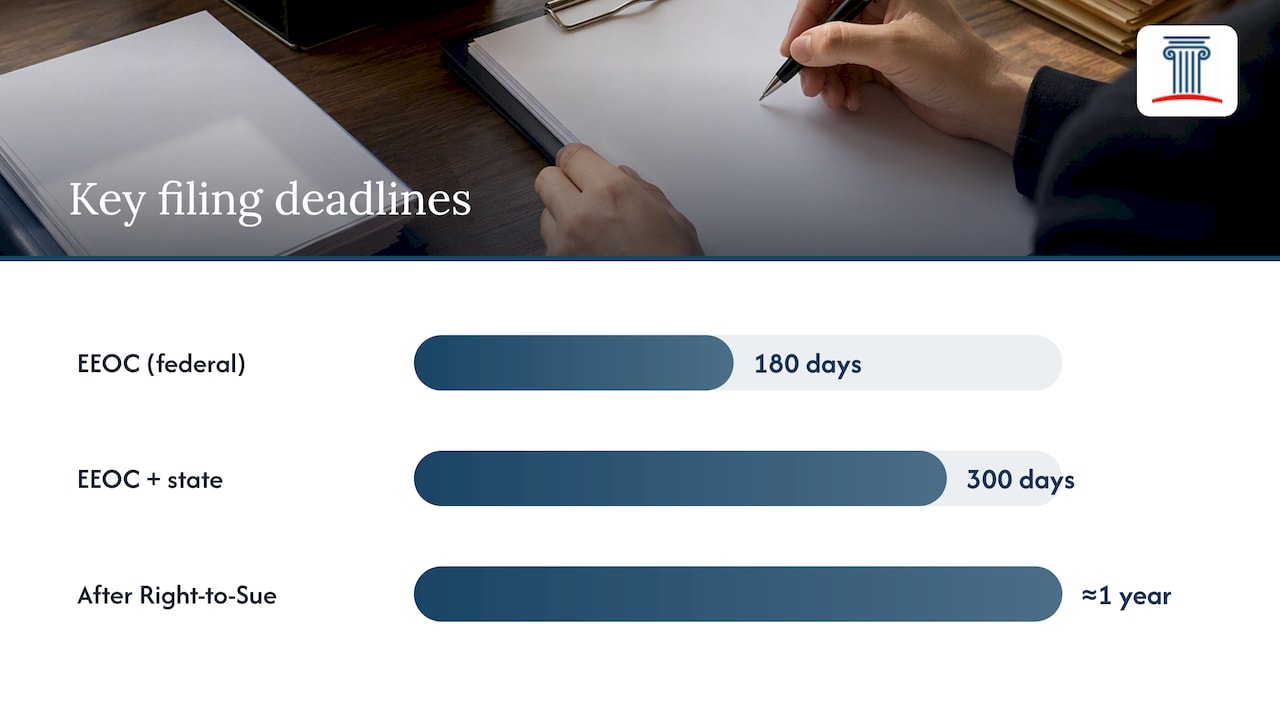
For discrimination claims, the EEOC generally requires filing within 180 days of the termination, a window that extends to a longer period when a state or local agency, like California’s Civil Rights Department, enforces a similar law. You can start the process through the EEOC Public Portal, which walks you through required documentation before an investigator is assigned.
- File with the California Civil Rights Department or the EEOC within the applicable deadline, since the two agencies coordinate through dual filing.
- Request a Right-to-Sue notice once the administrative review is complete, since FEHA claims generally require this notice before you can sue in court, and you then have a limited period from the notice date to file, typically about a year.
- For wage-related retaliation, file with the California Labor Commissioner, where claims must be filed within a limited statutory period.
One sourced detail worth remembering: the EEOC confirms that its standard 180-day deadline stretches to 300 days in states with their own enforcement agency, which includes California, giving Huntington Beach employees meaningfully more runway than the federal baseline suggests.
If a deadline is close, do not wait for a perfect case file. Contact an employment attorney immediately so they can request an expedited Right-to-Sue notice or evaluate dual-filing options before time runs out.
Remedies and Likely Outcomes in a Wrongful Termination Case
What you can recover depends heavily on the facts, but California law offers several categories of relief that go beyond simply getting your job back.
- Back pay covers wages lost between termination and resolution of the claim.
- Front pay compensates for future lost income when reinstatement is not practical.
- Reinstatement restores you to your former position where appropriate.
- Emotional distress damages and, in egregious cases, punitive damages may be available.
A protection unique to California wage law: under Labor Code Sections 201 and 203, an employer who willfully fails to pay all earned wages at termination can owe a waiting-time penalty of up to 30 days of wages, separate from any wrongful termination damages. Courts weigh causation, whether you mitigated your losses by seeking new work, and any defenses the employer raises, which is why two cases with similar facts can resolve very differently.
Practical Next Steps: Evidence Checklist Before Your Consultation
Acting quickly protects both your legal position and your ability to recover what you are owed. A clear, organized record makes the difference between a claim an attorney can move on immediately and one that takes weeks to untangle.
- Write down a timeline of events, including dates of complaints, warnings, and the termination itself, while details are still fresh.
- Save emails, text messages, and performance reviews before access to a work account is cut off, and request a copy of your personnel file.
- Request your final paycheck at termination, since California law requires immediate payment in most involuntary termination cases, and document any delay or shortfall.
- Gather your offer letter, employee handbook, pay stubs, and termination notice ahead of a consultation so an attorney can evaluate your claim quickly.
- Prepare specific questions about timeline, likely remedies, and whether your case qualifies for contingency representation.
Pro Tip: Export your work emails to a personal account the same day you are terminated, since employer systems often restrict access within hours.
Serendib Law: Local Huntington Beach Employment Law Resources
We represent employees throughout Orange County, including Huntington Beach, in wrongful termination, discrimination, and retaliation matters, with bilingual support available in English and Spanish for clients who prefer to discuss a sensitive situation in their own language.
- We offer consultations to evaluate whether a termination violated California law.
- We handle select employment matters on a contingency-fee basis.
- Our employment law practice covers discrimination, retaliation, wrongful termination, and related wage disputes.
- Our guide on what is wrongful termination walks through the legal doctrine in more depth for readers who want additional background.
Practitioner Perspective: What Recent Rulings Mean for Your Case
Even a strong whistleblower claim can lose value if the employer proves it would have made the same decision regardless of the protected activity, a defense recent California court rulings have reinforced. That makes contemporaneous documentation of timing and motive more valuable than memory reconstructed months later. In many cases, pursuing the Labor Commissioner or CRD process before filing suit builds a cleaner record and can resolve wage or retaliation issues faster than litigation.
— Maya Serkova
Request a Free Case Evaluation From Our Employment Team
If your termination looks like one of the patterns described above, waiting rarely helps your position and can cost you a filing deadline. We offer a free consultation to review your timeline, the documents you have gathered, and whether a discrimination, retaliation, or contract claim fits your situation, with contingency-fee representation available in qualifying employment matters.
- Bring your termination notice, offer letter, pay stubs, and any relevant emails to your intake call.
- Ask directly about filing deadlines that apply to your specific claim type.
- Request bilingual support if English is not your first language.
Reach our California employment lawyer team to schedule your free consultation and find out where your case stands.
This article is general information, not a substitute for advice from a qualified lawyer. Consult a qualified legal professional about your own circumstances before acting on anything here.
FAQ
What is the average payout for wrongful termination in California?
Settlement and verdict amounts vary widely based on lost wages, emotional distress, and whether punitive damages apply, so there is no single reliable average. An attorney can give you a realistic range only after reviewing your pay history, the strength of your evidence, and the specific legal grounds for your claim.
Can I sue my employer for wrongful termination in California?
Yes, if your firing involved discrimination, retaliation, whistleblower retaliation, breach of contract, or a public-policy violation, you may have grounds to sue. For FEHA-based claims, you generally need a Right-to-Sue notice from the state civil rights agency before filing in court.
What is the 72 hour rule in California?
The rule generally refers to final-pay timing for employees who quit without notice, not for involuntary terminations, which require immediate payment of final wages. If final wages are withheld improperly, a waiting-time penalty under Labor Code Section 203 may apply.
What are the odds of winning a wrongful termination suit?
Outcomes depend heavily on documentation, timing, and whether the employer can raise a valid defense, including the same-decision defense recognized in recent whistleblower rulings. Strong contemporaneous evidence, such as emails and witness accounts gathered soon after termination, generally improves an employee’s position.
Sources
- Time limits for filing a charge | U.S. Equal Employment Opportunity Commission
- Courts clarify California whistleblower law | JDSupra