
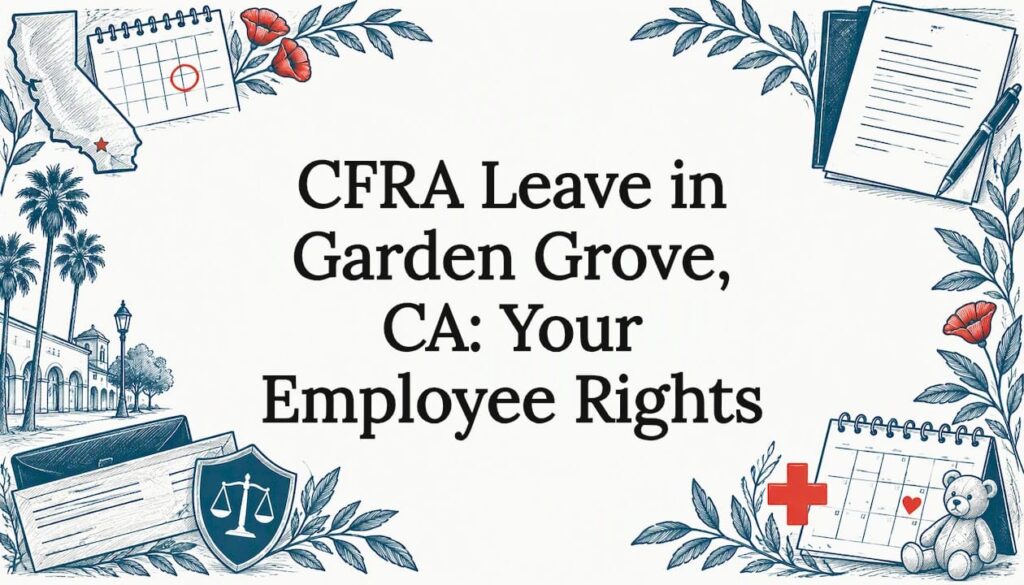
If you work in Garden Grove and need time off for your own serious health condition, to care for a loved one, or to bond with a new child, the California Family Rights Act (CFRA) may protect your job while you are away. In short, eligible employees can take up to 12 workweeks of job-protected leave in a 12-month period, and your employer may not retaliate against you for asking. This guide explains who qualifies, what the leave covers, how it fits with paid benefits, and what to do when an employer in Garden Grove or elsewhere in Orange County denies or punishes leave.
TL;DR
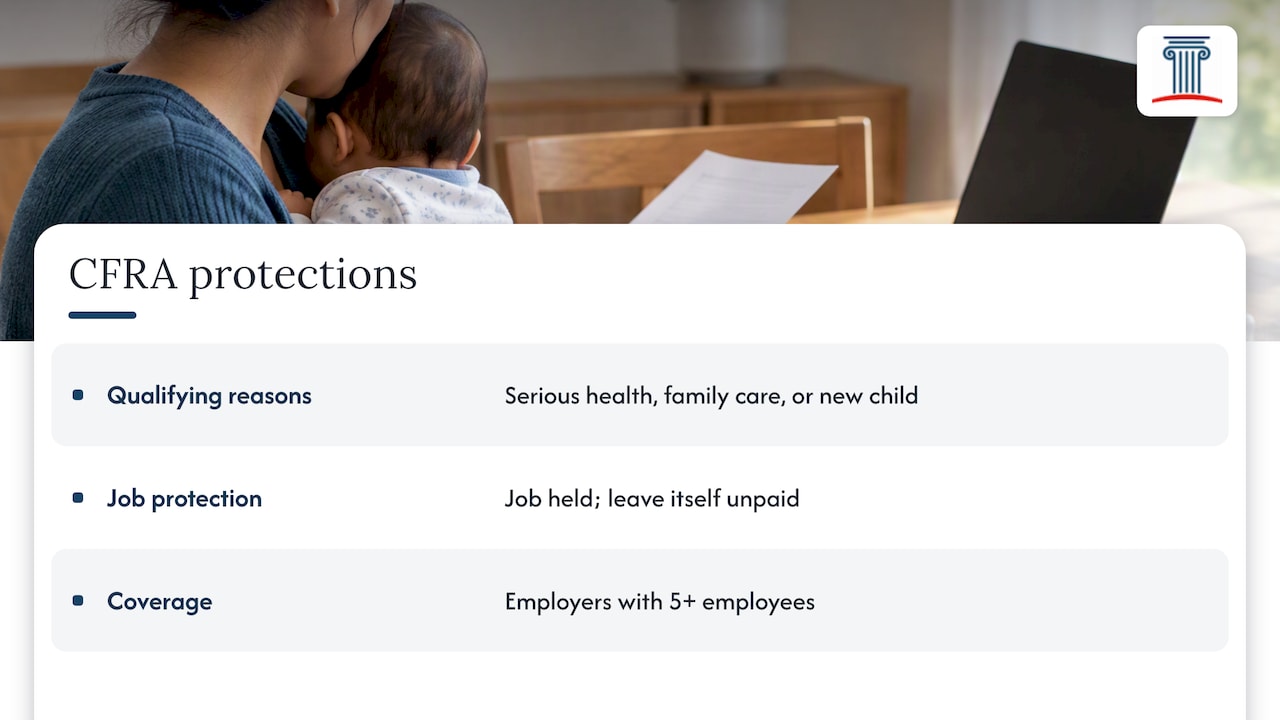
- CFRA gives eligible employees up to 12 weeks of unpaid, job-protected leave in a 12-month period, and it reaches employers with as few as 5 employees.
- You generally need 12 months with your employer and 1,250 hours worked in the prior 12 months.
- CFRA leave is unpaid by the employer, but California Paid Family Leave may replace part of your wages for up to 8 weeks.
- Denial, demotion, or termination because you requested or took leave can be unlawful retaliation, and a complaint with the California Civil Rights Department (CRD) is the first formal step.
- We offer a free consultation and speak English and Spanish.
Table of Contents
- What CFRA leave is, and why it matters in Garden Grove
- Who is eligible for CFRA leave
- Reasons you can take CFRA leave
- How long the leave lasts
- CFRA, FMLA, and pregnancy disability leave
- Getting paid during CFRA leave
- How to request leave in Garden Grove: a practical checklist
- When an employer denies leave or retaliates
- Our perspective
- Talk to our team about your leave
- FAQ
- Sources
What CFRA leave is, and why it matters in Garden Grove
The California Family Rights Act is a state law that guarantees job-protected leave to eligible employees. According to the California Civil Rights Department, it applies when you have a serious health condition, are caring for a family member with one, or are bonding with a new child by birth, adoption, or foster placement.
The key phrase is “job-protected.” CFRA does not make your employer pay you during leave. What it does is require the employer to hold your position, or a comparable one, and to leave your employment otherwise intact. For a household in Garden Grove juggling rent, a new baby, or a parent’s surgery, that security is often the difference between taking care of family and risking a paycheck.
Because CFRA reaches employers with 5 or more employees, it covers many workers at the small businesses, restaurants, medical offices, and warehouses that make up much of the local economy, not only people at large corporations.
Who is eligible for CFRA leave
The CRD guide sets out three basic requirements. You must have worked for your employer for at least 12 months, logged at least 1,250 hours of service in the 12 months before the leave begins, and work for an employer with 5 or more employees.
To check yourself quickly:
- Time on the job. Count back from the first day you plan to be off. Twelve months of employment do not have to be consecutive in every case, so ask us if you had a break in service.
- Hours worked. 1,250 hours is roughly 24 hours a week over a full year. Part-time workers in Garden Grove often qualify without realizing it.
- Employer size. Count everyone on the payroll, not just the people at your location.
If you fall short on any point, you may still have rights. Disability accommodation law, pregnancy disability leave, and paid sick leave can fill gaps, and we cover each below.
Reasons you can take CFRA leave
Eligible employees can use CFRA for:
- Your own serious health condition, including conditions that make you unable to do your job.
- Caring for a family member with a serious health condition.
- Bonding with a new child through birth, adoption, or foster care.
The definition of family is broader than many people expect. The CRD explains that eligible family members include a child, spouse, domestic partner, parent, grandparent, grandchild, sibling, or a “designated person”. Beginning in 2023, the definition expanded to include a person related by blood or someone who is like family to you. If your aunt raised you or a close friend has no one else, you may be able to take protected leave to care for them.
How long the leave lasts
You may take up to 12 workweeks within a 12-month period. The CRD notes the leave can be taken in a block or in smaller pieces when medically necessary, which matters for chemotherapy schedules, dialysis, or recurring treatment. A Garden Grove employee managing a chronic condition might use a few hours a week rather than three months at once.
Twelve weeks is a ceiling for CFRA itself, not necessarily the end of your protection. According to the CRD, an employer cannot fire you for being out sick if you are disabled and entitled to leave as a reasonable accommodation, or if your condition qualifies for CFRA or FMLA leave. When you cannot return after 12 weeks, the employer must engage in the interactive process, a good-faith conversation about what accommodation, including additional time off, is possible.
CFRA, FMLA, and pregnancy disability leave
Many workers ask whether CFRA or the federal Family and Medical Leave Act (FMLA) applies to them. They are similar, but they are not identical. The most important practical difference for Garden Grove workers is that CFRA is a California law with its own coverage rules, and it protects employers’ workers down to the 5-employee level. We cover federal-law specifics on our related pages, including our guide to pregnancy leave and CFRA/FMLA.
Pregnancy is where the laws interact most. According to the CRD, FMLA and Pregnancy Disability Leave (PDL) often run together, but CFRA is separate and adds another layer of protection. In practice:
| Leave type | Typical purpose | Key point |
|---|---|---|
| Pregnancy Disability Leave | Time you are disabled by pregnancy, childbirth, or related conditions | Up to 4 months |
| CFRA leave | Bonding with a new child, own or family member’s serious health condition | Up to 12 weeks |
| Reasonable accommodation under FEHA | Additional time off when still unable to work | Requires the interactive process |
The CRD states that PDL and CFRA are separate, consecutive entitlements, so a new parent can take 4 months of pregnancy disability leave followed by 12 weeks of CFRA bonding leave. If your disability continues after PDL ends, you are not automatically terminated, and you may request reasonable accommodation under the Fair Employment and Housing Act.
Getting paid during CFRA leave
CFRA protects your job but does not guarantee a paycheck. Three programs may help.
Paid Family Leave (PFL). The Employment Development Department says PFL provides up to 8 weeks of partial wage replacement for caregiving, bonding, or military assistance, generally 60% to 70% of weekly pay depending on income, with a maximum weekly benefit of $1,765 for claims beginning on or after January 1, 2026. PFL does not depend on length of service or company size. It does require that you paid into the State Disability Insurance program, which appears as CASDI on pay stubs, in the qualifying period before your claim. Payment begins the first day of leave with no waiting period.
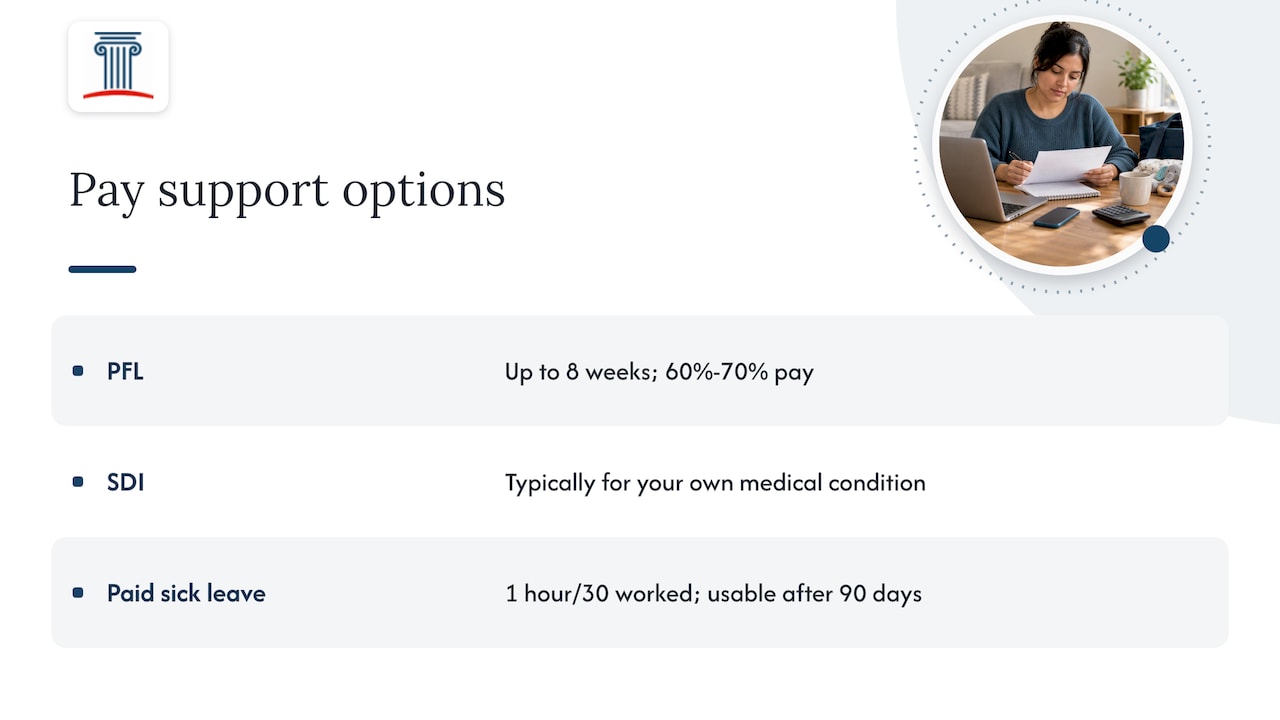
State Disability Insurance (SDI). If the leave is for your own medical condition, SDI rather than PFL is typically the benefit to ask about. Confirm the details with the EDD before you apply.
Paid sick leave. The Labor Commissioner’s office explains that California sick leave accrues at one hour for every 30 hours worked and can be used after 90 days. You can often use accrued days alongside CFRA, so ask your employer how it handles that.
A practical example: a Garden Grove warehouse employee with an aging parent needs six weeks to arrange care after a stroke. CFRA holds the job, PFL can replace a portion of income for up to 8 weeks, and accrued sick leave may cover a short gap. The numbers differ for each person, which is why a conversation with an attorney is worth having before you sign anything the employer hands you.
How to request leave in Garden Grove: a practical checklist
- Tell your employer in writing. Email your supervisor and HR. State that you are requesting leave under CFRA and give the expected start date and duration.
- Give notice when you can. If the need is foreseeable, give as much notice as you reasonably can. If it is an emergency, the CRD says an employer cannot deny the leave or fire you for lack of advance notice when the need was unforeseeable and you notified them as soon as practicable.
- Keep the paperwork. Save medical certifications, emails, text messages, and any written response or denial.
- Ask for the decision in writing. If the employer says you are not eligible, request the reason and the facts behind it.
- Apply for wage replacement. File for PFL or SDI with the EDD as early as the rules allow.
- Record changes after you ask. A sudden bad review, schedule cut, or write-up right after a leave request is evidence worth saving with dates.
When an employer denies leave or retaliates
The People Also Ask question we hear most is whether an employer can deny CFRA. If you meet the eligibility rules and the reason qualifies, a refusal is generally unlawful. The CRD also states that CFRA includes protections against retaliation for taking leave. Common warning signs include:
- Being told you will be replaced if you take leave.
- Termination, demotion, or reduced hours shortly after a request.
- Pressure to return early or to work while on leave.
- Refusal to reinstate you to the same or a comparable position.
- Penalties, such as attendance points, for protected absences.
- Silence when you ask about accommodation after your 12 weeks end.
If you experience any of these, speak with an employment attorney soon, ideally before you resign or sign a separation agreement.
Filing with the CRD
Even if you plan to go to court, you generally must start with the state agency. The CRD says you are legally required to file a complaint with the California Civil Rights Department first, and you can request an immediate right-to-sue notice upon filing so that you can proceed to court. The CRD also describes a 3-year window from the date of the alleged incident for filing. Deadlines can vary with the facts, so do not wait to find out which one applies to you.
Our perspective
In our experience as an employment practice serving Orange County, the hardest part of a leave dispute is rarely the statute. It is the moment an employee realizes that the manager who was supportive last week is now documenting attendance. We tell Garden Grove clients the same thing at the first call: protect your job before you protect your pride. Put the request in writing, keep every message, and let us read the employer’s response before you answer it.
We also see workers assume that because they are part-time, newer, or at a small company, CFRA does not apply to them. Sometimes that is right, but often the hours add up and the employer is covered. And even when CFRA does not fit, disability accommodation, pregnancy leave, and sick leave rules may. Our approach is not to ask whether you have a case but to work out how the law applies to your facts, in English or Spanish, so that you understand each step.
— Maya Serkova
Talk to our team about your leave
If your employer has denied leave, cut your hours after a request, or terminated you while you were out, our employment law practice handles wrongful termination, retaliation, discrimination, and family and medical leave claims. We offer free consultations, bilingual attorneys and staff, and contingency-based representation in select cases. You can contact us here to describe what happened.
FAQ
Can an employer deny CFRA leave?
Not if you are eligible and the reason qualifies. An employer that refuses protected leave, or fires or disciplines you for requesting it, may be violating CFRA. If you were told no, ask for the reason in writing and speak to an attorney about your options.
Is CFRA better than FMLA?
For many California workers, CFRA is the stronger protection because it applies to employers with 5 or more employees and recognizes a broader group of family members. It is also separate from pregnancy disability leave, so the two can be taken one after the other. Which law fits your situation depends on your employer and the reason for leave.
Is CFRA leave paid?
The leave itself is unpaid by the employer. You may be able to receive partial wage replacement through California Paid Family Leave for up to 8 weeks, and the amount depends on your earnings, up to the state maximum. Accrued paid sick leave may also be available.
Can I be fired for being out sick in Garden Grove?
Not if the absence is protected. The CRD says an employer cannot terminate you for being out sick when you are disabled and entitled to leave as an accommodation, or when your condition qualifies for CFRA or FMLA leave. Unprotected absences are different, so an attorney should review the facts.
How long do I have to file a complaint?
The CRD describes a 3-year window from the date of the alleged violation for employment complaints. Because details can change the analysis, contact an attorney promptly instead of waiting until the end of that period.
Sources
- California Civil Rights Department: Employment
- California Civil Rights Department: Family Care Medical Leave guide
- California Civil Rights Department: PDL, CFRA and FMLA guide
- California Civil Rights Department: Expanded Family and Medical Leave in California
- EDD: Paid Family Leave benefit payment amounts
- EDD: Paid Family Leave employer overview
- California Labor Commissioner: Worker leave and pay benefits