
If you work in Anaheim and meet CFRA’s eligibility tests, 12 or more months on the job, 1,250 hours worked, and an employer with five or more employees, you qualify for job-protected leave of a duration set by law. CFRA protects your job, not your paycheck. Wage replacement comes separately through EDD’s Paid Family Leave or State Disability Insurance programs, and Serendib Law Firm helps Anaheim workers sort out exactly where they stand.
TL;DR:
- Employees working in Anaheim must meet specific eligibility criteria, including 12 months on the job and 1,250 hours worked in the past year, regardless of employer size.
- CFRA generally offers up to 12 weeks of unpaid leave for various family and medical reasons, with leave periods often taken intermittently or in partial days when medically necessary.
- Wage replacement is provided separately through EDD’s Paid Family Leave and State Disability Insurance programs, which do not guarantee job protection.
- Employers must respond to leave requests within five business days and keep health coverage active, but they cannot deny leave or retaliate if proper procedures are followed.
- Proper documentation, timely notice, and understanding of overlapping laws like PDL and FMLA are crucial to ensuring rights are preserved and claims are successful.
Table of Contents
- What Are the CFRA Eligibility Rules for Anaheim Employees?
- What Reasons Qualify and How Much Leave Can You Take?
- How Does CFRA Interact With FMLA and Pregnancy Disability Leave?
- When Must You Give Notice, and How Fast Must Employers Respond?
- Does CFRA Pay You, and How Do PFL and SDI Fit In?
- What Are Your Reinstatement Rights, and What Happens if CFRA Is Violated?
- How Do You Request CFRA Leave in Anaheim, CA? A Step-by-Step Checklist
- What Employees Get Wrong About CFRA, According to Serendib Law Firm
- How Serendib Law Firm Helps Anaheim Employees Protect Their CFRA Rights
- Where to Verify CFRA Rules and Apply for Benefits
- Sources
What Are the CFRA Eligibility Rules for Anaheim Employees?
The California Family Rights Act sets several tests, and employees must meet all of them before qualifying for protected leave. These include a minimum period of service with the employer, a minimum number of hours worked in the year before leave, and working for an employer with at least five employees, whether private or public.
A change that matters for Anaheim workers: an old eligibility rule requiring 50 employees within a certain distance of the worksite has been removed. That rule used to knock out employees at small satellite offices or remote positions. Now, a five-person Anaheim marketing firm with employees scattered across Orange County has to comply just the same as a large employer.
A few situations trip people up:
- Part-time employees qualify if they meet the required hours threshold, even without full-time status.
- Seasonal workers count hours across the full 12-month lookback period, not just the current season.
- Employees who split time between two employers under a joint-employment arrangement may have hours counted differently depending on who directs and controls the work.
Check your pay stubs or timekeeping records if you’re unsure. That’s the fastest way to confirm the 1,250-hour threshold.
What Reasons Qualify and How Much Leave Can You Take?
CFRA covers a wide range of family and medical circumstances, and the CalHR HR Manual confirms eligible employees receive job-protected leave for a period defined by California law. Covered reasons include:
- Your own serious health condition that keeps you from doing your job.
- Caring for a spouse, parent, child, grandparent, grandchild, sibling, domestic partner, or a “designated person” you name.
- Bonding with a new child through birth, adoption, or foster placement.
- Certain military exigencies tied to a family member’s active duty.
A “serious health condition” generally means an illness, injury, or condition requiring inpatient care or continuing treatment from a health care provider, not a common cold or a one-day flu.
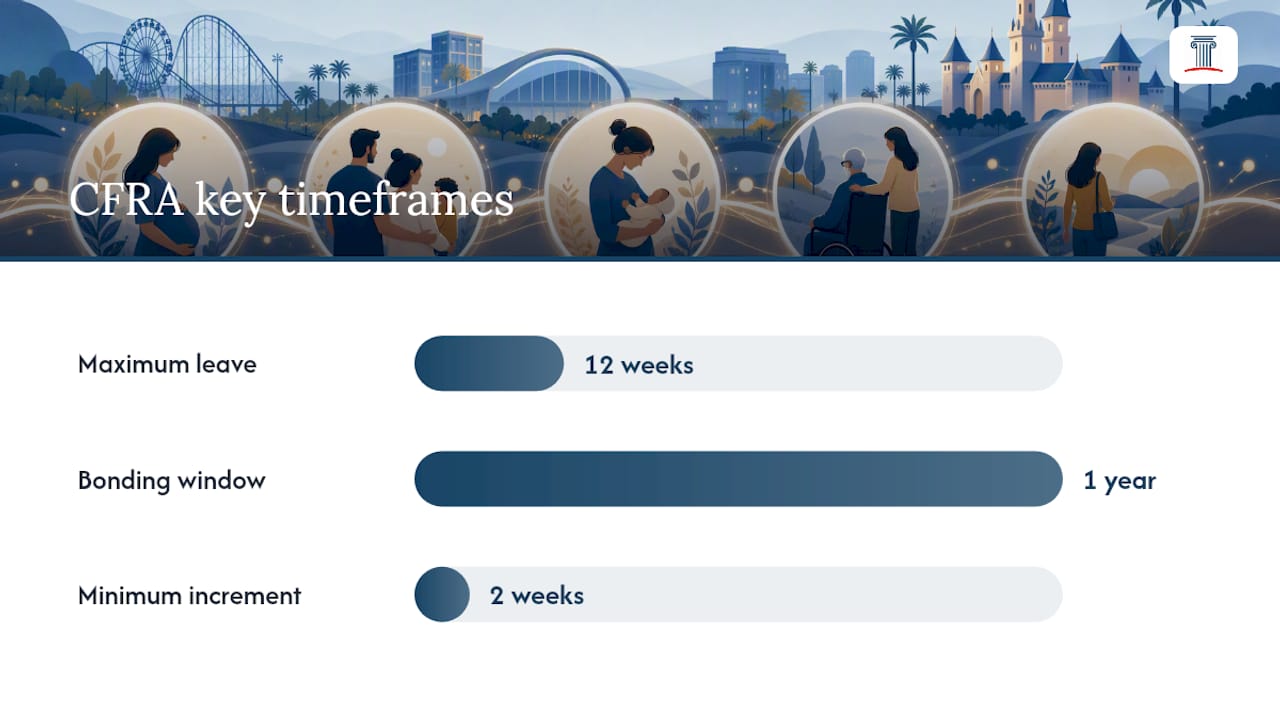
Leave doesn’t have to be taken in one continuous twelve-week block. Intermittent or reduced-schedule leave is available when medically necessary, and many Anaheim employers track it in hourly or daily increments rather than forcing an all-or-nothing approach. Bonding leave has its own wrinkle: it must be completed within one year of the child’s birth or placement, and employers can require it be taken in minimum two-week increments, though they must grant requests for shorter periods on at least two occasions.
How Does CFRA Interact With FMLA and Pregnancy Disability Leave?
CFRA and the federal Family and Medical Leave Act often run at the same time, but they’re not identical twins. When an Anaheim employee qualifies for both, the leave typically runs concurrently, using up the same 12 weeks under each law simultaneously. But gaps appear in specific situations.
- CFRA covers more family relationships than FMLA, including domestic partners, grandparents, siblings, and designated persons.
- Pregnancy Disability Leave (PDL) is a separate California protection that never reduces your CFRA bonding time.
- CFRA’s employer-size threshold (five employees) is far lower than FMLA’s threshold of 50 employees.
- Medical certification standards differ, with CFRA imposing tighter limits on what employers can ask a health care provider.
Here’s the practical payoff: a pregnant employee in Anaheim can take PDL for the physical disability of pregnancy and childbirth, then separately take a full 12 weeks of CFRA leave to bond with the baby. Combined, that can add up to substantially more protected time than either law provides alone, a point the CRD’s fact sheet on CFRA and pregnancy leave spells out directly. For a deeper look at how the federal law applies locally, our guide to FMLA leave rights in Anaheim breaks down the overlap in more detail.
When Must You Give Notice, and How Fast Must Employers Respond?
Timing rules cut both ways under CFRA, and missing a deadline on either side can cost you.
- Give your employer 30 days’ advance notice when your need for leave is foreseeable, such as a scheduled surgery or an expected birth.
- If the need is unexpected, an emergency medical situation, for instance, give notice “as soon as practicable,” even if that means calling in the same day.
- When your employer requests medical certification, respond promptly. Certifications can confirm the condition, expected duration, and need for leave, but they cannot force disclosure of the specific diagnosis.
- Your employer must respond to your leave request as soon as possible, and no later than five business days, according to California’s regulations governing CFRA notice.
- If your employer wants recertification or a second opinion, they must follow CFRA’s stricter authentication rules, which limit how much they can probe beyond confirming the certification is genuine.
Pro Tip: Track the date you submit your leave request in writing, even if you also tell your supervisor in person. If your employer blows past the five-business-day window, that delay itself can become evidence in a denial or interference claim.
Does CFRA Pay You, and How Do PFL and SDI Fit In?
CFRA leave itself is unpaid. Your employer isn’t required to pay your salary while you’re out, but they must keep your group health coverage active on the same terms as if you were working, per CalHR’s guidance. That distinction confuses a lot of Anaheim workers who assume “protected leave” means “paid leave.”
Wage replacement comes from a separate track:
- Paid Family Leave (PFL) replaces a portion of wages while caring for a family member or bonding with a new child.
- State Disability Insurance (SDI) replaces wages for your own serious health condition.
- Both programs are administered by the EDD, and neither one provides job protection on its own.
Your accrued vacation, PTO, or sick leave can often be used to bridge income gaps, and some employers require you to exhaust certain paid leave banks before or during CFRA leave. Apply for PFL or SDI as soon as your leave date is confirmed. Processing takes time, and coordinating the start date with your employer’s payroll cycle avoids a gap in income.
What Are Your Reinstatement Rights, and What Happens if CFRA Is Violated?
When your CFRA leave ends, you’re entitled to return to the same position or a comparable one, meaning equivalent pay, benefits, schedule, and generally the same worksite or one nearby. Anything less, a demotion, a pay cut, a transfer to a worse shift, can amount to an interference violation.
California law backs this up with real teeth:
- California law prohibits interference with leave requests and retaliation against employees who take protected leave.
- Small employers (five to 19 employees) may be required to participate in a mediation program through the Civil Rights Department before a lawsuit proceeds.
- Employees can file a complaint with the CRD or pursue a civil lawsuit for damages, reinstatement, and attorney’s fees.
- Common employer defenses include claiming the position was eliminated for legitimate business reasons unrelated to the leave, so documentation matters enormously; for a deeper understanding of employer-side considerations, see our guide for non-HR professionals on high risk terminations.
Keep every email, leave request, and denial letter. If a case ever needs proving, the paper trail is what carries it. If you were fired or pushed out after taking leave, our coverage of an Orange pregnancy retaliation case walks through how these claims actually play out.
How Do You Request CFRA Leave in Anaheim, CA? A Step-by-Step Checklist
Follow these steps in order, and you’ll cover nearly every requirement Anaheim employers and California law impose.
- Confirm you meet the 12-month, 1,250-hour, and employer-size thresholds before submitting anything.
- Give written notice stating your anticipated start date, expected duration, and whether the leave will be intermittent.
- Submit medical certification promptly when your employer requests it, and keep a copy for your own records.
- Apply for PFL or SDI through the EDD if you need wage replacement, and coordinate the start date with your leave request.
- Save every piece of employer communication, and reach out for legal help immediately if your leave is denied or you face retaliation afterward.
Pro Tip: Send your leave notice by email even if you’ve already discussed it verbally with HR. A dated, written record protects you far better than a hallway conversation your employer can later dispute.
What Employees Get Wrong About CFRA, According to Serendib Law Firm
The biggest mistake we see: employees assume a verbal leave request is enough, then have nothing to point to when an employer claims it never happened. The second: confusing PDL and CFRA bonding time, leaving weeks of protected leave unused because nobody explained they stack. The third: accepting a “comparable” position that’s actually a demotion in disguise.
Document everything, ask questions before you assume, and don’t let an employer’s silence past five business days go unchallenged. Anaheim employees who understand these interactions come out of leave with their job, and their rights, intact.
— Maya Serkova
How Serendib Law Firm Helps Anaheim Employees Protect Their CFRA Rights
Sorting out a denied leave request, a retaliation claim, or a murky PDL-to-CFRA transition isn’t something you should have to untangle alone, especially while managing a medical situation or a new baby. Serendib Law Firm is the direct local option for Anaheim employees who need a lawyer who actually understands how CRD and EDD rules apply to real workplace disputes, not a call center reading from a script. We review your documentation, evaluate whether your employer’s five-business-day response and reinstatement obligations were met, and represent you if your leave was denied or you faced retaliation for taking it. Consultations are free, our team supports clients in English and Spanish, and select employment matters are handled on contingency. If your CFRA leave was denied, delayed, or used against you, contact our team today to talk through what happened and what comes next.
Where to Verify CFRA Rules and Apply for Benefits
Confirm your rights directly with the CRD’s Family Care and Medical Leave guide, apply for wage replacement through EDD’s Paid Family Leave and Disability Insurance programs, and review the governing rules in California Code of Regulations, Title 2, sections 11087 through 11097.
This article is general information, not a substitute for advice from a qualified lawyer. Consult a qualified legal professional about your own circumstances before acting on anything here.