

Many County of Orange employees assume that whistleblower protections fully shield them when reporting misconduct, yet data reveals that fewer than 1% of hotline tips lead to full investigations. This gap between policy and practice creates uncertainty for workers who witness waste, abuse, or illegal activity in Santa Ana offices. Understanding your legal rights, the protections available under California and county laws, and how to navigate the reporting process effectively is essential to safeguard your career while doing the right thing. This article clarifies the whistleblower protections you can rely on, outlines practical reporting channels, and explains how to protect yourself from retaliation.
Table of Contents
- Key takeaways
- Legal protections for whistleblowers at County of Orange offices
- How to report misconduct safely and effectively in County of Orange offices
- Challenges and realities of whistleblowing in Santa Ana county offices
- Protecting yourself from retaliation and seeking help if it happens
- Need legal support with whistleblower rights and workplace retaliation?
- Frequently asked questions
Key Takeaways
| Point | Details |
|---|---|
| Legal protections overview | California Labor Code 1102.5 and the County Ethics Code shield employees who report misconduct and outline remedies for retaliation. |
| Multiple reporting channels | Employees can report to supervisors, Human Resources, or the Fraud Hotline and no single path is required. |
| Fraud Hotline limitations | Although anonymous, the Fraud Hotline has low investigation rates with fewer than 1 percent of tips leading to full reviews. |
| Keep records for protection | Maintain a dated log of observations and evidence to support a reasonable belief before reporting. |
Legal protections for whistleblowers at County of Orange offices
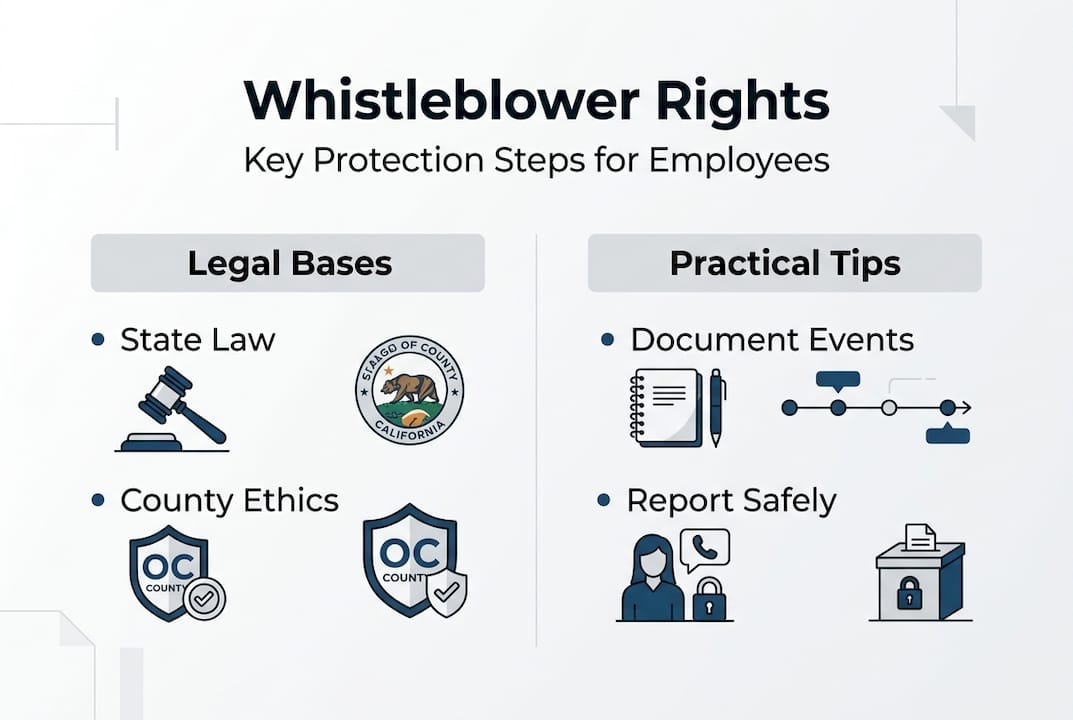
California law and county policies create a strong framework to protect employees who report misconduct. California Labor Code §1102.5 prohibits retaliation against employees for reporting legal violations to government agencies or refusing to participate in illegal acts. Violations carry civil penalties, giving employees legal recourse if employers retaliate. This protection applies broadly to any disclosure of information the employee reasonably believes involves a violation of state or federal law.
The County of Orange Ethics Code updated in 2025 specifically shields employees reporting gross waste, abuse, or danger to public health and safety. Unlike some policies requiring mandatory reporting, this code encourages voluntary disclosure without penalty. It reinforces that county workers can raise concerns about misuse of resources or unsafe conditions without fear of reprisal.
County Equal Employment Opportunity policy also prohibits retaliation related to discrimination or harassment reports and mandates prompt investigations. This policy ensures that employees who report workplace discrimination, harassment, or hostile work environments receive protection similar to other whistleblower scenarios. The policy requires supervisors and HR to respond quickly and impartially to complaints.
All these protections require a reasonable belief that misconduct or violation occurred. You do not need absolute proof before reporting. If you genuinely believe something wrong is happening based on the information available to you, the law protects your disclosure. This standard offers robust defense to whistleblowers acting in good faith.
Pro Tip: Keep a personal record of what you observed, when you observed it, and any evidence supporting your concerns before making a report. This documentation strengthens your position if your employer later questions your reasonable belief.
| Protection Source | Scope | Coverage | Procedures |
|---|---|---|---|
| California Labor Code §1102.5 | Statewide law | Reporting legal violations, refusing illegal acts | File complaint with Labor Commissioner or civil lawsuit |
| County Ethics Code (2025) | County employees | Gross waste, abuse, public health/safety danger | Report via Fraud Hotline, supervisor, or HR |
| County EEO Policy | County employees | Discrimination, harassment, retaliation | Report to EEO office, mandates prompt investigation |
Understanding how these protections overlap helps you recognize that whistleblower protections for government employees create multiple avenues for recourse. If one reporting channel fails, other legal frameworks may still apply.
How to report misconduct safely and effectively in County of Orange offices
The Fraud Hotline offers anonymous reporting at 714-834-3608 or online at ocgov.com/services/fraud, allowing employees to submit tips without revealing their identity. The county’s investigation process is designed to follow up on credible allegations while protecting reporter confidentiality. You can also mail reports to a designated P.O. box if you prefer written communication.
Employees may also report directly to supervisors, Human Resources, or the EEO office. The county’s no wrong door policy encourages any safe reporting path. Choosing the channel that feels most secure to you is valid. Some employees prefer speaking to a trusted supervisor first, while others feel safer using the anonymous hotline. Both approaches are legitimate.
Follow these steps to prepare and submit your report effectively:
- Document what you observed with specific dates, times, locations, and people involved before reporting.
- Gather any supporting evidence such as emails, documents, photos, or witness names if safe to do so.
- Choose your reporting channel based on the nature of the misconduct and your comfort level with confidentiality.
- Submit a clear, factual report focusing on what happened rather than speculation about motives.
- Request confirmation of receipt if possible and note the date you filed the report for your records.
- Follow up periodically to check on investigation status while respecting the process timeline.
When reporting, keep these guidelines in mind:
- Do focus on observable facts and avoid emotional language or personal attacks
- Do report as soon as reasonably possible after discovering the misconduct
- Do keep copies of all communications related to your report in a secure personal location
- Don’t threaten to go public or make ultimatums that could undermine your legal protections
- Don’t share your report widely with coworkers before filing, as this may complicate investigations
- Don’t assume silence means inaction, investigations often take time and remain confidential
Pro Tip: Request email confirmation when you file a report through HR or your supervisor. If using the Fraud Hotline, write down the date, time, and reference number provided. These records become critical if you later need to prove you reported misconduct before any retaliation occurred.
Understanding whistleblower protections in Santa Ana and public policy retaliation helps you recognize when your disclosure falls under protected activity, strengthening your position throughout the reporting process.
Challenges and realities of whistleblowing in Santa Ana county offices
Empirical data reveals significant gaps between policy promises and practical outcomes. Between 2020 and 2023, only 14 full investigations resulted from 1,497 tips filed via the Fraud Hotline. This less than 1% investigation rate highlights challenges in enforcement and outcomes that employees must understand when deciding whether to report.
Common fears employees experience include:
- Retaliation through demotion, unfavorable assignments, or termination despite legal protections
- Career harm from being labeled a troublemaker or losing advancement opportunities
- Lack of feedback after reporting, leaving employees uncertain whether their concerns were addressed
- Isolation from colleagues who may view whistleblowing negatively or fear association
- Emotional stress from navigating investigations while continuing to work in the same environment
OC Employees Association polling shows that fear of retaliation and distrust diminish willingness to report misconduct. Union representatives have stated:
The pervasive culture of fear reduces trust in the system, making employees hesitant to come forward even when they witness serious violations. Workers worry that reporting will harm their careers more than it will fix the problem.
This cultural barrier persists despite strong legal frameworks. The gap between written policy and workplace reality creates a chilling effect on reporting.
| Reporting Metric | Volume | Investigation Rate | Internal Probe Rate |
|---|---|---|---|
| Fraud Hotline tips (2020-2023) | 1,497 | 14 full investigations (0.9%) | 89 internal probes (5.9%) |
| Employee trust level | Declining per union polls | N/A | N/A |
Despite strong policies on paper, practical trust and protection remain complicated in Santa Ana’s county offices. Employees must weigh the moral imperative to report against real career risks. Consulting experienced workplace retaliation lawyers in Orange before or immediately after reporting can help you navigate these challenges strategically.
Understanding retaliation claims in Orange County court shows how legal recourse works when internal processes fail to protect whistleblowers adequately.
Protecting yourself from retaliation and seeking help if it happens
Retaliation includes demotion, harassment, termination, or unfavorable changes in job duties, schedule, or work environment after whistleblowing. California Labor Code protects employees against workplace retaliation, enforceable up to three years after the incident with civil penalties for violations. Recognizing retaliation early and responding appropriately protects your legal rights.
Warning signs and immediate steps include:
- Sudden negative performance reviews after previously positive evaluations, document the timing and save all review materials
- Exclusion from meetings, projects, or communications you previously attended, note specific instances with dates
- Increased scrutiny of your work or micromanagement that differs from past treatment, keep records of directives
- Hostile comments or cold treatment from supervisors or colleagues following your report, document who said what and when
- Reassignment to less desirable duties, shifts, or locations without legitimate business justification, request written explanation
- Threats, intimidation, or pressure to withdraw your complaint or resign, report immediately to HR and EEO
Pro Tip: Consult experienced employment law attorneys early when you suspect retaliation, even before it escalates. Early legal advice helps you document incidents properly and understand your options before the situation worsens. Waiting until after termination limits your strategic choices.
Employees can rely on the County EEO office for filing retaliation claims, which mandates prompt impartial investigations. The EEO policy provides specific reporting contacts and requires the county to investigate retaliation complaints thoroughly. You have three years under California law to pursue legal action for retaliation, giving you time to explore internal remedies first.
Knowing internal county procedures and external legal recourse options strengthens your position if retaliation occurs. Internal procedures may resolve the issue, but if they fail, you retain the right to file a lawsuit. Consulting experienced Anaheim workplace retaliation lawyers ensures you understand both paths and choose the most effective strategy for your situation.
If you face termination or severe retaliation, understanding wrongful termination after HR reports in Orange County clarifies your legal options and potential remedies, including reinstatement, back pay, and damages for emotional distress.
Need legal support with whistleblower rights and workplace retaliation?
Facing retaliation or confusion about whistleblower rights can be stressful, especially when you are trying to do the right thing while protecting your livelihood. Legal experts can help you understand your protections, document incidents properly, and pursue remedies if your employer violates your rights. Serendib Law Firm offers experienced employment law attorneys in Lake Forest, Huntington Beach, and Newport Beach who are skilled in whistleblower and retaliation cases. Contact our team for localized, trusted legal assistance tailored to county employees navigating these complex situations.
Frequently asked questions
What protections does California law offer if I report misconduct?
California Labor Code §1102.5 prohibits retaliation for reporting legal violations or refusing illegal acts, with civil penalties for employers who violate this protection. This protection lasts for up to three years, giving you time to pursue legal remedies if your employer retaliates. You must have a reasonable belief that a violation occurred, not absolute proof.
How can I report misconduct anonymously in County of Orange offices?
You can use the Fraud Hotline at 714-834-3608, online at ocgov.com/services/fraud, or mail to a designated P.O. box to submit anonymous tips safely. This ensures your identity is protected while allowing the county to investigate reported issues. The hotline is designed specifically to maintain confidentiality throughout the investigation process.
What should I do if I face retaliation after reporting misconduct?
Document all incidents of retaliation carefully, including dates, witnesses, and specific actions taken against you, and report them immediately to HR or the County EEO office. Consult experienced Anaheim workplace retaliation lawyers early to understand legal rights and options for wrongful termination or harassment claims. Early legal advice protects your ability to pursue all available remedies.
Does the county investigate every report filed through the Fraud Hotline?
No, empirical data shows that only a small percentage of tips lead to full investigations. The county reviews all reports but prioritizes cases based on severity, credibility, and available resources. Understanding this reality helps you set realistic expectations while still exercising your right to report.
Can I be fired for reporting misconduct even with legal protections?
Legally, no, but retaliation can take subtle forms that are harder to prove. Employers may claim performance issues or restructuring as reasons for adverse actions. Strong documentation of your report and any subsequent changes to your employment conditions is critical to proving retaliation if it occurs.
Recommended
- Whistleblower protections for government employees 2026 | Serendib Law Firm
- Complete Guide to Whistleblower Laws in Garden Grove | Serendib Law Firm
- Whistleblower Protections in Santa Ana After Corruption Cases | Serendib Law Firm
- Whistleblower Protections for Anaheim Healthcare Employees | Serendib Law Firm