
If you work in Irvine and you are being treated differently because of who you are, you have rights under both California and federal law, and a firm deadline that starts running the moment the unlawful conduct happens. In California, a discrimination complaint generally must be filed with the Civil Rights Department within three years of the discriminatory act, and you must go through that agency even if your goal is a lawsuit. This guide explains what counts as discrimination, what the process looks like, what to do this week, and when an attorney makes a real difference.
TL;DR
- California’s Fair Employment and Housing Act (FEHA) protects Irvine job applicants and employees from discrimination, harassment and retaliation at every stage of employment, from hiring to termination.
- You generally have three years from the discriminatory act to file with the California Civil Rights Department (CRD), and you need a right-to-sue notice before filing a court case.
- You do not have to wait for the agency process to finish before talking to an attorney. Starting early protects your evidence.
- Write down what happened, keep copies of everything you are lawfully entitled to keep, and report internally in writing.
- Serendib Law Firm offers free consultations to employees in Orange County, in English and Spanish.
Table of Contents
- What counts as employment discrimination in California
- Harassment is a form of discrimination
- Retaliation: the claim people forget
- How the process works: CRD, EEOC and court
- What to do in the first two weeks
- Know your rights as a worker, whatever your status
- Disability, pregnancy and accommodation
- Our perspective: why Irvine employees wait too long
- Working with Serendib Law Firm
- What strengthens an Irvine discrimination case
- FAQ
- Sources
What counts as employment discrimination in California
Employment discrimination means an employer treats an applicant or employee worse because of a protected characteristic. The CRD, the state agency that enforces these laws, makes it illegal to discriminate against a job applicant or employee on those grounds. Federal law, enforced by the EEOC, covers race, color, religion, sex (including pregnancy, sexual orientation and transgender status), national origin, age, disability and genetic information. California’s list is broader than the federal one, which is one reason many Irvine employees are better served by state law.
Discrimination is not always a firing. It can look like:
- Being passed over for a promotion that goes to a less qualified colleague outside your protected group.
- Unequal pay or different job assignments for the same role.
- A refusal to hire after an interview that turned on your accent, age, religion or pregnancy.
- A denied request for a reasonable accommodation for a disability or medical condition.
- Demotion, schedule cuts or discipline that began soon after you disclosed a protected characteristic.
- A layoff or termination that falls disproportionately on one group.
The common thread is the reason. An employer may make unpopular decisions, and California is not a place where every unfair decision is illegal. The question is whether a protected characteristic played a role.
Harassment is a form of discrimination
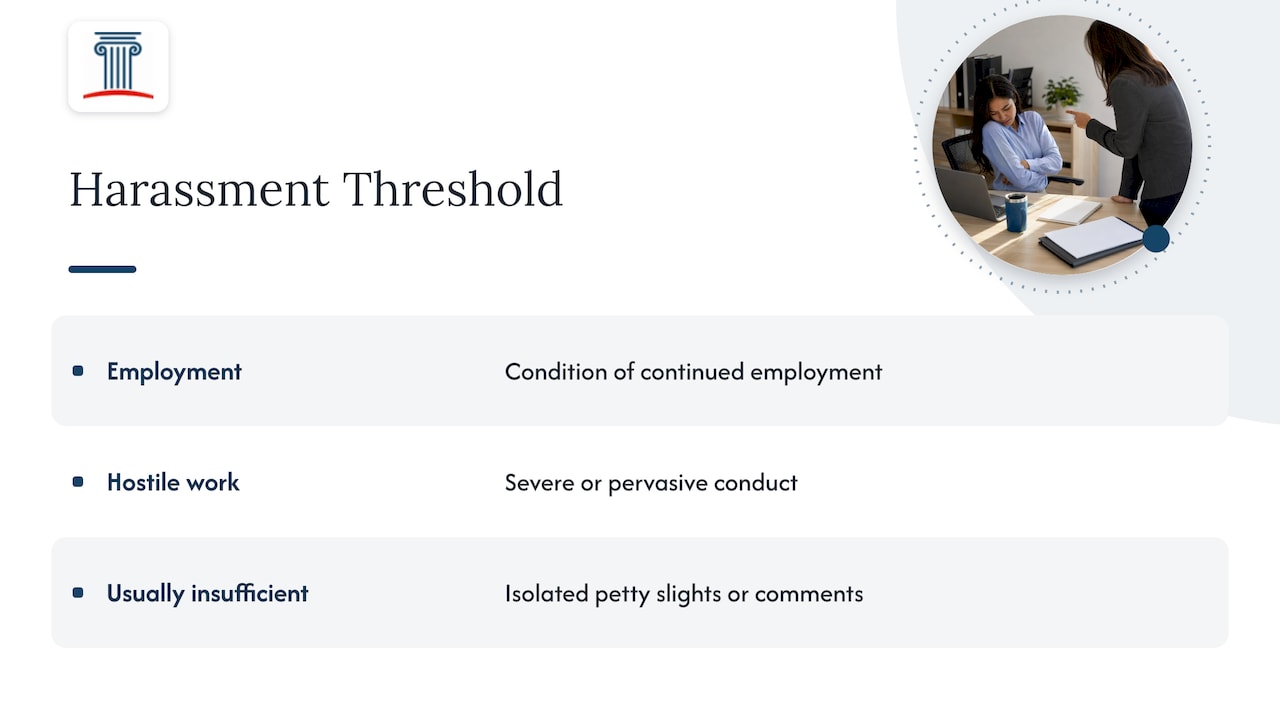
Harassment is unwelcome conduct based on a protected characteristic. The EEOC explains that it becomes unlawful when enduring the conduct becomes a condition of continued employment, or when it is severe or pervasive enough to create a hostile work environment. Isolated petty slights or offhand comments generally do not meet that threshold under the federal standard.
In practice, the pattern matters more than any single incident. A supervisor who repeatedly mocks an employee’s national origin, a coworker who keeps making sexual comments after being told to stop, or a manager who circulates jokes about someone’s disability can all create a hostile work environment. Harassers are not only supervisors: coworkers, clients and vendors can be the source, and what the employer did after learning of it is often the center of the case.
If harassment is what you are living with, our guide on how to document harassment at work in California walks through what to record and how.
Retaliation: the claim people forget
Many Irvine employees come to us after they complained and things got worse. That is retaliation, and it is a separate violation. The CRD’s fact sheet explains that California law protects employees who oppose discrimination, harassment and other illegal activity from job-related consequences. Protected activity includes filing a complaint, raising concerns with a supervisor, taking part in an investigation, or refusing to follow an order you reasonably believe is discriminatory.
A retaliation case generally rests on three links:
- You engaged in protected activity.
- Your employer took an adverse action, such as a firing, demotion, cut in hours or a sudden string of write-ups.
- The two are causally connected.
Timing, changes in how you were treated, and who knew about your complaint all help show that connection. One caution: the EEOC notes that protected activity does not shield you from all discipline. An employer may still act for legitimate, non-discriminatory reasons, but it cannot use its authority to discourage you from asserting your rights. That is why your performance records and the sequence of events matter so much.
If you work in a large Irvine workplace and layoffs are in the air, see our piece on layoffs and retaliation rights for Irvine employees.
How the process works: CRD, EEOC and court
There are two government doors, and understanding them early prevents costly mistakes.
The California Civil Rights Department
The CRD accepts discrimination, harassment and retaliation complaints under FEHA. According to the agency, a complaint must be filed within three years of the alleged act, and you must file with CRD even if you ultimately want to sue. If you want to go to court, you can request an immediate right-to-sue notice when you file. Otherwise, the agency evaluates the facts and decides whether to accept the case for investigation, and in general it has up to one year from filing to complete that investigation.
The EEOC
Federal claims go through the EEOC. Its filing page explains that a charge of discrimination is a signed statement asserting that an organization engaged in employment discrimination, and that most federal laws require you to file a charge before suing. Federal deadlines are shorter than California’s three years, so check them directly with the EEOC or an attorney as soon as possible rather than assuming the state deadline applies to every claim.
Choosing between them
For many Irvine employees, the state route is the natural starting point because FEHA offers broader protections. Whether to file with CRD, the EEOC or both depends on your facts, your employer’s size and the claims you have. Our Orange County readers can compare approaches in our guide to choosing between the EEOC and CRD, which applies the same state and federal framework.
Court
Once you have a right-to-sue notice, you can file a civil lawsuit. Many cases resolve before trial, but a well-built record strengthens your position in negotiation as well as in court.
What to do in the first two weeks
The first steps are practical, and none of them require you to quit or confront anyone.
- Write a timeline. Dates, times, places, what was said, who was present. Do it the same day if you can. Memories fade, and dates are what agencies and courts ask for first.
- Save what you lawfully have. Keep emails, texts, performance reviews, offer letters, pay stubs and your employee handbook. Do not take confidential company files you are not entitled to; ask an attorney what is safe to keep.
- Report in writing. A short, factual email to HR or your manager that describes the conduct creates a dated record that you raised it. It is also protected activity.
- Keep doing your job well. Do not give your employer a legitimate reason to discipline you.
- Watch the clocks. The CRD notes that an unfiled intake form in its online system is only retained for a limited time, so do not treat a started form as a saved claim. If your problem involves a workplace injury, report it promptly: delays of more than 30 days can complicate a workers’ compensation claim.
- Talk to an attorney. The CRD process is not a step you must finish first. You can consult a lawyer immediately, while the agency process is ongoing or before you file.
Know your rights as a worker, whatever your status
California’s labor protections apply to workers regardless of citizenship or immigration status. The Department of Industrial Relations states that California’s labor laws apply equally to all workers. If you fear that speaking up could create immigration trouble, say so in your consultation. It affects how we plan your case, and it is a question we are used to answering in Spanish as well as English.
For a broader overview of your workplace protections, our California employment law rights list covers wages, leave, accommodation and more.
Disability, pregnancy and accommodation
A large share of discrimination cases in Orange County offices, labs and warehouses involve medical conditions. FEHA prohibits discrimination and harassment based on disability or perceived disability, and employers are expected to engage with accommodation requests. A common red flag is an employer that responds to a medical request with silence, a sudden negative review or a termination. Put accommodation requests in writing, keep doctor’s notes, and note how each request was handled. If your condition came from a workplace injury, your situation may involve our disability and workers’ compensation practice as well.
Our perspective: why Irvine employees wait too long
We see the same pattern again and again with employees who work in Irvine’s offices, tech companies and medical and research facilities. They tell themselves it will get better, they worry about being labeled difficult, and they assume a lawyer is only for people who have already been fired. By the time they call, the evidence is thinner and the fear has grown.

Our approach starts from the opposite premise. We don’t ask if there is a claim, we figure out how to protect you. That means listening to the full story, explaining which laws apply under California and federal law, and giving you an honest read of the strengths and the weak points. Some conversations end with a clear plan to file. Others end with advice on documenting, reporting internally and waiting, because acting too early can also hurt. Either way, you leave knowing where you stand.
We also know that language can be a barrier. Our team works in English and Spanish so that clients can describe what happened, in their own words, to the people who will be fighting for them. And because the cost of a first conversation should never be the reason you stay silent, our consultations are free.
— Maya Serkova
Working with Serendib Law Firm
Our employment law practice represents employees in Orange County in cases involving wrongful termination, harassment, discrimination, retaliation, wage disputes, whistleblower protection, disability accommodation and family and medical leave. We offer free consultations, and contingency-based representation is available in select cases. Fees are discussed openly at the outset, and we do not publish a price list because every matter is different.
If you are ready to talk, contact our attorneys by phone, email or the online form. Bring your timeline, any written complaints and your most recent pay stub, and we will start from there.
What strengthens an Irvine discrimination case
No two files look alike, but cases tend to be stronger when they include:
- A consistent timeline that matches the documents you saved.
- Comparators: coworkers outside your protected group who were treated better in similar circumstances.
- Shifting explanations: reasons for a decision that change over time, or that conflict with your performance reviews.
- Witnesses who saw or heard the conduct and are willing to speak.
- Timing that links a complaint or accommodation request to a negative change.
- A written complaint to the employer, which shows the company was on notice.
Weaknesses are worth naming too: no documents at all, long gaps before reporting, inconsistent accounts, or genuine performance problems that predate your complaint. An attorney can help you address each of them before the other side raises them.
FAQ
How long do I have to file an employment discrimination complaint in California?
In general, a complaint with the California Civil Rights Department must be filed within three years of the alleged discriminatory act. Federal EEOC charges follow different, shorter timelines, so confirm those quickly. Because evidence and witnesses fade, we recommend acting well before the deadline.
Do I need a lawyer before I file with the CRD?
No, you can file on your own. But you can consult an attorney at any point, including before filing, and doing so early helps you choose the right claims and avoid mistakes in how the complaint is worded. Our first consultation is free.
Can my employer fire me for complaining about discrimination?
Not lawfully. Retaliation for opposing discrimination or taking part in an investigation violates California law. That said, an employer can still discipline you for legitimate reasons, so the timing and the stated reasons matter. If you were disciplined or terminated after complaining, call us promptly.
Does immigration status affect my rights at work in Irvine?
California labor laws apply equally to workers regardless of citizenship or immigration status. If you have concerns, raise them with us confidentially, and we can discuss them in English or Spanish.
Sources
- Employment Discrimination, California Civil Rights Department
- Complaint Process, California Civil Rights Department
- Workplace retaliation is against the law, CRD fact sheet
- Employment Discrimination Based on Disability, CRD brochure
- Harassment, U.S. Equal Employment Opportunity Commission
- Retaliation, U.S. Equal Employment Opportunity Commission
- Prohibited Employment Policies/Practices, EEOC
- How to File a Charge of Employment Discrimination, EEOC
- Frequently Asked Questions for Workers in California, Department of Industrial Relations