
If a driver hit you while you were walking in Fountain Valley, California law gives you the right to seek compensation for medical bills, lost income and the pain the collision caused, as long as you can show someone else’s negligence contributed to your injuries. How much you recover depends on who was at fault, how your own conduct is judged, which insurance policies apply and, critically, whether you act before a filing deadline closes the door. Some of those deadlines are as short as six months.
We are an Orange County firm, and we wrote this guide for pedestrians and families in Fountain Valley who want a plain explanation of how these claims work before they decide what to do next.
TL;DR
- Drivers in California must yield to pedestrians in marked and unmarked crosswalks, but pedestrians also have a duty not to step into the path of a car that cannot stop in time.
- Most injury lawsuits must be filed within two years of the injury. If a city or other government entity may share blame, the administrative claim deadline is only six months.
- Under comparative negligence, your compensation is reduced by your percentage of fault, but being partly at fault does not end your claim.
- Check your own auto policy: uninsured motorist coverage may pay if the driver had no insurance or too little.
- Photos, medical records and witness details gathered early often decide how a claim is valued.
Table of Contents
- How California law treats pedestrian collisions
- Why pedestrian injuries are often serious
- What compensation can include
- How fault is decided, and how it changes your payment
- Deadlines that can end a claim
- Insurance: where the money usually comes from
- What to do after a pedestrian accident in Fountain Valley
- Our perspective
- Talking to a Fountain Valley personal injury lawyer
- FAQ
- Sources
How California law treats pedestrian collisions
Pedestrian cases are built on negligence: a person who owes a duty of care acts carelessly, and that carelessness causes harm. For drivers, the duty is spelled out in the Vehicle Code. Section 21950 requires a driver to yield the right-of-way to a pedestrian crossing within any marked crosswalk or within an unmarked crosswalk at an intersection. The same statute also says a pedestrian may not suddenly leave a curb or other place of safety and walk into the path of a vehicle so close that the driver cannot yield. It also says the driver is not relieved of the duty to use due care.
That last point matters in practice. A pedestrian who has the right-of-way is not guaranteed to win, and a pedestrian who crossed outside a crosswalk is not guaranteed to lose. The California DMV driver handbook makes the same point for the road: right-of-way does not remove your own responsibility to watch for traffic, and it advises making eye contact with a driver before you step out rather than assuming the car will stop.
In Fountain Valley, where busy arterial streets, shopping center driveways and residential blocks all meet within a few miles, the typical fact patterns are familiar:
- A driver turning left or right at a signal who does not see someone in the crosswalk.
- A driver backing out of a parking space or driveway.
- A driver distracted by a phone, a navigation screen or a passenger.
- A driver traveling too fast for conditions at dusk or at night.
- A driver who fails to stop after the collision, leaving the injured person to find the responsible party.
Each of these changes who is responsible and which insurance policy responds, which is why the details of your accident matter more than any generic average.
Why pedestrian injuries are often serious
A pedestrian has no steel frame, airbag or seat belt. Even a collision at modest speed can cause fractures, head and spinal injuries, and injuries that require surgery and long rehabilitation. Statewide, pedestrian safety remains a public health concern: California recorded 1,108 pedestrian fatalities in 2021, and the state’s own performance target is only to hold that number steady through 2026, not to reduce it.
For families, the numbers translate into specific problems: weeks away from work, a car you can no longer drive, a child who needs help with daily tasks, and medical bills arriving while the insurance company is still asking you for a recorded statement. This is the moment when many people make avoidable mistakes, which we cover below.
What compensation can include
The California courts’ self-help guide explains that someone hurt by another person’s actions can ask for money to cover medical bills, lost wages, emotional harm and other losses. In a pedestrian claim, we usually think about damages in two groups.
Economic damages
These are the losses with a receipt or a paycheck behind them:
- Emergency care, ambulance transport, hospital stays and surgery.
- Follow-up care such as physical therapy, specialist visits, imaging and prescriptions.
- Lost income while you recover, and reduced earning capacity if you cannot return to the same work.
- Future medical costs when a doctor can support the need for continuing treatment.
- Property damage, such as a broken phone, glasses, or a damaged bicycle or mobility device.
Noneconomic damages
These cover harm that does not come with a bill: pain, physical limitation, anxiety, sleep problems, disfigurement and the loss of ordinary enjoyment of life. They are real losses, but they are harder to prove, which is why consistent medical records and an honest account of how the injury changed your days carry so much weight.
You will see settlement ranges online, some from a few thousand dollars to multimillion-dollar outcomes. Treat them with caution. A range that wide tells you the injury, the evidence and the available insurance drive the result, not an average. We do not promise outcomes, and nobody can responsibly quote a figure for your case before reviewing your records.
How fault is decided, and how it changes your payment
California follows pure comparative negligence. The jury instruction on a plaintiff’s own fault, CACI 405, asks whether the injured person’s own negligence contributed to the harm. If it did, the total award is reduced by that share. A pedestrian found 20 percent at fault on a $100,000 loss would recover $80,000. Unlike in some states, you are not barred from recovery because you were partly responsible.
Insurance adjusters know this and sometimes use it aggressively. Common arguments include:
- You were not in a crosswalk.
- You were looking at your phone.
- You were wearing dark clothing.
- You “darted out” from between parked cars.
Some of these may have a factual basis, many do not, and even when one does, it reduces your recovery rather than ending it. Evidence such as intersection video, a witness who saw the driver’s speed, or vehicle damage patterns can shift the percentage significantly.
When more than one party is responsible
Sometimes a collision involves a driver and a second party, such as an employer whose vehicle it was, a vehicle owner, or a property owner whose obstruction hid the crossing. Under Proposition 51, a defendant is responsible for noneconomic damages only in proportion to its own share of fault. In practical terms, if another responsible party has no insurance or assets, you may not be able to collect that party’s share of pain and suffering from the others. The courts’ small claims materials on joint and several liability describe how the plaintiff bears the shortfall when other wrongdoers cannot pay. This is one reason we identify every potentially responsible party early.
Deadlines that can end a claim
The most damaging mistake in a pedestrian case is waiting. Two clocks matter.
| Situation | Deadline | Source |
|---|---|---|
| Most personal injury lawsuits | 2 years from the date of injury | California Courts Self Help Guide |
| Claim against a government entity for injury to a person | 6 months to present a claim | Government Code 911.2 |
The six-month rule applies when a public agency may be responsible. Examples include a city-owned vehicle, a malfunctioning traffic signal, or a dangerous roadway condition the public entity controls. In those cases you generally must present an administrative claim to the agency first, and missing that window can bar a later lawsuit. We have written about the same trap in a different setting in our Santa Ana slip and fall guide on the six-month government claim deadline, and our neighbors’ version of the two-year rule is explained in our Costa Mesa pedestrian claims article.
The practical lesson: even if the driver seems clearly at fault, do not let the six-month period pass without having someone evaluate whether the road, the signal or a government vehicle played a role. A claim that looks like a simple driver case sometimes is not.
Insurance: where the money usually comes from
The driver’s liability coverage
The at-fault driver’s liability policy is the first source. The California Department of Insurance explains that liability coverage helps pay for injuries or damage to others when you are responsible. Policy limits can be modest compared with a serious injury, which is why we look at other sources too.
Your own uninsured and underinsured motorist coverage
If a driver has no insurance, or not enough, the Department of Insurance notes that you may be able to claim under your own policy’s uninsured motorist bodily injury coverage, unless you signed a waiver of that coverage. Many pedestrians do not realize this applies even when they were walking and not driving. Pull out your policy declarations page and read it, or ask your insurer in writing what coverages you carry.
Rideshare vehicles
If an Uber or Lyft driver hit you, the coverage question depends on what the driver was doing. The Department of Insurance’s background paper on ride-sharing companies discusses the commercial liability these companies must carry and the way coverage varies by the driver’s status in the app. Insurers may dispute whether the driver was providing services at the time. Preserve screenshots of the app, the driver’s information and the police report details right away.
Commercial and delivery vehicles
When a work truck or delivery van is involved, the employer may share responsibility, and commercial policies are often larger. If a large truck was involved, see our page on truck accidents in Fountain Valley.
What to do after a pedestrian accident in Fountain Valley
- Get medical care immediately. Some serious injuries, including concussions and internal injuries, do not show their full severity at the scene. Treatment also creates the record that proves your claim.
- Call 911 and make sure a police report is filed. Ask the officer for the report number and the names of the other parties.
- Document the scene. Take photos of the vehicle, the plate, the crosswalk, signals, signs, lighting and anything blocking visibility, plus your injuries. If you cannot, ask a friend or family member to go back to the location.
- Collect witnesses. Names and phone numbers matter more than you expect, since memories fade and bystanders leave.
- Keep every record. Medical bills, work notes, pay stubs, receipts and a short daily log of pain and limitations.
- Be careful with insurers. Report the accident, but do not give a recorded statement about fault or sign a release before speaking with an attorney. Early offers frequently come before the full extent of an injury is known.
- Note the dates. Count six months from the accident and two years from the accident, and ask whether any public agency could be involved.
Our perspective
We see the same pattern in pedestrian cases. People assume the system will sort itself out because the driver was obviously at fault. Then an adjuster raises a fault percentage, a medical bill goes to collections, or a public agency turns out to be involved, and the six-month window has already closed.
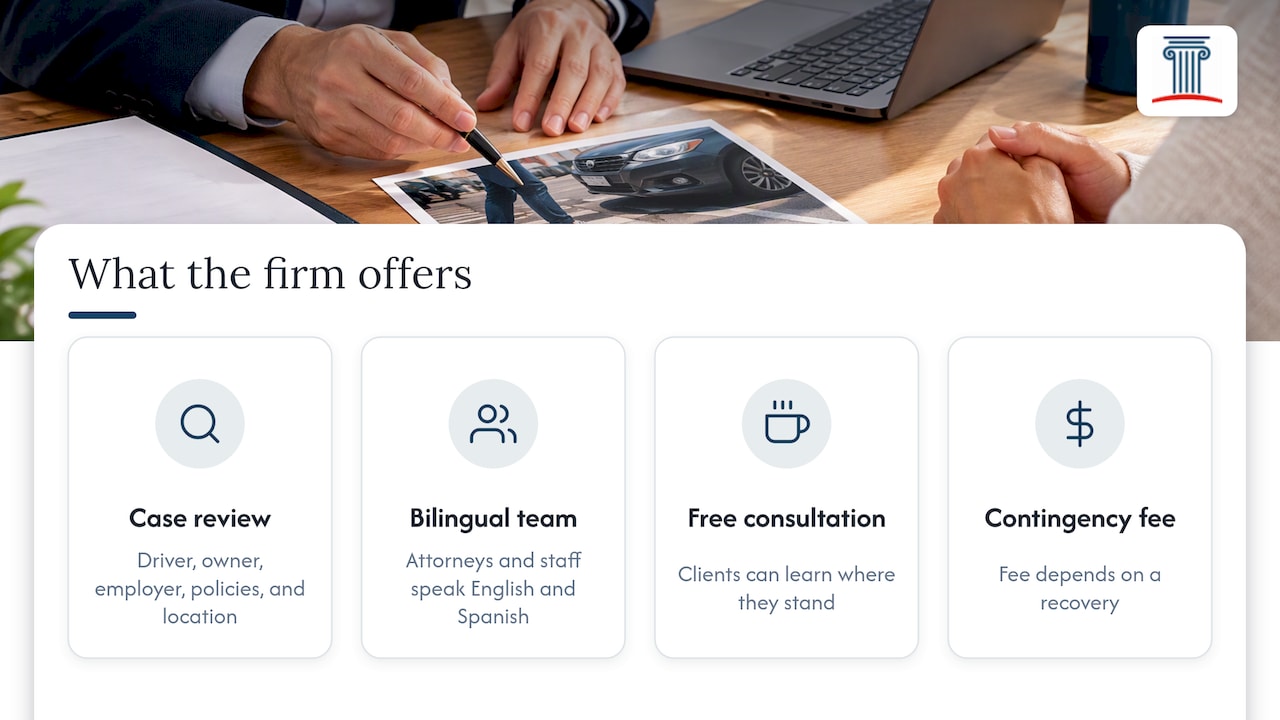
We approach these claims as we approach every matter: personal, thorough and persistent. We look at the whole picture, including the driver, the vehicle owner, the employer, the insurance policies that might apply (including your own) and conditions at the location. We bring detailed knowledge of California and federal law to the case, with a focus on maximizing what our clients recover. Our attorneys and staff speak English and Spanish, so a family can discuss the accident, the medical care and the paperwork in the language they are most comfortable with. Our approach is that we don’t ask if, we figure out how.
We also believe clients should know where they stand before they commit. That is why we offer a free consultation, and why personal injury representation can be handled on a contingency basis, meaning our fee depends on a recovery for you.
— Maya Serkova
Talking to a Fountain Valley personal injury lawyer
You do not have to hire a lawyer to file a claim, and a minor, fully insured incident with quick recovery may not need one. A lawyer becomes valuable when:
- The injuries are serious, ongoing or involve surgery.
- Fault is disputed or the insurer says you were partly to blame.
- The driver left the scene or had no insurance.
- A rideshare, commercial or government vehicle was involved.
- The road, signal or lighting may have contributed.
- A family member was killed or cannot speak for themselves.
If any of that sounds like your situation, we can review it with you at no cost. Learn more about our Fountain Valley personal injury lawyers and our personal injury practice, then contact us for a free consultation. If you were hurt in a neighboring city, our guide on pedestrian injuries in Fullerton walks through the same principles.
FAQ
How long do I have to file a pedestrian accident claim in Fountain Valley?
For most injury lawsuits, California allows two years from the date of injury. If a government entity may be responsible, you generally must present a claim within six months. Because it is not always obvious who is responsible, it is safest to have the facts reviewed soon after the accident.
Can I still recover if I was partly at fault?
Yes. California’s comparative negligence rules reduce your compensation by your percentage of fault rather than barring your claim. If a jury found you 25 percent responsible, for example, your award would be reduced by 25 percent. Evidence can often lower the share an insurer assigns to you.
What if the driver who hit me had no insurance?
You may be able to claim under the uninsured motorist bodily injury coverage on your own auto policy, unless you waived it. The Department of Insurance describes this option in its guidance for people injured in accidents. Check your declarations page or ask your insurer which coverages you have.
Do I need to be in a crosswalk to have a claim?
No. A crosswalk strengthens the right-of-way argument under Vehicle Code 21950, but drivers must still use due care. Crossing elsewhere may increase the share of fault assigned to you, but it does not automatically eliminate your claim.
Sources
- Deadlines to sue someone, California Courts Self Help Guide
- Personal injury cases, California Courts Self Help Guide
- California Vehicle Code 21950
- California Government Code 911.2
- California Driver Handbook, laws and rules of the road, DMV
- State performance targets, NHTSA
- CACI 405 comparative fault of plaintiff, California Courts
- Joint and several liability, California small claims course materials
- Automobile insurance guide, California Department of Insurance
- If you had an accident, California Department of Insurance
- TNC background white paper, California Department of Insurance