
Workplace harassment, discrimination, and wrongful termination in Buena Park, CA are unlawful under California employment law, and employees here have some of the strongest legal protections in the country. California’s Fair Employment and Housing Act (FEHA) covers nearly every worker in the state, regardless of employer size, and the Silenced No More Act (SB 331) adds another layer of protection by limiting how employers can silence employees through settlement agreements. If you work in Buena Park and you are facing a hostile work environment, unfair treatment based on a protected characteristic, or a termination that feels retaliatory, you have real legal options. Understanding those options is the first step toward doing something about it.
What legal protections do employees in Buena Park, CA have?
FEHA is the foundational law protecting employees in Buena Park from workplace harassment and discrimination. Unlike federal law, which applies only to employers with 15 or more employees, FEHA covers nearly every employer in California regardless of size. That distinction matters enormously for workers at smaller businesses throughout Orange County.
FEHA’s protected classes include race, sex, age, disability, gender identity, sexual orientation, national origin, religion, marital status, and more. Illegal conduct under FEHA includes unwanted sexual advances, racially hostile comments, denial of reasonable accommodations for disabilities, and any pattern of behavior that creates a work environment a reasonable person would find abusive or intimidating. The law covers both coworker conduct and supervisor conduct, and it holds employers accountable when they knew or should have known about the problem and failed to act.

The California Civil Rights Department (CRD) enforces FEHA. Employees can file a complaint with the CRD, which will investigate and either attempt to resolve the matter or issue a Right-to-Sue notice. Federal law through the Equal Employment Opportunity Commission (EEOC) offers parallel protections, but FEHA’s remedies are broader. There is no cap on compensatory or punitive damages under FEHA, and prevailing employees can recover attorney’s fees.
Key remedies available to Buena Park employees under FEHA include:
- Back pay and front pay for lost wages
- Compensatory damages for emotional distress
- Punitive damages in cases of malicious or oppressive conduct
- Reinstatement to your former position
- Attorney’s fees and litigation costs
Pro Tip: If you believe you have a FEHA claim, consult an employment attorney before filing with the CRD. Choosing between an immediate Right-to-Sue notice and a full CRD investigation has strategic consequences that vary by case.
How can employees document and preserve evidence effectively?
Documentation is the backbone of any successful harassment or discrimination claim. Contemporaneous written logs with dates, times, locations, and the names of witnesses are far more persuasive to investigators and courts than reconstructed memories prepared months later. The moment something happens, write it down.
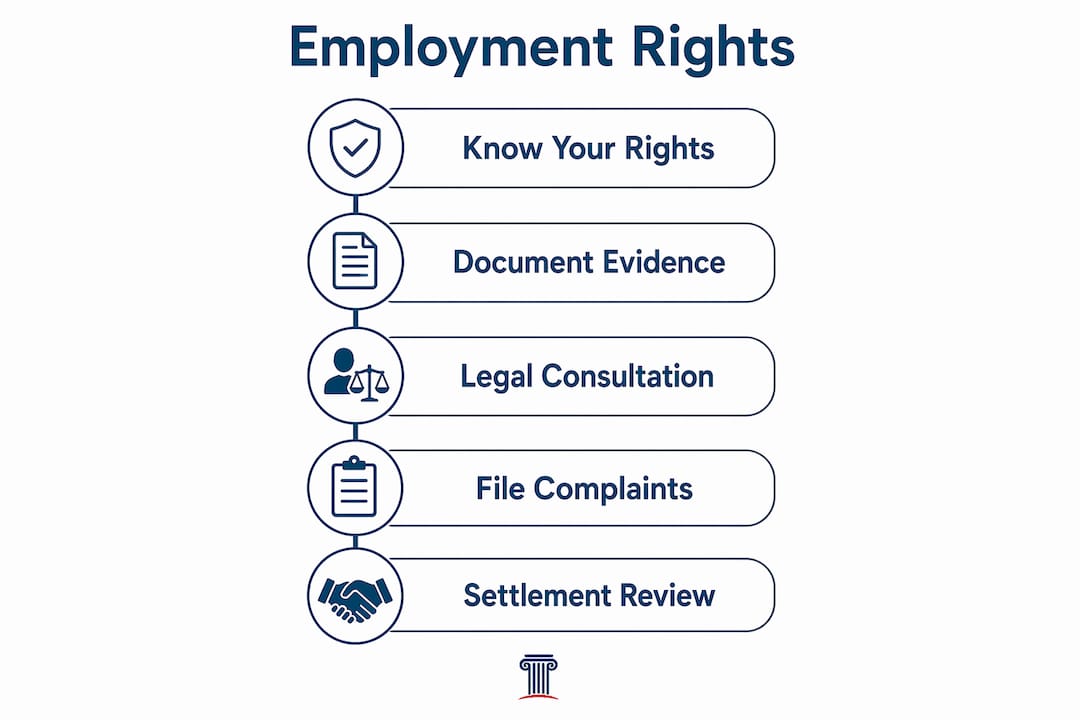
Follow these steps to build a credible evidence record:
- Start a private incident log immediately. Record every incident in a personal notebook or a document stored on your personal device, not a company laptop. Include the date, time, location, who was present, exactly what was said or done, and how it affected you.
- Capture digital evidence with full context. Screenshots of harassing emails, text messages, or Slack messages should include timestamps and the sender’s name. Cropped images that remove context are far less useful.
- Back up everything outside employer-controlled systems. Email copies of relevant documents to a personal Gmail or iCloud account. Employers can restrict access to company systems the moment a dispute arises, and you could lose critical evidence overnight.
- Preserve witness information. Note the names and contact details of coworkers who witnessed incidents. Witness corroboration significantly strengthens a claim.
- Save performance records. Positive reviews, awards, or commendations before the harassment began establish a baseline that contradicts any retaliatory negative evaluations that follow.
Multiple redundancy layers for evidence storage, including personal backups and timestamped screenshots, are the standard recommendation from practitioners who handle these cases regularly. For a deeper breakdown of best practices, Serendib law’s California harassment documentation guide walks through the process step by step.
Pro Tip: Never use your work email to communicate with an attorney about your case. Employers can access company email accounts, and that communication could be reviewed before you ever file a claim.
What should employees know about settlements and confidentiality?
California’s Silenced No More Act, enacted as SB 331, took effect on January 1, 2022, and it fundamentally changed what employers can and cannot include in settlement agreements. Before SB 331, employers routinely used non-disclosure agreements (NDAs) to prevent employees from discussing workplace misconduct after settling claims. The law now limits NDA and non-disparagement clauses across all protected bases under California law, not just sex-based harassment claims.
Here is what SB 331 means for Buena Park employees in practice:
- Employers cannot require you to sign an agreement that prevents you from disclosing facts related to harassment, discrimination, or retaliation based on any protected characteristic.
- Non-disparagement clauses that would prohibit you from discussing unlawful workplace conduct are unenforceable under SB 331.
- Settlement agreements must include a notice informing you that you retain the right to speak with law enforcement, regulatory agencies, and your attorney.
- Employers can still protect the dollar amount of a settlement as confidential. They cannot silence you about the underlying facts of what happened.
If an employer offers you a settlement after a workplace dispute, scrutinize the NDA language carefully before signing. Agreements that violate SB 331 are unenforceable, but signing one without understanding its terms can create confusion about your rights. An employment attorney can review any proposed settlement and flag language that conflicts with the Silenced No More Act before you commit to anything.
What are the legal options for wrongful termination or retaliation?
Wrongful termination in California occurs when an employer fires an employee for an illegal reason. California is an at-will employment state, meaning employers can generally terminate workers without cause. However, terminations that violate FEHA, breach an employment contract, or punish an employee for engaging in legally protected activity are unlawful. Common examples include firing someone after they report harassment, after they request medical leave, or after they file a workers’ compensation claim.
Retaliation under FEHA is defined broadly. Adverse actions that would discourage a reasonable employee from reporting misconduct qualify as retaliation, even if the employer stops short of termination. Demotions, schedule changes, exclusion from meetings, sudden negative performance reviews, and reassignment to less desirable roles all count.
Comparing your primary legal pathways:
| Option | What it involves |
|---|---|
| CRD complaint with investigation | Agency investigates; may take up to a year; can result in settlement or Right-to-Sue notice |
| Immediate Right-to-Sue notice | Bypasses investigation; triggers lawsuit filing in Superior Court |
| Superior Court lawsuit | Full civil litigation; access to discovery, depositions, and jury trial |
| EEOC complaint | Federal parallel process; useful when federal law provides additional protections |
Once the CRD issues a Right-to-Sue notice, you have one year to file a lawsuit in Superior Court under FEHA. Missing that window forfeits your right to sue, which is why understanding applicable statutes of limitations is critical. The specific deadlines in your case depend on the facts, so evaluate them with an attorney rather than relying on general timelines.
Steps Buena Park employees should take after a wrongful termination or retaliation:
- Document the circumstances of your termination or the retaliatory acts in writing immediately.
- Preserve any communications from your employer related to the adverse action.
- Consult an employment attorney before accepting any severance package or signing any release of claims.
- File a complaint with the CRD or request an immediate Right-to-Sue notice based on your attorney’s recommendation.
- Consider whether workplace retaliation attorneys in your area have handled similar cases.
Key takeaways
Employees in Buena Park, CA have strong legal protections under FEHA and SB 331, and acting quickly with thorough documentation is the single most important factor in the outcome of a workplace dispute claim.
| Point | Details |
|---|---|
| FEHA covers all employers | California law protects Buena Park employees regardless of employer size, unlike federal law. |
| Document immediately | Contemporaneous logs and timestamped screenshots are far more credible than later recollections. |
| SB 331 limits NDAs | Employers cannot silence you about harassment or discrimination facts in settlement agreements. |
| Retaliation is broadly defined | Demotions, bad reviews, and exclusion qualify as retaliation, not just termination. |
| Legal deadlines apply | After a CRD Right-to-Sue notice, you have one year to file in Superior Court. |
What I have learned representing employees in Buena Park
After years of working with employees across Orange County, including many in Buena Park, I have seen one pattern repeat itself more than any other: employees wait too long. They hope the situation will improve. They worry about being labeled a troublemaker. By the time they come to me, weeks or months of critical evidence have disappeared from employer-controlled systems they no longer have access to.
The second most common mistake is signing a settlement agreement without reading it carefully. Since SB 331 took effect, I have reviewed agreements that still contain NDA language that would violate the law. Employers do not always correct these voluntarily. You need someone in your corner who knows what to look for.
Buena Park’s workforce spans hospitality, retail, entertainment, and logistics, and the power imbalance between large employers and individual workers is real. That imbalance is exactly what California employment law is designed to correct. The law is on your side. The question is whether you act on it in time and with the right support.
Do not let the emotional weight of a workplace dispute push you into a hasty decision. The legal process takes time, but the first step, talking to an attorney, costs you nothing and tells you exactly where you stand.
Legal support for Buena Park employees facing workplace disputes
Serendib law represents employees in Buena Park, CA who are dealing with harassment, discrimination, and wrongful termination. The firm’s Buena Park employment law attorneys handle cases involving FEHA violations, retaliation, and unlawful settlement agreements, offering free consultations and contingency-based representation in qualifying cases. The team is bilingual in English and Spanish, making legal support accessible to a broader range of workers throughout Orange County. If you are unsure whether what happened to you is actionable, a consultation will give you a clear answer. You can also explore the full range of California employment law claims the firm handles to understand where your situation fits.
FAQ
What is FEHA and how does it protect Buena Park employees?
FEHA is California’s Fair Employment and Housing Act, the primary state law prohibiting workplace harassment and discrimination. It covers employers of all sizes in Buena Park and provides broader protections and remedies than federal law, including no cap on damages.
Can my employer make me sign an NDA after a harassment settlement?
Under California’s Silenced No More Act (SB 331), employers cannot require you to sign an NDA that prevents you from discussing harassment or discrimination facts based on any protected characteristic. The dollar amount of a settlement can remain confidential, but the underlying facts cannot be suppressed.
What counts as wrongful termination in California?
Wrongful termination occurs when an employer fires you for an illegal reason, such as reporting harassment, requesting medical leave, or filing a workers’ compensation claim. California’s at-will employment rule does not protect terminations that violate FEHA or other state statutes.
How do I start a harassment or discrimination claim in Buena Park?
File a complaint with the California Civil Rights Department (CRD) or request an immediate Right-to-Sue notice. The CRD can investigate your claim or issue a notice that allows you to file a lawsuit in Superior Court. Consulting an employment attorney before filing helps you choose the right path for your specific situation.
What should I do if I think I am being retaliated against at work?
Document every adverse action immediately, including demotions, schedule changes, negative reviews, and exclusion from meetings. Retaliation under FEHA covers any action that would discourage a reasonable employee from reporting misconduct, not just termination. Contact an employment attorney as soon as possible to preserve your legal options.