
What is whistleblower retaliation, and how does California protect Cypress employees?
Whistleblower retaliation happens when an employer punishes you for reporting suspected illegal conduct, and California law treats that as a serious violation. If you work in Cypress and your employer has fired you, demoted you, or made your work life miserable after you spoke up about wrongdoing, you have concrete legal protections that apply right now.

California Labor Code Section 1102.5 is the cornerstone of those protections. It prohibits retaliation in both public and private workplaces, regardless of company size, and it covers reporting to a supervisor, a government agency, or any person with authority to investigate the issue. You do not need to be certain a law was broken. You only need a reasonable, good-faith belief that a violation occurred.
Key protections under Section 1102.5 include:
- Employers cannot create or enforce any policy that prevents you from reporting suspected violations.
- Retaliation is prohibited whether you reported internally or directly to a government agency.
- Protection extends to employees who refuse to participate in illegal activity.
- Even if your employer only believes you might report misconduct, you are protected.
- Retaliation against a family member of a whistleblower is also prohibited.
Civil penalty: Employers who violate Section 1102.5 face a civil penalty of up to $10,000 per employee per violation, awarded directly to the retaliated employee.
Cypress employees can file complaints with the California Labor Commissioner’s Office, which operates a dedicated Retaliation Complaint Investigation Unit with offices in Los Angeles and Sacramento, or with the California Civil Rights Department (CRD), the state agency charged with enforcing California’s civil rights laws.
Who qualifies for protection, and what counts as illegal retaliation?
The definition of “employee” under Section 1102.5 is intentionally broad. It covers workers at private companies, state agencies, counties, cities, school districts, community college districts, and public corporations. If you work in Cypress, whether for a logistics company, a healthcare provider, a retail chain, or a city department, you are almost certainly covered.
A whistleblower, under California law, is any employee who discloses information about a suspected violation of a state or federal statute, a local or state rule or regulation, or unsafe working conditions, to someone with authority to act on it. That includes your direct supervisor, an HR department, or an outside government agency. You are also protected if you refuse to participate in activity that would violate the law.
Prohibited retaliatory actions include:
- Termination or constructive dismissal
- Demotion or reduction in pay
- Suspension or unpaid leave
- Exclusion from professional development or advancement opportunities
- Negative performance reviews used as pretext
- Hostile work environment tactics, including isolation or harassment
- Threats, surveillance, or intimidation designed to discourage reporting
Pro Tip: Retaliation rarely arrives as an obvious firing. Watch for sudden negative performance reviews after years of positive ones, exclusion from meetings you previously attended, or a sudden reassignment to undesirable shifts. These subtle patterns are legally actionable and courts recognize them as adverse employment actions.

How do you prove whistleblower retaliation in a California workplace?
Proving retaliation in California is more achievable than most employees realize, largely because of Labor Code Section 1102.6. Under this standard, you do not need to prove that retaliation was the only reason for the adverse action. You only need to show that your protected whistleblowing activity was a contributing factor.
Once you establish that, the burden shifts entirely to your employer. They must then prove, by clear and convincing evidence, that the same adverse action would have occurred even without your whistleblowing. That is a notably high bar for employers, and it is one of the reasons California’s framework is considered among the most employee-favorable in the country.
| Proof stage | What you must show | What the employer must show |
|---|---|---|
| Step 1: Protected activity | You disclosed or refused to participate in a suspected violation | N/A |
| — | Employer knew or believed you engaged in protected activity | N/A |
| — | You suffered a negative employment consequence | N/A |
| — | Protected activity was at least partly why the action occurred | N/A |
| — | N/A | Clear and convincing evidence the action would have happened anyway |
Common evidence types that support a retaliation claim include the timing of adverse actions relative to your report, documented differences in how you were treated compared to coworkers who did not report misconduct, prior positive performance reviews that contradict a sudden termination, and written communications that reveal employer awareness of your protected activity. Employers frequently claim legitimate reasons to mask retaliation, so building a paper trail that exposes those reasons as pretextual is central to a strong claim.
How to file a whistleblower retaliation complaint in Cypress, California
Cypress employees have two primary avenues for filing a formal complaint: the California Labor Commissioner’s Office and the California Civil Rights Department. Both agencies investigate retaliation claims and can compel employer accountability.
Practical steps for filing:
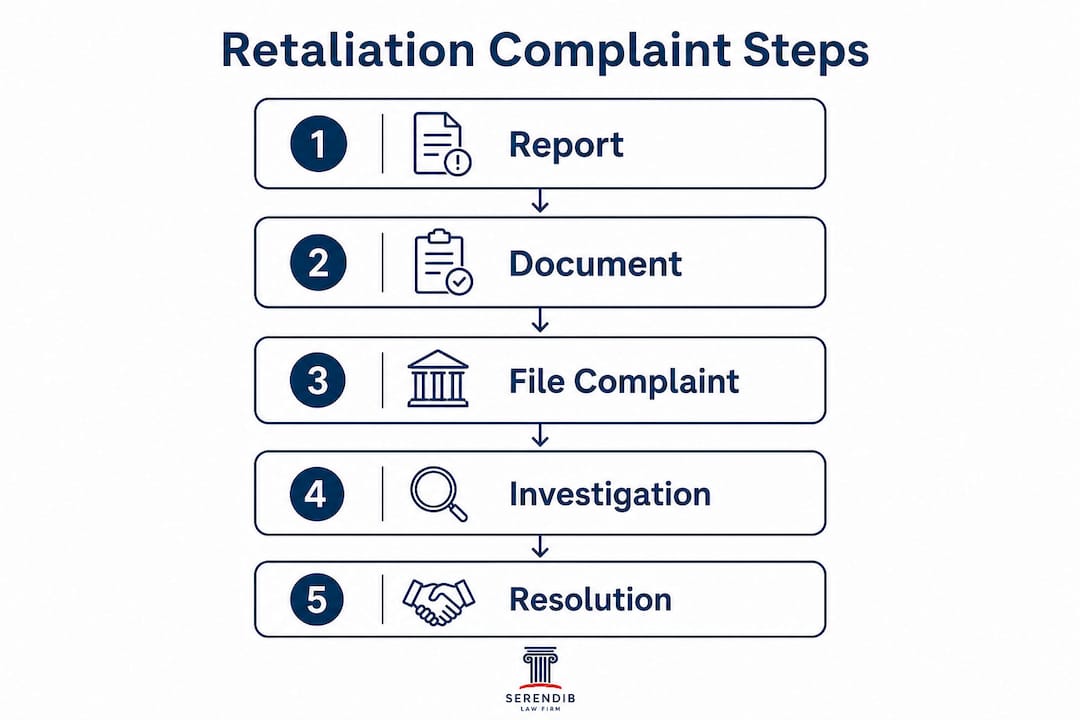
- Gather documentation first. Collect performance reviews, emails, text messages, schedules, and any written communications that show the timeline of your report and the subsequent adverse actions.
- Choose your filing agency. The Labor Commissioner’s Office handles retaliation complaints under the Labor Code, while the CRD handles retaliation tied to discrimination or harassment under the Fair Employment and Housing Act (FEHA). Some situations warrant filing with both.
- Submit an intake form. The CRD offers employment complaint forms in multiple languages, including Spanish. The Labor Commissioner’s Office accepts complaints by mail or at local offices.
- Cooperate with the investigation. After filing, a Discrimination Complaint Investigator will contact you. You, your employer, and relevant witnesses may all be interviewed. The investigator prepares a written report, and the Labor Commissioner issues a determination.
- Understand your right to civil court. If the Labor Commissioner dismisses your complaint, you retain the right to file a private lawsuit against your employer.
Applicable statutes of limitations vary depending on the specific claim type and the agency involved. Because filing deadlines differ and missing one can forfeit your rights, we strongly advise consulting an employment attorney in Cypress as soon as possible after experiencing retaliation.
What legal remedies are available to retaliated employees in Cypress?
California law gives retaliated employees access to meaningful relief, not just symbolic acknowledgment. The remedies available under Section 1102.5 are designed to make you whole and to deter employers from repeating the conduct.
Available remedies include:
- Reinstatement to your former position with full benefits restored
- Back pay covering lost wages from the date of the adverse action
- Compensatory damages for emotional distress and other harm suffered
- Civil penalties of up to $10,000 per violation, paid directly to you
- Purging of adverse records from your personnel file
- Cease and desist orders requiring the employer to stop retaliatory conduct
- Court orders mandating employer compliance programs or workplace notices
The Labor Commissioner considers the nature and seriousness of each violation when assessing penalties, including the economic harm you suffered, the mental harm caused, and the chilling effect the retaliation had on other employees’ willingness to speak up. Courts take that chilling effect seriously, particularly in workplaces where fear of retaliation silences multiple employees at once. Securing experienced legal counsel gives you the best chance of recovering the full range of remedies the law allows.
How Serendib Law Firm helps Cypress employees navigate retaliation claims
At Serendib Law Firm, we have seen firsthand how quickly a retaliation situation can escalate once an employer senses legal exposure. Cypress employees who come to us often underestimate the strength of their position, precisely because California’s burden-shifting framework under Section 1102.6 puts real pressure on employers once a contributing factor is established.
Our approach starts with evidence. We work with you to reconstruct the timeline of your protected activity and the adverse actions that followed, identifying the communications, performance records, and witness accounts that build the clearest possible picture of pretext. Bilingual representation in English and Spanish means we can serve the full range of Cypress’s workforce without any loss of nuance in your account.
Pro Tip: Do not confront your employer or HR about suspected retaliation before speaking with an attorney. Anything you say can be used to frame your complaint as a performance dispute rather than a protected activity claim. Let your legal team shape the narrative from the start.
California’s low burden of proof is genuinely on your side, but only if your claim is documented and presented correctly. We provide personalized, zealous advocacy at every stage, from the initial complaint filing through agency investigation and, when necessary, civil litigation. Our whistleblower protection practice is built around one goal: making sure your employer cannot bury what you reported under a pile of manufactured justifications.
Common whistleblowing scenarios in Cypress workplaces
Cypress sits in a part of Orange County with a diverse economic base, including logistics and warehousing operations, healthcare facilities, retail employers, and light manufacturing. Whistleblower situations in these industries tend to follow recognizable patterns.
A warehouse worker at a Cypress distribution facility reports that supervisors are falsifying safety inspection records to avoid OSHA citations. Within two weeks, that worker is reassigned to a physically demanding role they had not previously performed and receives their first negative evaluation in three years. That sequence is a textbook retaliation pattern under Section 1102.5.
A medical billing employee at a Cypress healthcare clinic notices that the practice is submitting duplicate claims to Medicare and reports it to a compliance officer. Shortly after, their hours are cut and they are excluded from team meetings. Federal healthcare fraud reporting is protected under both California law and federal whistleblower statutes, giving that employee layered protection.
A retail employee at a Cypress store reports that management is requiring off-the-clock work and shorting employees on overtime pay. After reporting to the Labor Commissioner’s Office, the employee is placed on a performance improvement plan for the first time in their tenure. The timing alone is powerful circumstantial evidence of retaliation.
Federal whistleblower laws that also protect Cypress employees
California’s protections do not exist in isolation. Several federal statutes extend additional rights to Cypress employees, and in some cases those federal protections run alongside state law claims.
The federal Sarbanes-Oxley Act protects employees of publicly traded companies who report securities fraud or financial misconduct. Employees at Cypress-based subsidiaries of publicly traded corporations can file complaints with the U.S. Department of Labor’s Occupational Safety and Health Administration (OSHA) under this statute.
The False Claims Act protects employees who report fraud against the federal government, including Medicare and Medicaid fraud. This statute includes a qui tam provision that allows employees to file suit on the government’s behalf and potentially share in any financial recovery.
Federal OSHA regulations protect employees who report workplace safety violations. Cypress employees who file a safety complaint with the state Labor Commissioner can simultaneously file with federal OSHA, though federal OSHA has its own filing deadlines that differ from state timelines. Consulting an attorney before filing ensures you do not inadvertently waive federal protections while pursuing state remedies.
The Dodd-Frank Act protects employees who report securities violations to the U.S. Securities and Exchange Commission (SEC), and it prohibits employer retaliation even when the report turns out to be incorrect, as long as the employee had a reasonable belief that a violation occurred.
What to do immediately after experiencing retaliation
The steps you take in the days and weeks after retaliation begins can determine whether your claim succeeds or stalls. Acting quickly and deliberately protects both your legal rights and your evidence.
Start by writing down everything you remember about the protected activity you engaged in: when you reported, to whom, what you said, and how the person responded. Then document every adverse action that followed, including dates, times, who was involved, and any witnesses present. Do not rely on memory alone. Courts and investigators work from records, not recollections.
Preserve all relevant communications. Forward work emails to a personal account if your employer’s policy allows it, save text messages, and keep copies of any written performance reviews or disciplinary notices. If your employer suddenly restricts your access to systems or files, note that as well, because it can signal an attempt to control the narrative.
Avoid discussing your situation with coworkers beyond what is necessary. Well-meaning colleagues can inadvertently repeat your statements to management, and those statements can be reframed in ways that hurt your claim. Reach out to an employment law attorney before making any formal internal complaint or responding to HR inquiries about the situation.
Free and low-cost legal resources for Cypress employees
If you are not yet ready to retain private counsel, several resources can help you understand your rights and take initial steps.
The California Labor Commissioner’s Office provides free complaint intake and investigation services. You can file a retaliation complaint at no cost, and the agency will investigate on your behalf. Their Retaliation Complaint Investigation Unit is reachable by mail at their Sacramento and Los Angeles offices.
The California Civil Rights Department offers a free complaint process for retaliation tied to discrimination or harassment under FEHA. The CRD can investigate your complaint or issue a right-to-sue letter so you can pursue the case in civil court. Their toll-free line is 800-884-1684.
The California State Attorney General’s Whistleblower Hotline at 1-800-952-5225 accepts reports of suspected violations of state or federal law and refers callers to the appropriate government authority for review and possible investigation.
Legal aid organizations serving Orange County, including those affiliated with the State Bar of California’s Lawyer Referral Service, can connect lower-income employees with free or reduced-fee consultations. Many employment attorneys, including those at Serendib Law Firm, offer free initial consultations and handle retaliation cases on a contingency basis, meaning you pay no attorney fees unless you recover.
What employers face when they retaliate against a whistleblower
The consequences for employers who retaliate are substantial, and California courts have shown little patience for employers who dress up retaliation as legitimate personnel decisions.
Beyond the civil penalty paid directly to the affected employee, employers can face full back pay liability covering every paycheck missed from the date of the adverse action. Reinstatement orders can force an employer to restore a terminated employee to their exact former position, with all benefits intact. Compensatory damages for emotional distress add another layer of financial exposure, and in cases where the conduct is particularly egregious, punitive damages may be available in civil litigation.
Employers also face reputational consequences. CRD settlements are often publicly announced, as seen in recent enforcement actions against major California employers. A public finding of retaliation can affect an employer’s ability to recruit, retain staff, and maintain government contracts. For Cypress employers in regulated industries like healthcare or defense contracting, a retaliation finding can trigger additional regulatory scrutiny. The cumulative exposure gives employees real leverage, and it is one reason why employers with competent legal counsel often prefer to resolve retaliation claims before they reach a formal determination.
Serendib Law Firm stands with Cypress whistleblowers
Facing retaliation after doing the right thing is one of the most disorienting experiences a working person can go through. You reported misconduct because you believed it was the right call, and your employer responded by making your professional life harder. That is exactly the situation California law was written to address, and it is exactly the situation Serendib Law Firm was built to fight.
We represent Cypress employees exclusively on the employee side. We do not represent employers, and we do not hedge our advocacy. From the moment you contact us, our focus is on building the strongest possible case for you, whether that means filing with the Labor Commissioner’s Office, pursuing a CRD complaint, or taking your employer to civil court. Our bilingual team serves English and Spanish-speaking clients throughout Orange County, and we handle retaliation cases on a contingency basis in qualifying matters, so cost is not a barrier to getting real legal help.
Contact Serendib Law Firm today for a free consultation. Tell us what happened, and we will tell you exactly where you stand.
Key Takeaways
California’s whistleblower retaliation protections under Labor Code Section 1102.5 give Cypress employees a concrete, enforceable right to report misconduct without fear of employer punishment, backed by significant civil penalties.
| Point | Details |
|---|---|
| Core legal protection | California Labor Code Section 1102.5 prohibits retaliation in all public and private workplaces, regardless of company size. |
| Employer penalty exposure | Employers face civil penalties awarded directly to the retaliated employee. |
| Employee-favorable burden | Under Section 1102.6, employees need only show protected activity was a contributing factor; employers must then prove by clear and convincing evidence the action was independent. |
| Filing options in Cypress | Complaints may be filed with the California Labor Commissioner’s Office or the California Civil Rights Department; statutes of limitations vary and require case-by-case legal evaluation. |
| Serendib Law Firm | Serendib Law Firm represents Cypress employees in whistleblower retaliation claims, offering free consultations and contingency-based representation in qualifying cases. |
Recommended
- Whistleblower Retaliation in Costa Mesa CA: Know Your Rights | Serendib Law Firm
- Retaliation After Whistleblowing in Yorba Linda – Employee Impact | Serendib Law Firm
- Whistleblower Retaliation Rights In Yorba Linda Accounting | Serendib Law Firm
- Whistleblower Retaliation in Newport Beach, CA: Are You Protected? | Serendib Law Firm