
If you were fired from a job in Newport Beach, you may have a legal claim, but only if the reason for the firing was unlawful. California treats most employees as at-will, so an employer can end the relationship for almost any reason, as long as the reason is not illegal. A termination is wrongful when it is motivated by discrimination, retaliation, a protected leave, a complaint about illegal conduct, or a violation of a contract or public policy. The deadlines to act are short and differ from agency to agency, so the sooner you understand where you stand, the more options you keep.
This guide explains what wrongful termination actually means under California law, which rights protect Newport Beach employees, how claims are proved, which agencies you may need to file with, and what to do in the first days after you lose your job.
TL;DR
- Being fired is not automatically illegal in California. It becomes wrongful when the real reason is discrimination, retaliation, whistleblowing, a protected leave, or a breach of contract or public policy.
- Deadlines vary: three years for most employment complaints filed with the California Civil Rights Department, generally one year for retaliation complaints with the Labor Commissioner, and 300 days for an EEOC charge in California.
- Most cases turn on proving that the employer’s stated reason is a pretext, so a dated timeline and copies of your performance records matter more than the termination notice itself.
- You are protected for raising concerns internally, not only for formal complaints to a government agency.
- A free consultation with an employment attorney early on helps you choose the right agency and avoid a missed deadline.
Table of Contents
- What wrongful termination means in California
- Retaliation and whistleblower protection in Newport Beach
- How a wrongful termination claim is proved
- Which agency to file with, and by when
- What is new in 2026 for California employees
- Perspective: what we see when Newport Beach employees come to us
- What to do in the first days after being fired
- Remedies that may be available
- How we can help in Newport Beach
- FAQ
- Sources
What wrongful termination means in California
Many people assume “wrongful termination” is one specific cause of action. It is better understood as a label for any firing that violates a law, a contract, or a fundamental public policy. Because California is an at-will state, the question is never whether your employer had a good reason. The question is whether the reason was illegal.
In practice, a firing is usually unlawful in one of these situations:
- Discrimination. You were terminated because of a protected characteristic such as race, sex, religion, national origin, age, or disability. The California Civil Rights Department explains that these state laws reach every stage of employment, including hiring, promotion, and termination.
- Retaliation. You engaged in a protected activity, such as complaining about harassment, asking about pay, or reporting a safety problem, and then were fired or demoted because of it.
- Whistleblowing. You disclosed or refused to take part in conduct you reasonably believed violated the law.
- Protected leave or accommodation. You were terminated for taking medical or family leave, or for requesting a disability accommodation.
- Workers’ compensation. You were let go after reporting a workplace injury or filing a claim. We cover this scenario in more depth in our guide to wrongful termination after a workers’ compensation claim.
- Breach of contract or public policy. You were fired in violation of a written or implied agreement, or for refusing to do something the law forbids.
For a broader foundation, see our statewide explainer, what wrongful termination is under California law, and our overview of wrongful termination rights across Orange County.
Retaliation and whistleblower protection in Newport Beach
Retaliation is behind a large share of wrongful termination cases. The Labor Commissioner’s Office describes retaliation as an adverse action, such as discharge or demotion, that follows an employee’s protected activity. The EEOC’s retaliation brochure frames it the same way at the federal level: treating someone badly because they complained about discrimination, filed a charge, or took part in an investigation.
California’s whistleblower statute, Labor Code section 1102.5, is broader than many employees expect. The statute bars an employer from adopting or enforcing any rule that prevents you from disclosing information to a government or law enforcement agency, and it also protects employees who report suspected violations. You do not need to use the word “whistleblower,” hire a lawyer, or file anything formal before you are protected. Raising a concern with your supervisor about conduct you believe is illegal can qualify, and so can refusing to take part in an act that would break the law.
That matters in a city like Newport Beach, where many people work in finance, real estate, hospitality, healthcare, and professional services. Reporting an accounting irregularity, an unsafe condition, or unpaid wages to a manager is exactly the kind of activity the law is meant to protect. If that describes your situation, read our pages on whistleblower retaliation and Labor Code 1102.5 rights in Newport Beach and on whether you are protected as a Newport Beach whistleblower.
How a wrongful termination claim is proved
The “smoking gun,” such as an email that says “we are firing you because you complained,” is rare. Most claims are won by showing that the employer’s explanation does not hold together. This is called pretext.
The causal connection
To prove retaliation, you must connect the protected activity to the firing. Being fired is not enough. You have to show you were fired because of what you did. The EEOC notes that a close timeline between the protected activity and the adverse action is one common way to show that link, and you strengthen it by showing the employer knew about your complaint before it acted.
Showing the stated reason is false
Employers usually cite performance, restructuring, or policy violations. Warning signs that a stated reason may be pretext include:
- A glowing performance history that suddenly turns negative right after you complained.
- A first-ever written warning or poor review issued days after a protected activity.
- Inconsistent explanations from different managers.
- Coworkers who did the same thing and were not disciplined.
- A “position elimination” followed by a quick replacement hire.
Evidence that carries weight
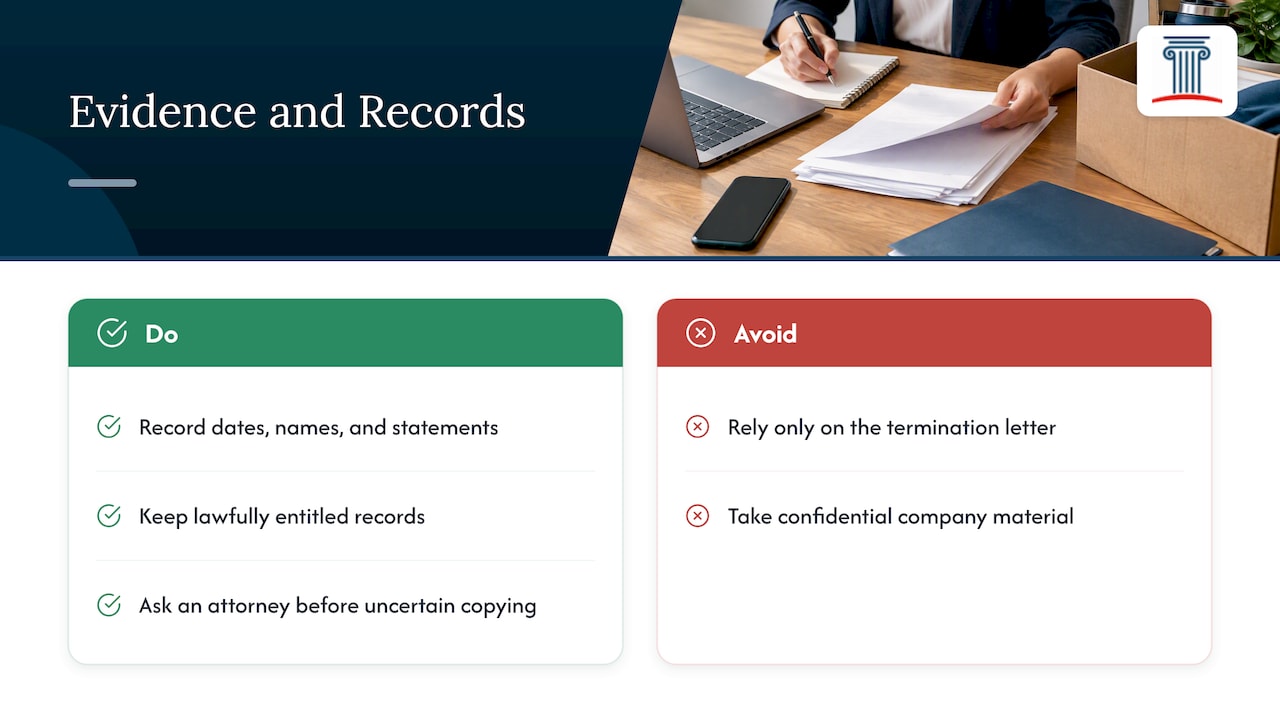
Do not rely on the termination letter alone. The most useful evidence tends to be a timeline of events, performance reviews from before and after the protected activity, and communications that show your employer knew about your complaint. Write the timeline while your memory is fresh, with dates, names, and what was said.
A practical point for Newport Beach employees: you may lose access to your work email and systems the moment you are terminated. Keep copies of documents you are legitimately entitled to, such as your own pay stubs, offer letter, reviews, and handbook acknowledgments, and avoid taking confidential company material that is not yours. If you are unsure what you may lawfully keep, ask an attorney before you copy anything.
Which agency to file with, and by when
This is where many employees lose rights without realizing it. California has overlapping state and federal systems, and each has its own clock. The table below summarizes the main routes. Always confirm the deadline that applies to your specific claim.
| Route | Typical use | General deadline |
|---|---|---|
| California Civil Rights Department (CRD) | Discrimination, harassment, and retaliation under state law | Three years from the date you were last harmed for employment cases |
| Labor Commissioner (DLSE) | Retaliation for activity under the Labor Code | Generally one year, with exceptions that are shorter or longer |
| U.S. EEOC | Federal discrimination and retaliation claims | 300 days in California, instead of the standard 180 |
California Civil Rights Department
For discrimination, harassment, or retaliation, you generally file an intake form with the CRD within three years of the date you were last harmed. The CRD can issue a right-to-sue notice, which is a prerequisite if you intend to take an employment discrimination or retaliation case to a California civil court. You are not required to use the CRD’s own investigation process to obtain that notice.
Labor Commissioner
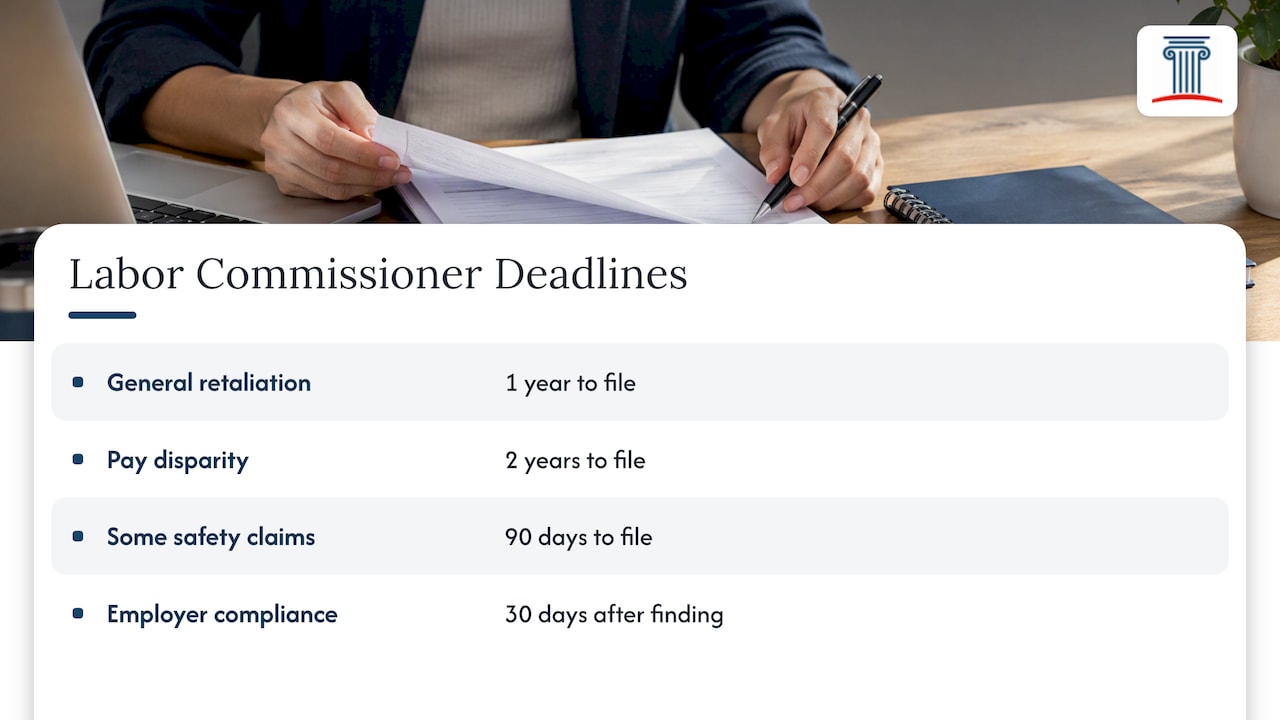
For many Labor Code violations, you have one year from the adverse action to file a retaliation complaint with the Labor Commissioner’s Office. Exceptions exist: pay disparity complaints under Labor Code 1197.5 generally allow two years, and some health and safety retaliation claims may carry a 90-day window. Because the exceptions run in both directions, do not assume the one-year rule fits your facts. Once the Labor Commissioner finds a violation, its procedures give the employer 30 days to comply with the remedy ordered.
EEOC
For federal discrimination claims, the EEOC deadline in California is extended to 300 days because a state agency also covers the claim. The EEOC covers employers with 15 or more employees, or 20 or more for age discrimination. Filing with the CRD or the EEOC is not a substitute for filing with the other, so an attorney can help you decide where to file and whether to file in both places.
These are administrative deadlines. Court claims such as breach of contract or termination in violation of public policy follow their own limitation periods, which is another reason to get your dates reviewed early.
What is new in 2026 for California employees
Two 2026 changes are worth knowing if you work in Newport Beach. According to Paylocity’s 2026 California employment law update, the Workplace Know Your Rights Act (SB 294) requires employers to give workers a standalone written notice of their rights, at hire and annually. If your employer never gave you that notice, it can be one more piece of evidence that the company was not following state standards, though it does not by itself prove a wrongful firing.
The same update describes 2026 amendments to the Equal Pay Act (SB 642) that broaden the definition of wages and extend the time to recover them. If your termination followed a question about pay, a pay transparency request, or a complaint about unequal pay, that change may give you an additional avenue for relief. Laws and effective dates change, so verify the current text with an attorney before relying on any single summary.
Perspective: what we see when Newport Beach employees come to us
At Serendib Law Firm, we represent employees across Orange County, and the pattern is consistent. People rarely wait too long because they doubt they were treated unfairly. They wait because they are hoping the situation will resolve, because they are embarrassed, or because they assume that an at-will job means they have no rights. By the time they call, a deadline may be close and key messages may already be out of reach.
We approach every case the same way: we don’t ask if, we figure out how. That begins with listening to the sequence of events, identifying the protected activity or protected characteristic that may be involved, and mapping it against the agencies and courts where it can be raised. Our work covers wrongful termination, harassment, discrimination, retaliation, wage disputes, whistleblower protection, disability accommodation, and family and medical leave, so we can look at your situation as a whole rather than through one narrow claim.
We also know that a firing is not only a legal event. It affects income, health coverage, and how you see yourself. That is why we offer free consultations, why many employment matters can be handled on a contingency basis in select cases, and why our team is fluent in English and Spanish. A worker should never have to explain the most stressful moment of their career through a language barrier.
Our honest advice is simple. Write down what happened this week, not next month. Do not sign a severance agreement before someone has read it. And do not decide for yourself that your case is too small or too weak to be worth a conversation.
— Maya Serkova
What to do in the first days after being fired
- Write a timeline. List dates, names, what was said, and any complaints you made before the firing, whether verbal or written.
- Preserve your records. Gather your offer letter, pay stubs, performance reviews, handbook acknowledgments, and any messages you are legitimately entitled to keep. Store them in a personal account.
- Identify the possible unlawful reason. Ask yourself what changed before the firing: a complaint, an injury, a pregnancy, a medical leave, an accommodation request, a birthday, a report to a manager.
- Be careful with severance papers. A severance agreement often includes a release of claims. Do not sign it until you understand what you would be giving up.
- Check your final pay. Unpaid wages and accrued vacation are separate problems from the firing itself, and they may point to additional claims.
- Note your deadlines. Count from the date of termination, and from any earlier adverse action such as a demotion or suspension.
- Speak with an employment attorney. An evaluation early on helps you choose between the CRD, the Labor Commissioner, the EEOC, and court.
If you think your employer is also ignoring other rules, such as unpaid overtime or failure to provide the required rights notice, include that in your timeline. These details sometimes explain why a termination happened.
Remedies that may be available
The remedies depend on the claim and the facts. Depending on the case, an employee may seek compensation for lost wages and benefits, the cost of finding new work, emotional distress, and in some cases punitive damages. Some claims also allow recovery of attorney’s fees. We do not promise any outcome, because every case turns on its evidence, and an attorney who guarantees a result before reviewing your documents is not being straight with you.
How we can help in Newport Beach
If you were terminated and suspect the reason was unlawful, our employment team can review your situation at no cost. We can evaluate whether your facts point to discrimination, retaliation, whistleblower protection, a leave violation, or another claim, and explain which deadlines apply to you. You can learn more about our work on our Newport Beach employment law attorneys page, read about our Employment Law practice, or contact our firm for a free consultation. We serve clients in English and Spanish.
If your employer is a Newport Beach business and you are weighing a claim that involves pay arrangements at the executive level, our guide to executive compensation disputes in Newport Beach covers a related set of issues.
FAQ
Is there wrongful termination in California?
Yes. California recognizes wrongful termination when a firing violates a statute, a contract, or public policy, even though most employees are at-will. Common examples include firing someone for discrimination, retaliation, whistleblowing, or taking protected leave. The key question is whether the true reason for the firing was unlawful.
How do you prove retaliation in the workplace in California?
You must show that you engaged in a protected activity, that you suffered an adverse action such as termination, and that the two are causally connected. Evidence often includes timing, your prior performance reviews, and proof the employer knew about your complaint. Showing that the employer’s stated reason is false or inconsistent is frequently the deciding factor.
What is retaliation in the workplace?
Retaliation happens when an employer punishes you for exercising a legal right, such as complaining about discrimination, reporting suspected illegal conduct, or filing a complaint with an agency. The EEOC describes it as treating employees badly because they complained or participated in a proceeding. The punishment can be a firing, but also a demotion, a cut in hours, or a suspension.
How long do I have to file a wrongful termination claim?
It depends on the legal theory. Many employment discrimination and retaliation complaints can be filed with the CRD within three years, Labor Commissioner retaliation complaints are generally due within one year, and EEOC charges within 300 days in California. Because some claims have shorter windows, speak with an attorney as soon as possible.
Sources
- California Civil Rights Department: Employment
- California Civil Rights Department: Complaint Process
- Labor Commissioner’s Office: Retaliation and Discrimination Complaints
- Labor Commissioner’s Office: Summary of Procedures
- U.S. EEOC: Timeliness (Los Angeles Field Office)
- U.S. EEOC: Retaliation/Reprisal brochure
- California Labor Code section 1102.5 and related provisions
- Paylocity: 2026 California Employment Law Update